In today’s digital workplace, clear communication is essential. That is why phrases like “please confirm receipt” are widely used in emails. Simply put, this request asks the recipient to confirm that they have received a message, document, or payment.
Understanding email acknowledgment helps you respond professionally and avoid misunderstandings. In this guide, we will clearly explain its meaning, usage, and best response practices in real-life situations.
What Does Email Acknowledgment Mean?
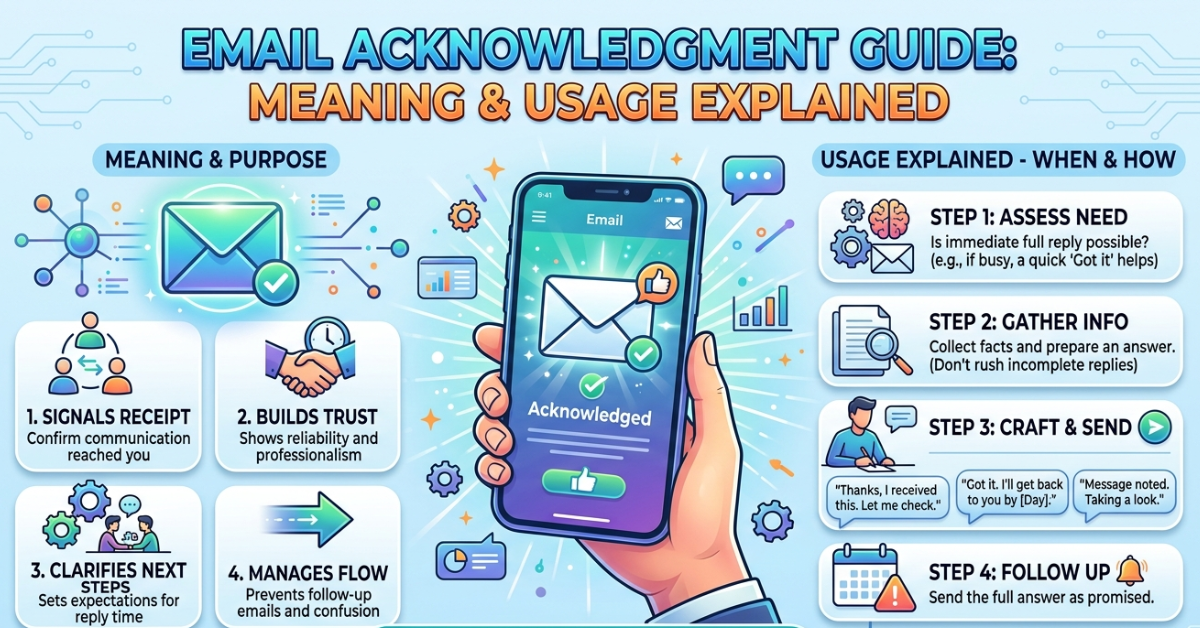
Email acknowledgment refers to a simple confirmation that you have received an email. In other words, the sender wants to ensure their message has successfully reached you.
To break it down further:
- “Receipt” means receiving something
- “Confirmation” means verifying it
Therefore, the phrase basically means: “Let me know you received this email.”
Moreover, this is commonly used in professional, legal, and business communication to ensure clarity and record-keeping.
Why Is Email Confirmation Important?
Email confirmation is not just a formality. Instead, it plays an important role in professional communication.
1. To ensure message delivery
Sometimes emails do not reach the inbox directly. Therefore, confirmation helps the sender know the message was delivered.
2. To improve communication clarity
In addition, it reduces confusion between sender and receiver.
3. To support business records
Companies often use email acknowledgment as proof of communication.
4. To track payments and documents
Especially in finance, it helps confirm that invoices or payments have been received.
Common Ways to Request Email Confirmation
People do not always use the same wording. Instead, they choose different phrases depending on tone and formality.
Formal expressions:
- Kindly acknowledge receipt of this email
- Please confirm that you have received this message
- I would appreciate your confirmation
Professional business tone:
- Please let me know once you have received this email
- Could you confirm receipt of the attached document?
Payment-related messages:
- Kindly confirm receipt of payment for our records
- Please acknowledge receipt of the invoice payment
How to Respond to Email Confirmation Requests
When someone asks for confirmation, your reply should be short, clear, and polite. Fortunately, you do not need a long response.
Simple responses:
- “Received, thank you.”
- “I confirm that I have received your email.”
- “Message received and acknowledged.”
If action is required:
- “Received. I will review it and respond shortly.”
- “Acknowledged. I will get back to you soon after checking the details.”
As a result, communication remains smooth and professional.
When Should You Use Email Acknowledgment?
You should use acknowledgment requests in situations where clarity is important. For example:
- When sending legal documents
- When sharing official instructions
- When submitting invoices or payments
- When delivering time-sensitive updates
- When sending academic or business files
In these cases, confirmation ensures that nothing important gets missed.
Alternative Phrases You Can Use
To avoid repetition, you can use several similar expressions. Additionally, these variations make your emails sound more natural:
- Kindly acknowledge receipt
- Please confirm the email has been received
- Your confirmation is appreciated
- Please verify that the message has reached you
All of these serve the same purpose while improving tone variety.
Why Email Confirmation Improves Communication
Email confirmation improves communication in several ways. First, it reduces misunderstandings. Second, it increases accountability. Third, it ensures important information is not ignored.
Furthermore, it helps teams and businesses maintain better workflow efficiency. As a result, communication becomes faster and more reliable.
FAQs
1. What does email acknowledgment mean?
It means confirming that you have successfully received an email, document, or message.
2. Is it necessary to confirm receipt of every email?
No, it is not always necessary. However, it is important for formal or important messages.
3. How do I reply to a confirmation request?
You can reply with simple phrases like “Received” or “Email acknowledged.”
4. Is asking for email confirmation professional?
Yes, it is a standard and professional communication practice.
5. Why do companies use receipt confirmation?
They use it to ensure messages, documents, or payments are properly received and recorded.
Conclusion
To sum up, email acknowledgment is a simple but powerful communication tool. It ensures that important messages are received, understood, and recorded properly.
Moreover, when you understand how to use and respond to these requests, your communication becomes clearer and more professional. Therefore, whether you are handling business emails, documents, or payments, using acknowledgment correctly can significantly improve your workflow and reduce misunderstandings.