Finding the right word for paying attention to detail can instantly improve how you express precision, care, and accuracy in writing or speech. Whether you’re describing a person, a skill, or a professional trait, choosing the correct term makes your message clearer and more impactful.
At its core, the idea of paying attention to detail reflects focus, accuracy, and mindfulness in small things that others often overlook. In this article, we’ll explore the most accurate words, their meanings, and how you can use them naturally in everyday language.
What Does Paying Attention to Detail Mean?
Before we explore the word for paying attention to detail, it’s important to understand the concept itself. It refers to the ability to notice small elements, avoid mistakes, and ensure accuracy in work or thought.
People with this skill often demonstrate:
- Strong focus and concentration
- Careful observation
- High accuracy in tasks
- Consistency in quality
- A methodical approach to work
This trait is highly valued in fields like design, writing, engineering, medicine, and business.
Best Words for Paying Attention to Detail
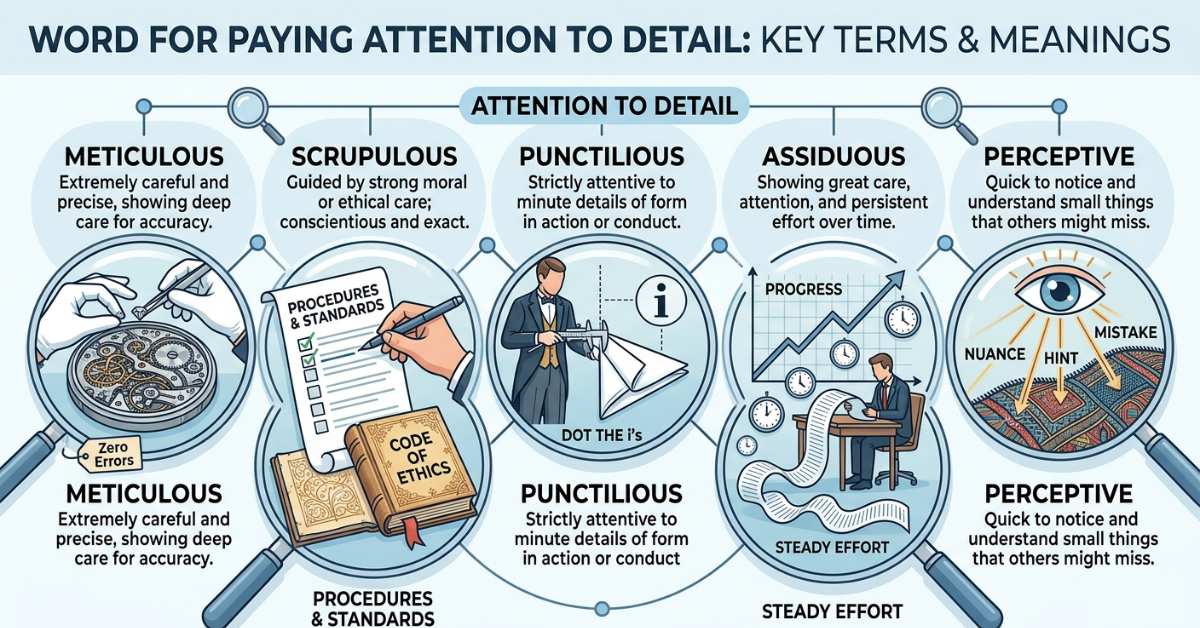
There isn’t just one perfect term—several words capture this idea depending on context. Here are the most commonly used ones:
1. Meticulous
A widely used word for paying attention to detail, “meticulous” describes someone who is extremely careful and precise in their work.
Example:
She is meticulous in her research, checking every fact twice.
2. Detail-oriented
This is one of the most direct and modern terms. It describes someone who naturally focuses on small but important details.
Example:
He is detail-oriented and rarely misses errors in reports.
3. Thorough
“Thorough” refers to completing something fully and carefully without missing anything important.
Example:
The inspector gave a thorough review of the building.
4. Precise
This word highlights accuracy and exactness, especially in measurements, language, or execution.
Example:
Her instructions were precise and easy to follow.
5. Attentive
An attentive person is alert, focused, and aware of small changes or details.
Example:
The teacher was attentive to each student’s needs.
Why Attention to Detail Matters
Understanding the right word for paying attention to detail is useful, but applying the skill is even more important. Attention to detail can improve:
- Academic performance
- Workplace productivity
- Creative design quality
- Communication clarity
- Problem-solving ability
In many careers, this skill can be the difference between average and excellent results.
How to Improve Attention to Detail
If you want to become more detail-focused, here are simple strategies:
- Slow down your work process
- Double-check your output
- Break tasks into smaller steps
- Remove distractions while working
- Practice mindfulness and focus exercises
Over time, these habits naturally strengthen your ability to notice small but important elements.
Common Uses in Writing and Communication
Using the right word for paying attention to detail in writing helps you sound more professional and expressive. For example:
- Instead of “careful,” use meticulous for stronger impact
- Instead of “focused,” use detail-oriented for workplace descriptions
- Instead of “accurate,” use precise in technical writing
Small word choices can significantly improve how your message is received.
FAQs
1. What is the best word for paying attention to detail?
The most commonly used word is “meticulous,” but “detail-oriented” and “thorough” are also widely accepted depending on context.
2. Is being detail-oriented a skill or personality trait?
It is both. Some people naturally have it as a personality trait, but it can also be developed as a skill.
3. What jobs require attention to detail?
Jobs in design, architecture, engineering, writing, accounting, and healthcare require strong attention to detail.
4. How can I describe someone who pays attention to detail?
You can describe them as meticulous, precise, thorough, or detail-oriented depending on the situation.
5. Why is attention to detail important in work?
It reduces mistakes, improves quality, and ensures tasks are completed accurately and efficiently.
Conclusion
Choosing the right word for paying attention to detail helps you communicate precision and professionalism more effectively. Whether you use “meticulous,” “detail-oriented,” or “precise,” each word adds clarity and strength to your expression.
Developing this skill is just as important as describing it. The more you practice focusing on small details, the more accurate and confident your work becomes.