Language can be tricky, especially when two words look and sound almost identical but mean completely different things. One of the most confusing pairs is Gamble vs Gambol.
At first glance, they might seem related—or even interchangeable—but they actually belong to entirely different worlds. One is tied to risk and chance, while the other is all about playfulness and movement.
In this guide, we’ll break down Gamble vs Gambol, explore their meanings, usage, and real-life examples so you never confuse them again.
What Does “Gamble” Mean?
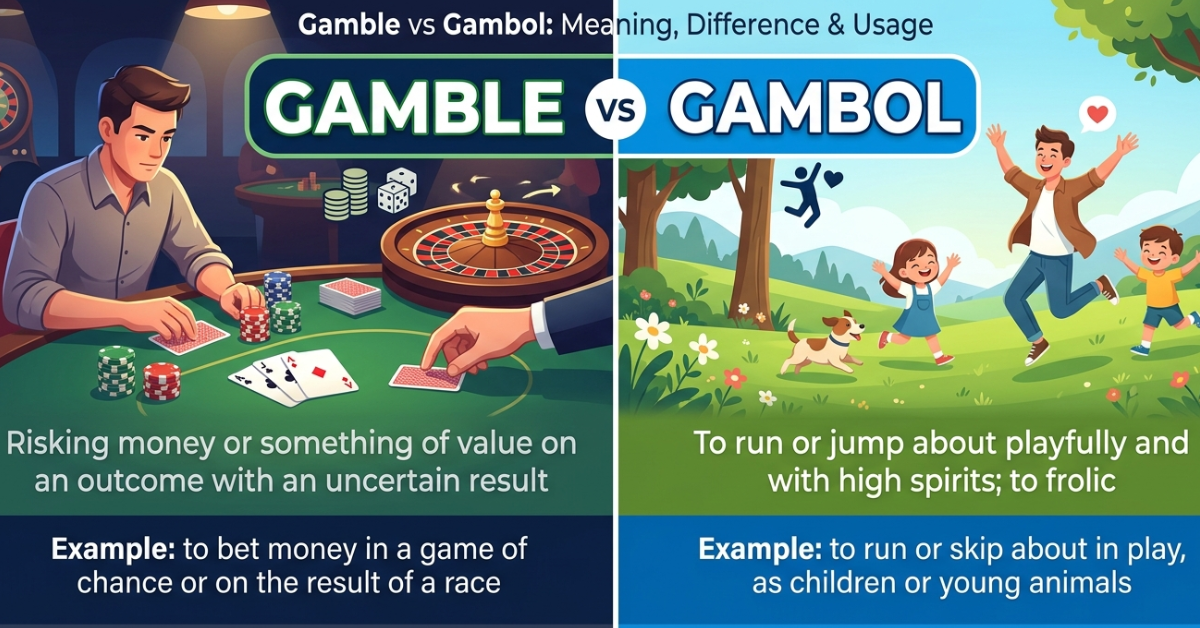
The word gamble refers to taking a risk, usually involving money, with an uncertain outcome. It’s commonly associated with betting, casinos, or any situation where you risk losing something valuable for a possible gain.
Key meanings of Gamble:
- To bet money on games of chance or events
- To take a risky action in hopes of reward
- To rely on uncertain outcomes in decision-making
Examples:
- He decided to gamble his savings on a business idea.
- Many people enjoy visiting casinos to gamble.
- Starting a new company in a competitive market is always a gamble.
In short, gamble vs gambol becomes easier to understand when you remember that gamble = risk + chance.
What Does “Gambol” Mean?
Now let’s switch to the lighter word. Gambol means to skip, leap, or move around in a playful and lively way. It is often used to describe children, animals, or anyone expressing joy through movement.
Key meanings of Gambol:
- To run or jump playfully
- To move around with carefree energy
- To express happiness through physical activity
Examples:
- Lambs gambol in the spring meadow.
- Children were gamboling in the park on a sunny afternoon.
- The puppies began to gambol as soon as they were released.
So, when comparing Gamble vs Gambol, think of gambol = joy + movement.
Gamble vs Gambol: Key Differences Explained
Even though they sound similar, their meanings are completely unrelated. Here’s a simple breakdown:
1. Meaning Difference
- Gamble: Risk-taking, betting, uncertainty
- Gambol: Playful movement, jumping, joy
2. Context Difference
- Gamble is used in finance, business, games, and decision-making
- Gambol is used in nature, childhood, and descriptive storytelling
3. Emotional Tone
- Gamble often carries seriousness or tension
- Gambol carries happiness and lightness
Understanding this contrast makes Gamble vs Gambol much easier to remember.
Easy Memory Trick to Avoid Confusion
Still mixing them up? Try this simple trick:
- Gamble = Game + risk (money or outcome involved)
- Gambol = Go bounce (playful movement)
Another way to remember:
- If money or risk is involved → it’s gamble
- If jumping or playing is involved → it’s gambol
Common Mistakes People Make
Many English learners confuse these words because of their similar spelling and pronunciation. Here are common errors:
- Using gambol when talking about betting
- Using gamble to describe playing children or animals
- Assuming both words are modern slang (they’re actually traditional English words)
Being aware of these mistakes helps you master Gamble vs Gambol more confidently.
Why This Confusion Matters in English
You might wonder—why even care?
Well, using the wrong word can completely change your meaning. Imagine saying:
- “The children are gambling in the garden” (sounds wrong and confusing)
instead of - “The children are gamboling in the garden” (Correct)
Small spelling differences can create big misunderstandings in communication.
FAQs About Gamble vs Gambol
1. Are gamble and gambol pronounced the same?
No, they sound slightly different. “Gamble” has a harder ending, while “gambol” sounds lighter and more flowing.
2. Is gambol a common English word?
It is less common in everyday speech but still used in literature, poetry, and descriptive writing.
3. Can gamble ever mean something positive?
Yes, in some contexts it can mean taking a bold risk, especially in business or life decisions.
4. What is the easiest way to remember Gamble vs Gambol?
Think of “gamble” as risk-taking and “gambol” as playful jumping or running.
5. Is gambol used for humans or animals?
Both, but it’s more commonly used for children and animals behaving playfully.
Conclusion
The confusion between Gamble vs Gambol is completely normal, but once you understand their meanings, it becomes easy to separate them. One represents risk, uncertainty, and chance, while the other represents joy, playfulness, and movement.
Next time you come across these words, just remember:
gamble = risk, gambol = play.
Mastering small differences like this not only improves your vocabulary but also makes your communication clearer and more confident.