Have you ever heard someone say a politician or company did an “about face” and wondered what it actually means? The phrase sounds military, but it appears in everyday conversations, news headlines, and workplace discussions more often than many people realize.
About face meaning refers to a sudden or complete change in direction, opinion, decision, or behavior. While the expression began as a military command, it has evolved into a common idiom used to describe dramatic reversals in many areas of life. In this article, we’ll explore its definition, history, real-life examples, and how to use it correctly in conversation.
What Does About Face Mean?
At its core, the phrase about face meaning describes a complete turnaround.
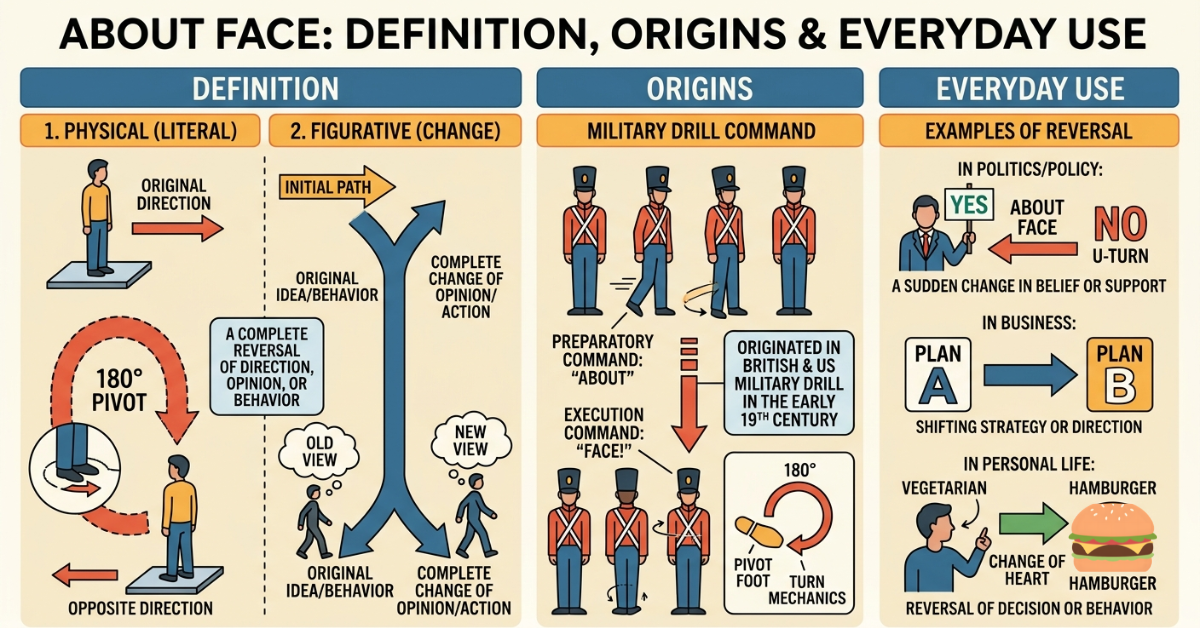
In military terms, an “about face” is a command ordering soldiers to turn 180 degrees and face the opposite direction instantly. Outside the military, the phrase is often used figuratively to describe someone suddenly changing their position or attitude.
Simple Definition
An about face means:
- A complete reversal of opinion or action
- A sudden change in plans or decisions
- A dramatic shift in behavior or strategy
For example:
“The company made an about face on its remote work policy.”
This means the company changed its previous position completely.
The Origin of the Phrase
The expression comes directly from military drill commands.
Historically, soldiers were instructed to perform an “about face” to turn around quickly and efficiently. The movement involved pivoting precisely to face the opposite direction. Over time, people began using the phrase metaphorically to describe non-military situations involving major reversals.
Today, the expression appears in:
- Political discussions
- Business decisions
- Personal relationships
- News reporting
- Everyday conversations
Because of its vivid imagery, the phrase effectively communicates a dramatic shift in thinking or direction.
How the Phrase Is Used in Everyday Language
Although rooted in military language, modern usage is mostly figurative.
People use it when someone unexpectedly changes their opinion, policy, or behavior.
In Politics
Politicians are often accused of making an about face after changing their stance on important issues.
Example:
“The senator made an about face on environmental policy after public pressure.”
In Business
Companies may reverse strategies due to market changes or customer feedback.
Example:
“After declining sales, the brand performed an about face and lowered prices.”
In Personal Life
The phrase can also describe personal decisions.
Example:
“She was planning to move abroad but made an about face at the last minute.”
Difference Between “About Face” and Similar Expressions
Many phrases describe change, but not all mean the same thing.
Here’s how they compare:
About Face vs. U-Turn
A U-turn often refers to reversing a decision after realizing it was wrong.
An about face usually suggests a more immediate or dramatic reversal.
About Face vs. Change of Heart
A change of heart is emotional and personal.
An about face focuses more on action, policy, or direction.
About Face vs. Turnaround
A turnaround often implies improvement over time.
An about face highlights the moment of sudden reversal.
Common Situations Where You’ll Hear This Phrase
You may encounter the term in several contexts.
1. News Headlines
Journalists often use it to describe policy reversals.
Example:
“Government Makes Major About Face on Tax Reform”
2. Workplace Conversations
Managers or teams sometimes reverse plans.
Example:
“Leadership did an about face after hearing employee concerns.”
3. Relationships
People occasionally change their minds unexpectedly.
Example:
“He did an about face and decided to stay in the relationship.”
Synonyms and Related Terms
If you want variety in writing or conversation, these words and phrases have similar meanings:
- Reversal
- Turnaround
- Change of direction
- Policy shift
- U-turn
- Flip-flop
- Sudden change
Using related expressions naturally helps improve readability and keeps language engaging.
How to Use the Phrase Correctly
Understanding context matters.
Here are a few simple tips for proper usage:
Use It for Major Changes
The phrase works best when describing significant reversals, not small adjustments.
Correct:
“The company made an about face on pricing.”
Less suitable:
“He made an about face by choosing tea instead of coffee.”
Keep Context Clear
Readers or listeners should understand what changed and why.
Example:
“After customer complaints increased, the business made an about face in its return policy.”
Why This Phrase Remains Popular
There’s a reason the expression has stood the test of time.
It creates a strong mental image of someone literally turning around and going in the opposite direction. That visual makes communication more powerful and memorable.
In modern communication—especially media and business reporting—clear, vivid language matters. Expressions like this help people quickly understand sudden changes without lengthy explanations.
FAQs
What is the exact about face meaning?
It refers to a complete or sudden reversal in direction, opinion, policy, or behavior. The phrase originally comes from military drill commands.
Is “about face” only used in the military?
No. Although military in origin, it is now commonly used in politics, business, relationships, and everyday speech.
Is “about face” positive or negative?
It depends on context. Sometimes a reversal is viewed positively, such as correcting a mistake. Other times, people may see it as inconsistency.
Can “about-face” be hyphenated?
Yes. You may see it written as about-face, especially when used as a noun or adjective in formal writing.
What is another word for this phrase?
Common alternatives include reversal, U-turn, policy shift, and turnaround.
Conclusion
Understanding the about face meaning can help you better interpret conversations, news stories, and everyday communication. What began as a military command has become a widely used expression for dramatic reversals in decisions, opinions, or actions.
Whether discussing politics, business, or personal choices, the phrase paints a clear picture of someone changing direction completely. If you enjoy learning the meanings behind popular expressions, explore more idioms and language guides to sharpen your communication skills.