Have you ever noticed the same word spelled two different ways—authorisation and authorization—and wondered if one of them is wrong? You’re not alone. This small spelling difference often confuses writers, students, and even professionals working in law, business, and technology.
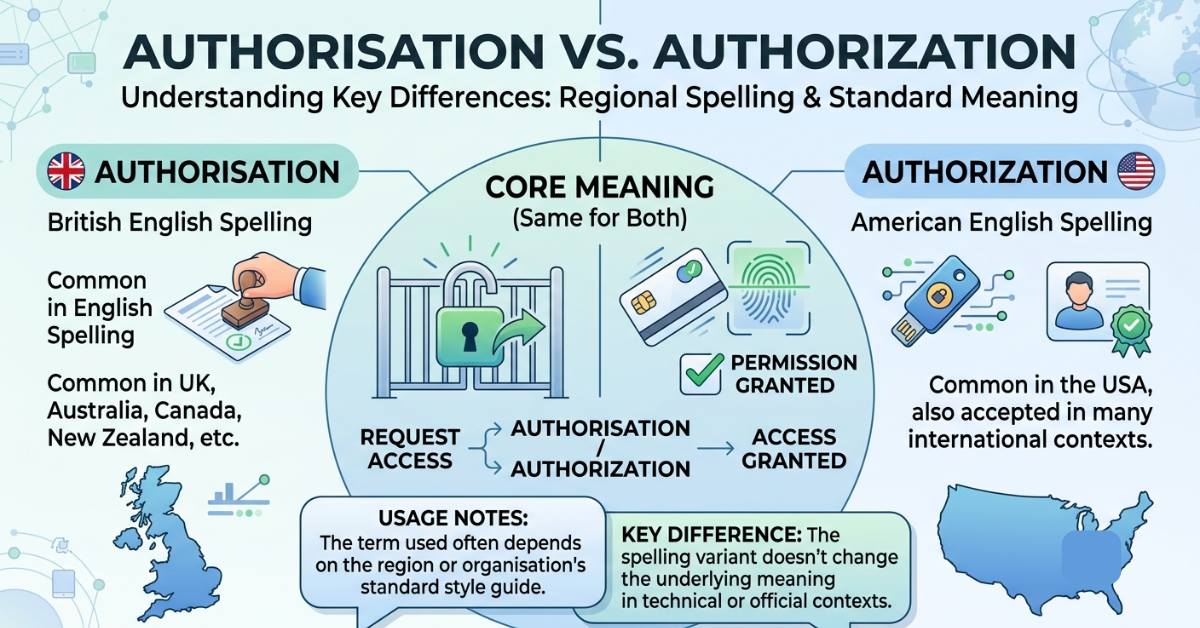
The topic of authorisation vs authorization is actually less about meaning and more about regional spelling conventions. Both words refer to the same concept: giving official permission or approval for something. In this article, you’ll learn why both spellings exist, where each is used, and how to choose the correct one depending on your audience.
What Does Authorisation vs Authorization Mean?
At their core, both spellings represent the same idea:
- Permission granted by an authority
- Approval to access, use, or perform something
- A formal confirmation that an action is allowed
For example:
- A bank may require authorization before processing a large transaction.
- A manager may give authorisation for an employee to access confidential files.
So, in the debate of authorisation vs authorization, meaning is not the issue—spelling is.
Why Are There Two Spellings? (British vs American English)
The difference comes down to regional English variations:
British English: Authorisation
Used in:
- United Kingdom
- India
- Australia
- Pakistan
- Most Commonwealth countries
British English prefers “-isation” endings, such as:
- organisation
- realisation
- authorisation
American English: Authorization
Used in:
- United States
- American-based tech companies and documentation
- International software systems influenced by US English
American English prefers “-ization” endings:
- organization
- realization
- authorization
This is why you’ll often see both forms in global content, especially online.
Authorisation vs Authorization in Real-World Usage
1. Legal and Government Context
In legal documents, the spelling depends on jurisdiction:
- UK law → authorisation
- US law → authorization
Even though the meaning stays identical, consistency is critical in legal writing.
2. Technology and Cybersecurity
In IT systems, “authorization” is commonly used worldwide, especially in:
- Access control systems
- Login permissions
- API security
For example:
- OAuth systems (used by platforms like Google and Microsoft) handle user authorization.
3. Business Communication
Global companies often choose one standard spelling based on their primary market:
- US companies → authorization
- UK/Commonwealth companies → authorisation
Consistency helps avoid confusion in documentation and contracts.
Common Confusion Around Authorisation vs Authorization
Many people assume one spelling is incorrect—but that’s not true. The confusion usually comes from:
- Exposure to mixed English sources online
- Software using American English by default
- Academic writing standards differing by country
The key is not correctness, but consistency.
How to Choose the Correct Spelling
Here’s a simple guide:
- If your audience is American → use authorization
- If your audience is British or Commonwealth → use authorisation
- If writing globally → choose one and stay consistent
Practical tip:
Pick one style guide (UK or US) and apply it throughout your document.
Key Takeaways
- Authorisation vs authorization means the same thing
- The difference is purely British vs American spelling
- UK English uses authorisation, US English uses authorization
- Context (legal, business, tech) determines consistency
- There is no “wrong” spelling—only regional preference
Frequently Asked Questions (FAQs)
1. Is authorisation vs authorization the same thing?
Yes, both words mean giving official permission or approval. The only difference is spelling based on regional English.
2. Which spelling is correct: authorisation or authorization?
Both are correct. Authorisation is British English, while authorization is American English.
3. Why does authorization end with “z” in American English?
American English simplified many “-isation” words to “-ization” for consistency and pronunciation clarity.
4. Where is authorisation commonly used?
It is commonly used in the UK, Commonwealth countries, and formal British English writing.
5. What is authorization in cybersecurity?
In cybersecurity, authorization refers to granting users permission to access systems, files, or data after authentication.
6. Can I mix authorisation and authorization in writing?
It’s best not to. Mixing both forms can look inconsistent and unprofessional. Choose one style and stick with it.
Conclusion
The debate over authorisation vs authorization is really about language style, not meaning. Both terms describe the same essential concept—granting permission—but differ based on whether you’re using British or American English.
Understanding this small distinction helps you write more clearly, professionally, and appropriately for your audience. Whether you choose authorisation or authorization, the key is consistency.