Language can be tricky, especially when two words look or sound similar but mean completely different things. One such confusing pair is cachet vs cache. If you’ve ever stumbled upon these terms and wondered whether they are related or interchangeable, you’re not alone.
The keyword cachet vs cache often confuses learners, writers, and even professionals because both words come from French roots and appear in modern English with distinct meanings. In this guide, we’ll break everything down in a simple, human way so you never mix them up again.
What Does “Cachet” Mean?
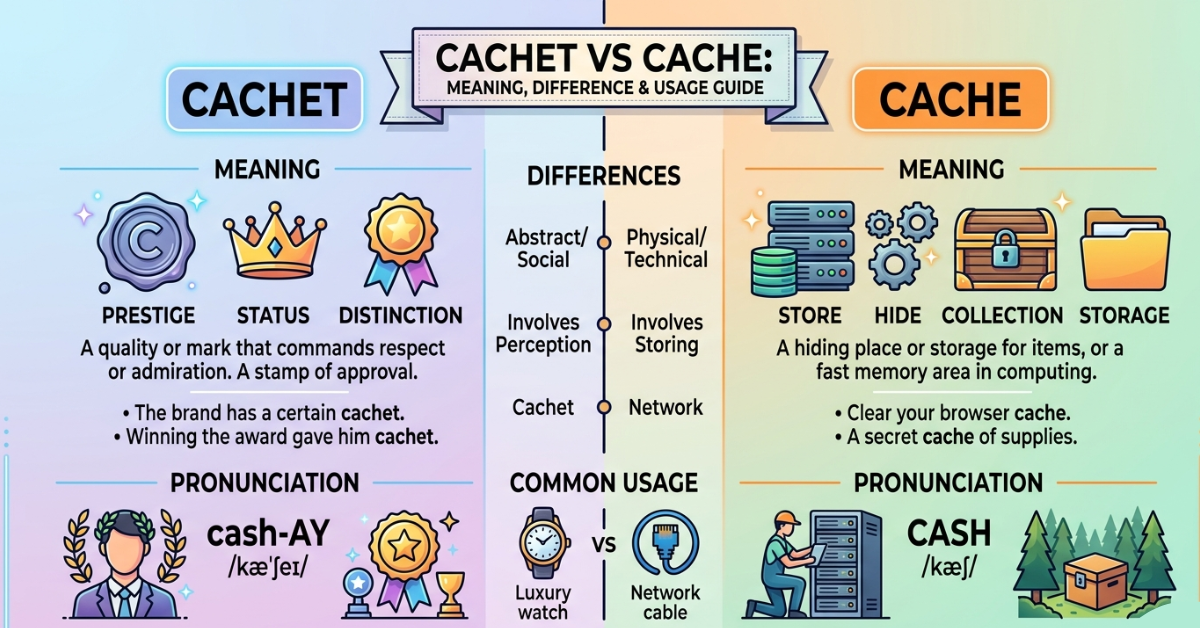
The word cachet is all about prestige, uniqueness, and approval. It is often used to describe something that carries status or high reputation.
Cachet meaning in simple words:
- A mark of distinction or prestige
- A sign of approval or authenticity
- Something that adds value or elegance
Examples of “cachet” in use:
- The designer brand adds cachet to the outfit.
- Winning that award gave her career real cachet.
- The hotel has a certain artistic cachet that attracts tourists.
In short, cachet is not physical—it’s symbolic. It represents reputation and style.
What Does “Cache” Mean?
Now let’s talk about cache, which is completely different in meaning and usage.
Cache meaning in simple words:
- A hidden storage place
- A reserved location for storing data or objects
- A computer memory system that saves temporary data
Everyday examples:
- A hiker found a cache of supplies buried in the forest.
- Your browser uses a cache to load websites faster.
- The system clears old cache to improve performance.
So, unlike cachet, cache is something physical or digital that stores things temporarily or secretly.
Cachet vs Cache: Key Differences
To make things crystal clear, here’s a simple comparison:
1. Meaning
- Cachet: Prestige, reputation, or approval
- Cache: Storage place or hidden collection
2. Usage Context
- Cachet: Social, cultural, or branding contexts
- Cache: Technology, geography, or storage contexts
3. Nature
- Cachet: Abstract (non-physical)
- Cache: Physical or digital
4. Origin
- Both come from French, but evolved differently in English usage.
Understanding cachet vs cache becomes easier when you remember this simple rule:
Cachet = status
Cache = storage
Common Confusion Between Cachet and Cache
Many people confuse these words because:
- They look similar in spelling
- They share French origin
- They are often mispronounced in casual speech
However, they are not interchangeable in any situation. Using one instead of the other can completely change the meaning of your sentence.
For example:
- In correct: The hotel has a hidden cachet in the basement.
- Correct: The hotel has a hidden cache in the basement.
One refers to prestige, the other to storage.
How to Remember the Difference Easily
Here are a few memory tricks:
1. Think of “T” in Cachet
- T = Trophy (something valuable or prestigious)
2. Think of “Cache” as Hidden Storage
- Cache = hidden storage in tech or real life
3. Associate Context
- Fashion, brands, reputation → Cachet
- Computers, data, hidden items → Cache
These simple tricks make cachet vs cache easy to remember forever.
Real-Life Usage Examples
Cachet in sentences:
- The artist’s work carries international cachet.
- That restaurant gained cachet after winning awards.
Cache in sentences:
- I cleared my phone’s cache to fix the issue.
- Archaeologists discovered a buried cache of coins.
Seeing them in context helps reinforce their meanings clearly.
Why Understanding Cachet vs Cache Matters
You might think this is just a grammar detail, but it actually matters in:
- Academic writing
- Professional communication
- Tech documentation
- Branding and marketing content
Using the wrong word can confuse readers or reduce credibility. That’s why mastering cachet vs cache improves both clarity and confidence in writing.
Quick Summary Table
| Feature | Cachet | Cache |
| Meaning | Prestige or status | Storage or hidden place |
| Type | Abstract concept | Physical/digital object |
| Usage | Branding, reputation | Tech, geography |
| Example | Luxury brand cachet | Browser cache |
FAQs about Cachet vs Cache
1. Are cachet and cache related?
No, they are not related in meaning even though they share French origins.
2. Is cachet used in technology?
No, cachet is never used in tech contexts. It refers to prestige or reputation.
3. What is a cache in computers?
A cache in computers is temporary storage that helps load data faster.
4. Can cachet mean money or value?
Not directly. It refers more to reputation or status that adds perceived value.
5. Which is more commonly used today?
“Cache” is more common in tech and everyday usage, while “cachet” is more formal and less frequently used.
Conclusion
Understanding cachet vs cache is all about recognizing context. One word represents prestige and reputation, while the other refers to storage or hidden data. Even though they look similar, their meanings are completely different and used in very different situations.
Once you remember that cachet is about status and cache is about storage, you’ll never confuse them again. Keep practicing with examples, and soon this distinction will feel completely natural in your writing.
If you’re interested in more confusing word pairs like this, exploring similar language differences can make your vocabulary even stronger and more precise.