Leaves or Leafs: Which Is Correct and When to Use It

Have you ever paused while writing and wondered, “is it leaves or leafs?” You’re not alone. This confusion shows up in everyday writing, from school assignments to product descriptions like furniture or architecture terms. The difference between leaves or leafs isn’t just about spelling—it’s about grammar, meaning, and context.
In this guide, you’ll learn exactly which form is correct, when each one is used, and how to avoid common mistakes in words like table leaves, tree leaves, and door leaves.
Leaves or Leafs: Quick Answer
The correct plural is:
- Correct: tree leaves, table leaves, dining table leaves
- Incorrect: tree leafs, table leafs (in standard grammar)
However, “leafs” is not completely wrong—it is used in specific cases, which we’ll explain below.
So if you’re asking which is correct, the simple answer is:
“Leaves” is correct in most situations.
Why “Leaves” Is the Correct Plural
The word leaf follows an irregular plural rule in English.
Grammar Rule:
Nouns ending in -f or -fe often change to -ves in plural form.
Examples:
- leaf → leaves
- wolf → wolves
- knife → knives
That’s why we say:
- tree leaves
- plant leaves
- book leaves (pages in older usage)
So when people search, grammar clearly supports “leaves.”
When “Leafs” Is Actually Correct
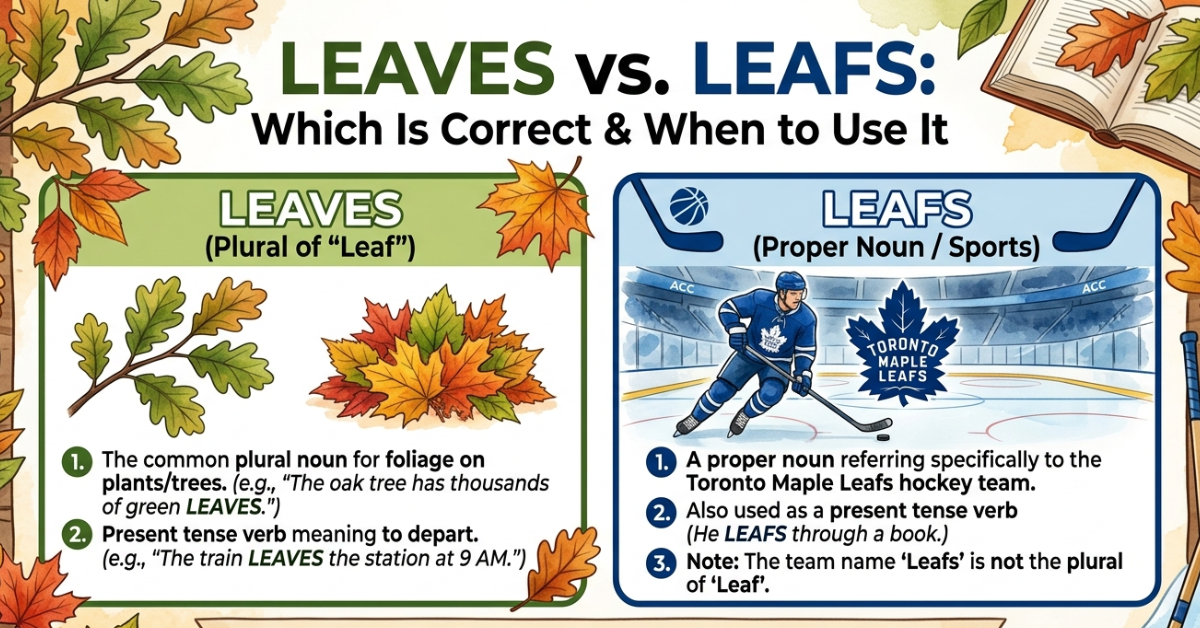
Even though “leafs” is usually incorrect as a plural noun, it still exists in English in two main cases:
1. As a Verb
“Leafs” is the third-person singular form of the verb to leaf.
Example:
- She leafs through the magazine quickly.
Here, it has nothing to do with plants.
2. Proper Nouns (Names)
Some names intentionally use “Leafs,” such as:
- Toronto Maple Leafs (NHL hockey team)
So if you see “leafs,” it’s usually either a verb or a name—not a plural noun.
Table Leaves or Leafs (Furniture Meaning)
One of the most common real-world confusions is table leaves or leafs.
In furniture, a “table leaf” refers to an extension piece that makes the table larger.
Correct usage:
- table leaves
- dining table leaves
Example:
- “We added the table leaves to accommodate guests.”
So if you’re writing about furniture, always use table leaves or leafs → correct is leaves.
Dining Table Leaves or Leafs
The same rule applies to dining furniture.
Correct:
- dining table leaves
- dining room table leaves
These are removable sections used to extend seating space.
Example:
- “The dining table leaves were inserted before the dinner party.”
So again, leaves or leafs → leaves is correct in all dining furniture contexts.
Tree Leaves or Leafs
This is the most common everyday usage.
Correct form:
- tree leaves
- plant leaves
Example:
- “The tree leaves turned golden in autumn.”
Incorrect usage like tree leafs is considered non-standard English.
So when asking tree leaves or leafs, the answer is always “leaves.”
Door Leaves or Leafs (Architecture Term)
In architecture, the term “leaf” has a special meaning.
A door leaf is a single panel of a door.
Correct usage:
- door leaves
- double door leaves
Example:
- “The double door has two leaves that open outward.”
So in construction and architecture:
- leaves or leafs → always leaves
Common Mistakes People Make
Many users confuse spelling because of how English sounds.
Frequent errors:
- writing “table leafs” instead of “table leaves”
- using “leafs” for plants
- assuming “leafs” is always plural
Why this happens:
- English irregular plurals are inconsistent
- pronunciation doesn’t clearly show spelling differences
Key Takeaways
- The correct plural of leaf is leaves
- “Leafs” is only correct as a verb or proper noun
- Furniture, plants, and architecture all use leaves
- Context matters more than spelling assumptions
FAQs About Leaves or Leafs
1. Is it leaves or leafs in grammar?
The correct plural is leaves. “Leafs” is generally incorrect unless used as a verb or proper noun.
2. What is correct: table leaves or leafs?
The correct term is table leaves, referring to extension panels in furniture.
3. Can we say tree leafs?
No, the correct phrase is tree leaves. “Leafs” is not used in botanical context.
4. Why do people say leafs instead of leaves?
It’s usually due to spelling confusion or misunderstanding of irregular plural rules in English.
5. What does door leaves mean?
It refers to individual panels of a door, especially in double-door systems.
6. Is leafs ever correct?
Yes, but only as a verb (“he leafs through a book”) or in names like sports teams.
Conclusion
Understanding it is all about context. While “leafs” appears in limited cases, “leaves” is the correct and widely accepted plural in almost every situation—from nature to furniture and architecture.
If you remember one rule, make it this:
In everyday writing, leaves is almost always correct.
Now that you know the difference between leaves or leafs, you can write more confidently and avoid one of the most common English mistakes.