Have you ever paused while writing the word independant or independent and wondered which one is actually correct? You’re not alone. This is one of the most common spelling confusions in English writing.
The correct form is independent, but many people mistakenly write independant due to pronunciation influence or spelling habits. In this guide, we’ll break down the correct usage, why the mistake happens, and how you can avoid it in your writing.
Independant or Independent: Correct Spelling Explained
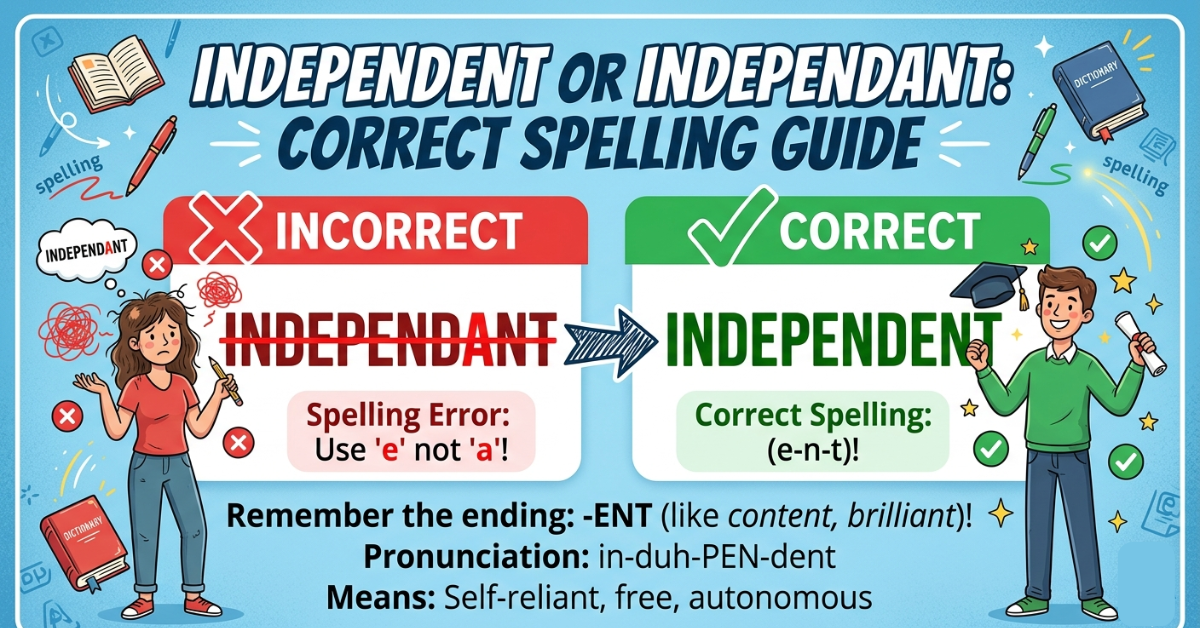
Let’s clear the confusion right away. The correct spelling is independent, not independant.
The word independent comes from Latin roots where “dependere” means “to hang from.” When you add the prefix “in-,” it becomes “not hanging from” or “free from control.”
Why “independant” is incorrect
People often write independant or independent interchangeably, but only one is accepted in standard English. The incorrect version usually appears because:
- It sounds natural when spoken
- Similar spelling patterns in other English words
- Lack of familiarity with word origins
Meaning of Independent in English
The word independent has several meanings depending on context:
- Free from control or influence
- Self-reliant or self-sufficient
- Not connected with another system or organization
For example:
- She is financially independent.
- The country became independent in 1947.
- He prefers independent decision-making.
Common Spelling Mistakes and Why They Happen
Many learners confuse spelling due to English pronunciation and word patterns. The incorrect form independant or independent often appears in casual writing.
Here are a few reasons behind such mistakes:
- Phonetic spelling (writing words as they sound)
- Influence of similar-sounding words like “dependant” (used in British English as a noun)
- Lack of proofreading
Quick tip to remember
Think of it like this:
“Independent = I depend on no one.”
Independent vs Dependent: Understanding the Difference
A helpful way to understand independent is by comparing it with its opposite:
- Independent: Self-reliant, free, not controlled
- Dependent: Relying on someone or something else
Examples:
- Independent thinker → makes own decisions
- Dependent child → relies on parents
This contrast makes it easier to remember the correct spelling and meaning.
How to Avoid Spelling Errors in Writing
If you often get confused between independant or independent, try these simple strategies:
- Use spell-check tools while writing
- Practice common vocabulary daily
- Read more English articles and books
- Break the word into parts: in + depend + ent
Consistency is key to improving spelling accuracy over time.
FAQs
1. Is “independant” ever correct?
No, independant is always incorrect in standard English. The correct spelling is independent.
2. Why do people write independant instead of independent?
It usually happens due to pronunciation confusion and spelling habits influenced by similar words.
3. What does independent mean in simple words?
It means being free, self-reliant, and not depending on others.
4. Is dependent and independent related words?
Yes, they are opposites. Dependent means relying on others, while independent means self-sufficient.
5. How can I remember the correct spelling?
A simple trick is: “I depend on no one” → independent.
Conclusion
Understanding the difference between independant or independent is important for clear and correct English writing. The right spelling is independent, and using it correctly reflects better language skills and professionalism.
With practice, reading, and attention to detail, you can easily avoid this common mistake and improve your overall writing accuracy. Keep learning, keep practicing, and your confidence in English will grow stronger every day.