Many people use the words review and revise interchangeably, especially in schools, workplaces, and writing projects. While they seem similar, they actually mean different things. Understanding review vs revise can improve your communication, writing process, and even academic performance.
Whether you are editing an essay, preparing for an exam, or improving professional documents, knowing when to review and when to revise matters. In simple terms, reviewing means checking or examining something, while revising involves making changes to improve it.
This guide breaks down the meaning, differences, examples, and proper usage of both terms in an easy-to-understand way.
What Does “Review” Mean?
The word review refers to examining, analyzing, or evaluating something carefully. It usually involves looking over information to understand it better or judge its quality.
A review does not always require changes. Sometimes, the purpose is simply to check accuracy, refresh knowledge, or provide feedback.
Common Uses of Review
People review many things in everyday life, including:
- Notes before an exam
- Business reports
- Books or movies
- Contracts and documents
- Work performance
- Research papers
Examples of Review in Sentences
- I need to review my lecture notes before tomorrow’s test.
- The manager reviewed the project proposal carefully.
- She wrote a review of the restaurant online.
In each example, the focus is on checking, analyzing, or evaluating rather than changing the content itself.
What Does “Revise” Mean?
The word revise means changing or improving something after reviewing it. Revision involves correcting mistakes, reorganizing ideas, or updating information.
Unlike reviewing, revising is an active process that results in modifications.
Common Uses of Revise
People revise:
- Essays and assignments
- Reports and presentations
- Study materials
- Laws or policies
- Designs and plans
Examples of Revise in Sentences
- I need to revise my essay before submitting it.
- The company revised its marketing strategy.
- He revised the presentation to make it clearer.
The key idea is improvement through editing or modification.
Review vs Revise: The Main Difference
The easiest way to understand the difference is this:
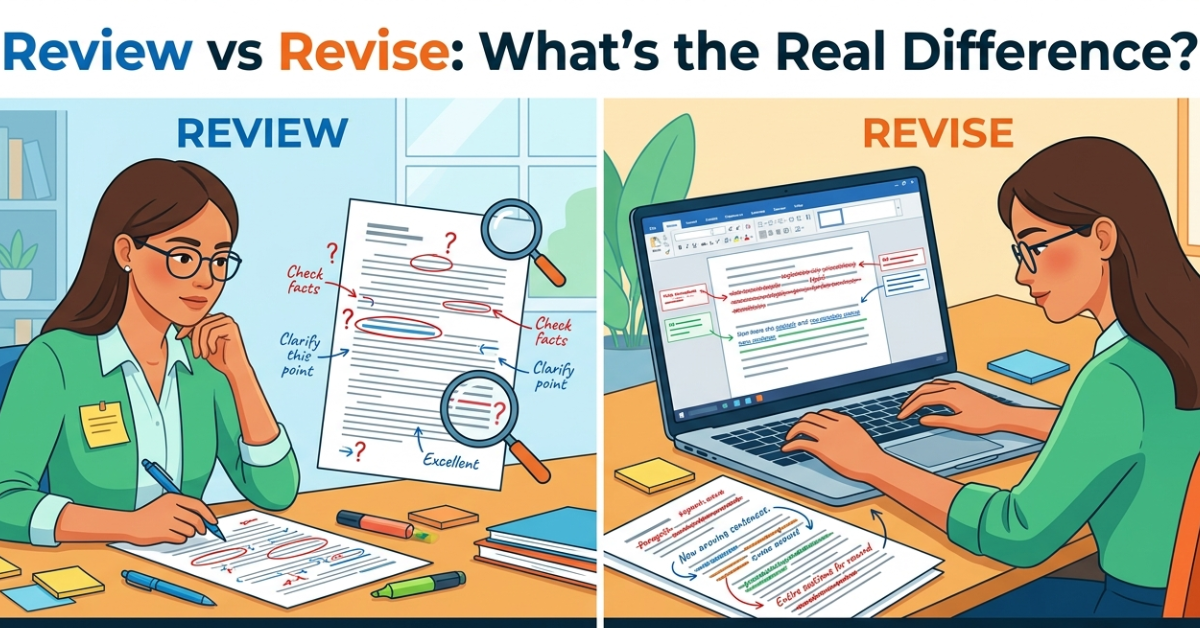
- Review = Examine or evaluate
- Revise = Change or improve
Reviewing often comes first. Revising usually happens afterward if improvements are needed.
Quick Comparison Table
| Aspect | Review | Revise |
| Main Purpose | Check or evaluate | Improve or modify |
| Changes Required | Not always | Yes |
| Focus | Understanding or analysis | Correction and improvement |
| Common Context | Reading, feedback, assessment | Editing, rewriting, updating |
| Result | Better awareness | Better final version |
Why People Confuse These Words
The confusion happens because both terms are connected to improvement and preparation. In academic settings especially, students often review material and revise notes around the same time.
However, the actions are different:
- Reviewing helps identify problems.
- Revising solves those problems.
Think of review as diagnosis and revision as treatment.
Review vs Revise in Writing
Writing is one of the best examples for understanding these terms.
When You Review Writing
During a review, you may:
- Read the content carefully
- Check grammar and clarity
- Evaluate structure
- Identify weak arguments
- Notice formatting issues
At this stage, you are mainly observing and analyzing.
When You Revise Writing
Revision involves action, such as:
- Rewriting unclear sentences
- Correcting grammar mistakes
- Improving vocabulary
- Rearranging paragraphs
- Adding stronger examples
This stage improves the quality of the content itself.
Review vs Revise in Studying
Students often hear both terms during exam preparation.
Reviewing for Exams
Reviewing study material usually means:
- Reading notes again
- Going through summaries
- Watching recorded lectures
- Testing understanding
Revising for Exams
Revising may involve:
- Updating notes
- Correcting misunderstand concepts
- Creating improved summaries
- Practicing weak topics repeatedly
In many countries, “revision” is also commonly used to describe exam preparation in general.
Key Signs You Need a Review
You should review something when:
- You want feedback
- You need to check accuracy
- You are preparing for a test or presentation
- You want to evaluate quality
- You need a better understanding
Reviewing is often the first step before making decisions.
Key Signs You Need Revision
You should revise something when:
- There are errors or mistakes
- The content feels unclear
- Information is outdated
- Structure needs improvement
- Feedback suggests changes
Revision is essential when improvement is necessary.
Common Mistakes People Make
Here are some frequent errors people make when using these terms:
Using “Review” Instead of “Revise”
Incorrect:
- I reviewed my essay by rewriting the entire introduction.
Better:
- I revised my essay by rewriting the introduction.
Using “Revise” Instead of “Review”
Incorrect:
- The teacher revised the assignment for accuracy.
Better:
- The teacher reviewed the assignment for accuracy.
Understanding the intended action helps you choose the correct word.
Simple Memory Trick
A quick trick can help you remember the difference:
- Review = Read and evaluate
- Revise = Rewrite and improve
The word revise is closely connected with visible changes.
How Professionals Use These Terms
In workplaces, both actions are important.
Review in Professional Settings
Managers may review:
- Employee performance
- Financial reports
- Project proposals
- Contracts
Revision in Professional Settings
Teams may revise:
- Marketing campaigns
- Product designs
- Company policies
- Presentations
Businesses often review first and revise later.
Which Is More Important?
Neither is more important because they work together.
A proper review helps identify weaknesses, while effective revision improves the final result. Skipping either step can reduce quality and accuracy.
For example:
- Reviewing without revising leaves mistakes unfixed.
- Revising without reviewing may lead to unnecessary changes.
The best process combines both.
Tips to Review and Revise Effectively
Effective Reviewing Tips
- Read slowly and carefully
- Take notes while checking
- Look for clarity and consistency
- Ask for feedback from others
- Focus on overall understanding
Effective Revision Tips
- Edit one issue at a time
- Improve weak sections first
- Remove unnecessary information
- Simplify complicated sentences
- Double-check grammar and formatting
Using both methods together creates stronger results.
FAQs
Is reviewing the same as revising?
No. Reviewing means examining or evaluating something, while revising means changing or improving it.
Which comes first: review or revise?
Usually, reviewing comes first because you need to identify problems before fixing them.
Can you review without revising?
Yes. Sometimes people review documents only to evaluate them without making changes.
Why is revision important in writing?
Revision improves clarity, grammar, structure, and overall quality, making writing more effective.
Do students review or revise for exams?
Students often do both. They review material to understand it and revise notes to improve learning.
Is revision only about grammar?
No. Revision can include reorganizing ideas, improving arguments, updating information, and rewriting sections.
Conclusion
Understanding review vs revise helps you communicate more clearly and work more effectively in academics, writing, and professional tasks. While reviewing focuses on examining and evaluating, revising is about making improvements based on what you discover.
Both processes are valuable and often work together. First, you review to identify what needs attention. Then, you revise to create a stronger final version.
The next time you edit an essay, prepare for an exam, or check a document, you’ll know exactly whether you need a review, a revision, or both.