English can be tricky, especially when words change form depending on tense. One of the most confusing verb pairs is freeze vs Froze. At first glance, they look similar, but they play completely different roles in grammar.
If you’ve ever wondered when to say “freeze” or “froze,” you’re not alone. This guide breaks it down in a simple, practical way so you can use both confidently in everyday writing and speaking.
What Does “Freeze” Mean?
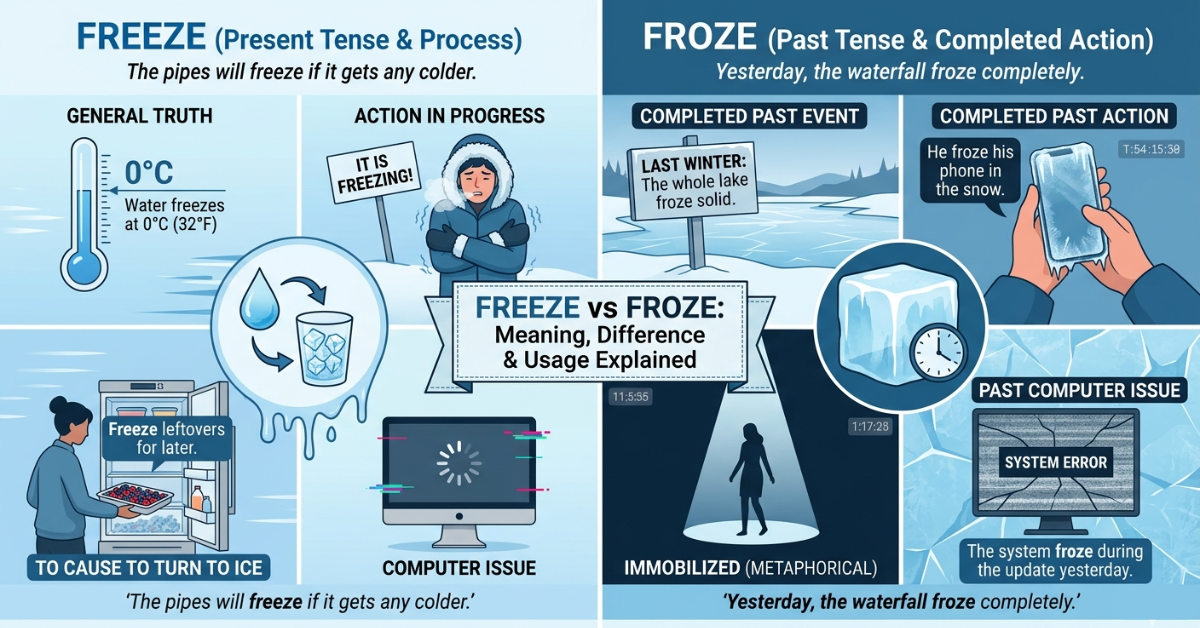
The word freeze is the base form of the verb. It refers to something becoming solid due to cold or stopping movement completely.
Common meanings of freeze:
- To turn into ice due to low temperature
- To stop suddenly (movement, progress, or action)
- To become stuck or unresponsive
Examples of “freeze” in sentences:
- Water will freeze at 0°C.
- My computer tends to freeze when too many apps are open.
- Don’t let your emotions freeze your decision-making.
In grammar terms, freeze is used in:
- Present tense
- Future tense
- Base form after modal verbs (can, will, should)
What Does “Froze” Mean?
The word froze is the simple past tense of “freeze.” It describes something that already happened in the past.
Key meanings of “froze”:
- Something turned into ice earlier
- Something stopped or became still in the past
- A reaction or situation that occurred before now
Examples of “froze” in sentences:
- The lake froze overnight.
- I froze when I saw the snake.
- His computer froze during the presentation.
Unlike the base form, froze always refers to completed actions in the past.
Freeze vs Froze: Key Differences
Understanding freeze vs Froze becomes easier when you compare them side by side.
1. Tense Difference
- Freeze → Present or future
- Froze → Past
2. Usage Context
- Freeze is used for ongoing or general actions
- Froze is used for completed actions
3. Sentence Structure
- I freeze when I feel nervous.
- I froze when I felt nervous yesterday.
Easy Grammar Rule to Remember
Here’s a simple trick to avoid confusion:
If the action is happening now or will happen → use freeze
If the action already happened → use froze
This mental shortcut helps you quickly decide the correct form without overthinking grammar rules.
Common Mistakes People Make
Even fluent English speakers sometimes mix up freeze vs Froze. Here are a few common errors:
1. Using “froze” for present tense
Incorrect: Water froze every winter.
Correct: Water freezes every winter.
2. Using “freeze” for past tense
Incorrect: My phone freeze yesterday.
Correct: My phone froze yesterday.
3. Confusing verb forms in writing
- Freeze (base form)
- Froze (past form)
- Frozen (past participle — bonus form often confused with both)
Related Forms You Should Know
To fully understand freeze vs Froze, it helps to know the full verb family:
- Freeze → base form
- Froze → past tense
- Frozen → past participle
Example:
- The pond will freeze tonight.
- It froze last night.
- It has frozen completely now.
Why This Confusion Happens
The English language has many irregular verbs, and freeze vs Froze is one of them. Instead of following a simple pattern like “walk/walked,” this verb changes completely in its past form.
That’s why learners often mix it up, especially when switching between speaking and writing quickly.
Quick Practice Examples
Try identifying the correct word:
- The pipes will ___ in winter.
- My screen ___ during the call yesterday.
- Water ___ at low temperatures.
Answers:
- freeze
- froze
- freezes
FAQs about Freeze vs Froze
1. What is the main difference between freeze vs Froze?
The main difference is tense. “Freeze” is present/future, while “froze” is past tense.
2. Is “froze” the past tense of freeze?
Yes, “froze” is the simple past form of the verb freeze.
3. Can I use “freeze” in past sentences?
No, for past actions you should use “froze,” not “freeze.”
4. What is the past participle of freeze?
The past participle is “frozen.”
5. Why do people confuse freeze vs Froze?
Because freeze is irregular, and its past form “froze” does not follow standard grammar patterns.
Conclusion
Mastering freeze vs Froze is easier once you understand their tense difference. “Freeze” is used for present or future actions, while “froze” describes something that already happened.
If you remember this simple rule, you’ll avoid one of the most common English grammar mistakes. Keep practicing with real-life examples, and soon it will become second nature.
Understanding freeze vs Froze not only improves your grammar but also makes your communication clearer and more confident.