
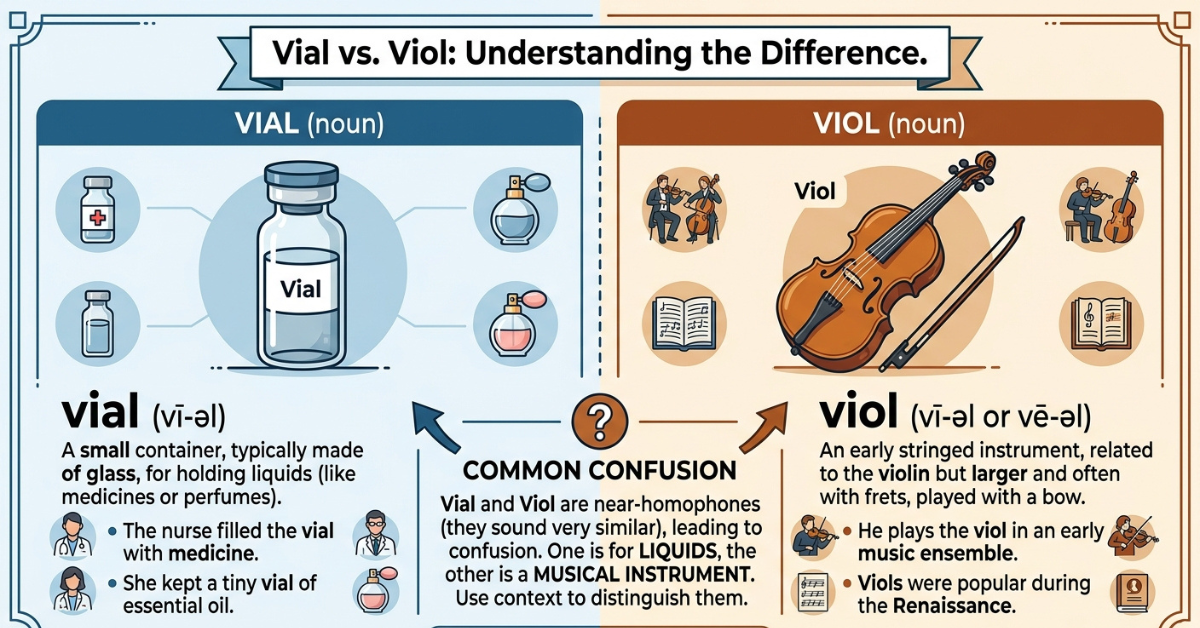
At first glance, Vial vs Viol looks like a simple spelling mistake people often make, but in reality, these two words are completely different in meaning, usage, and context. Because they look and sound somewhat similar, they frequently confuse learners of English, writers, and even native speakers.
In this article, we’ll break down the difference between vial vs viol, explore their definitions, real-life usage, pronunciation, and common mistakes. By the end, you’ll never mix them up again.
What Does “Vial” Mean?
A vial is a small container, usually made of glass or plastic, used to store liquids, especially in medical or laboratory settings.
Common Uses of Vial:
- Medicine (vaccines, injections)
- Laboratory samples
- Essential oils or perfumes
- Chemical storage
Example Sentences:
- The nurse opened a vial of vaccine before the injection.
- Scientists stored the chemical in a sealed vial.
The word is commonly used in healthcare, science, and pharmacy industries. When people refer to small medical bottles, they are talking about a vial.
What Does “Viol” Mean?
A viol is a historical musical instrument that belongs to the string family. It was popular during the Renaissance and Baroque periods.
Key Features of a Viol:
- Played with a bow like a violin
- Has frets on the fingerboard
- Produces a softer, more delicate sound than modern string instruments
Example Sentences:
- The musician performed a piece on a viol during the historical concert.
- Museums often display ancient string instruments like the viol.
Unlike a vial, this word is mostly found in music history, classical studies, and museums.
Vial vs Viol: Key Differences Explained
To clearly understand vial vs viol, let’s compare them side by side:
1. Meaning
- Vial: A small container for liquids
- Viol: A historical string instrument
2. Field of Use
- Vial: Science, medicine, pharmacy
- Viol: Music, history, classical arts
3. Physical Form
- Vial: Glass or plastic bottle
- Viol: Wooden musical instrument
4. Pronunciation
- Vial: /ˈvaɪ.əl/ (two syllables: vi-al)
- Viol: /ˈvaɪəl/ or /ˈvaɪ.əl/ depending on usage, often similar but context differs
5. Modern Usage
- Vial: Common in everyday life
- Viol: Rare, mostly academic or historical
This comparison makes it clear that vial vs viol are not interchangeable in any context.
Why People Confuse Vial and Viol
The confusion around vial vs viol usually happens due to:
1. Similar spelling
Both words are almost identical, differing only by one letter.
2. Similar pronunciation
In spoken English, they can sound nearly the same depending on accent.
3. Lack of exposure
“Viol” is rarely used in modern conversation, so many people assume it is a typo.
4. Typing errors
Fast typing often leads to accidental swapping of letters.
How to Remember the Difference Easily
Here are some simple memory tricks:
Vial = Vaccine
Think of “vial” with the letter A, like A for medicine.
Viol = Violin family
Think of “viol” as related to violin and music.
Quick Tip:
If it holds liquid → Vial
If it makes music → Viol
This simple association can help you avoid confusion in writing and exams.
Real-Life Usage Examples
To further understand vial vs viol, here are practical examples:
- The lab assistant carefully labeled each vial of blood sample.
- The orchestra included a rare viol in their historical performance.
- She dropped the vial accidentally, spilling the liquid.
- The museum displayed a beautifully preserved viol from the 16th century.
These examples show how different the contexts really are.
Common Mistakes to Avoid
When using vial vs viol, avoid these errors:
- Using “viol” when talking about medicine
- Using “vial” when referring to instruments
- Assuming they are spelling variations of the same word
- Ignoring context while writing
Always check the subject you’re referring to before choosing the correct word.
FAQs About Vial vs Viol
1. Are vial and viol the same thing?
No, they are completely different words with unrelated meanings.
2. What is a vial used for?
A vial is used to store liquids like medicines, vaccines, or lab samples.
3. What is a viol in music?
A viol is a historical string instrument used mainly in classical music.
4. Why do people confuse vial and viol?
Because they look similar in spelling and sound almost the same when spoken.
5. Which word is more commonly used today?
“Vial” is commonly used in modern language, while “viol” is rare and mostly historical.
Conclusion
Understanding vial vs viol is simple once you break down their meanings and usage. A vial belongs to the world of science and medicine, while a viol belongs to music history. Despite their similar appearance, they have no connection in meaning or context.
The key takeaway is to always focus on context—liquid storage means vial, musical instrument means viol. Once you remember this, you’ll never confuse them again.
If you’re interested in improving your vocabulary further, exploring similar confusing word pairs can be a great next step in mastering English.