Have you ever stopped mid-sentence and wondered whether to write protestors or protesters? It’s a surprisingly common confusion, especially in news writing, essays, and social media discussions about public demonstrations.
The debate around protestors or protesters isn’t just about spelling—it reflects how English evolves across regions, dictionaries, and modern usage trends. In this article, you’ll learn the correct spelling, why both forms exist, how major dictionaries treat them, and when to use each confidently in your writing.
By the end, you’ll never second-guess this word again.
Protestors or Protesters: The Correct Spelling Explained
The most widely accepted spelling in modern English is “protesters.” This is the standard form used in academic writing, journalism, and official publications.
However, “protestors” is also seen occasionally, especially in informal writing or certain regional styles.
Why “Protesters” Is Preferred
According to major language authorities like:
- Merriam-Webster
- Cambridge University Press
- Oxford University Press
The preferred spelling follows a simple rule:
When the base verb ends in -t, the suffix -er is added directly → protest + er = protester.
This aligns with standard English noun formation patterns.
Why Do “Protestors or Protesters” Both Exist?
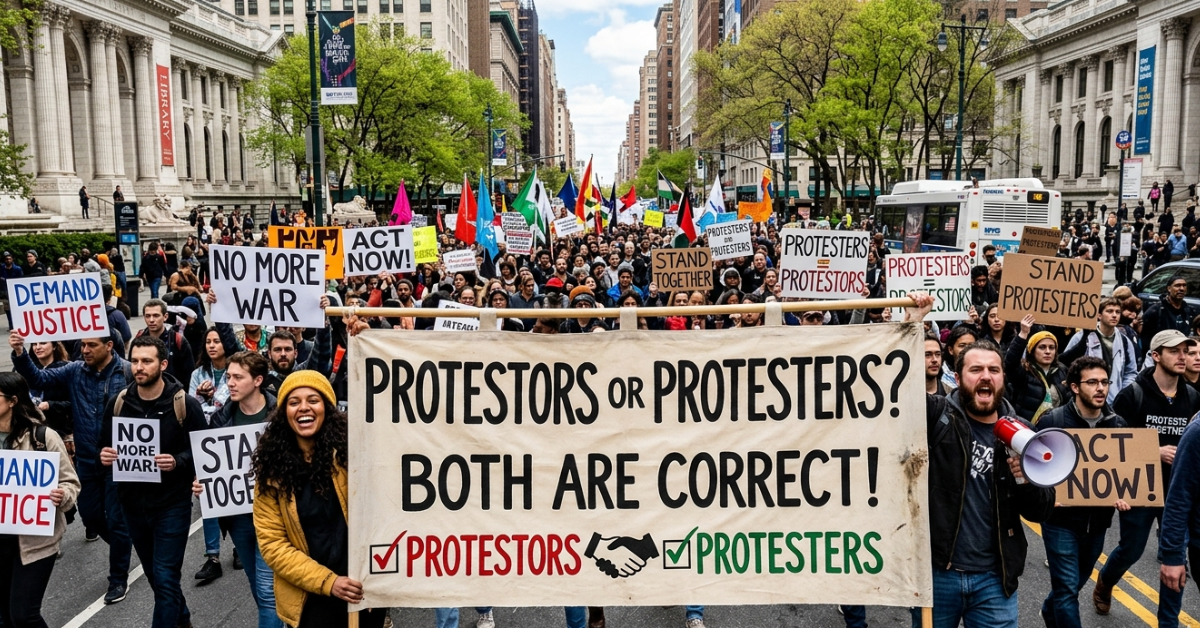
Even though protesters is standard, protestors or protesters both appear in real-world writing due to language variation and stylistic preferences.
1. Regional Differences
- American English: Strongly favors protesters
- British English: Also prefers protesters, though variation appears less strictly regulated in informal writing
2. Alternative Morphology
Some writers mistakenly assume that words like doctor → doctors or actor → actors justify protestor. This creates the spelling protestors, but linguistically, it’s not necessary.
3. Digital and Social Media Influence
On platforms like Twitter (X), Instagram, and TikTok, spelling variations spread quickly. As a result, protestors or protesters both appear in captions, hashtags, and comments.
Grammar Insight: What Makes “Protesters” Correct?
English nouns formed from verbs often follow consistent patterns:
Common Formation Rules
- Verb + “er” → worker, writer, runner
- Drop silent letters if needed → make + maker
- Maintain clarity and pronunciation consistency
In this system, protester is the grammatically correct derivation from the verb protest.
Linguists at institutions like Oxford University Press emphasize that standardization exists to reduce confusion in formal communication.
Is “Protestors” Ever Acceptable?
Yes—but with caution.
While protestors is not considered standard in most dictionaries, it may appear in:
- Informal blog writing
- Opinion pieces
- Non-edited social media posts
- Regional variations or stylistic choices
However, in academic, legal, or journalistic contexts, “protesters” should always be used.
So when choosing between protestors or protesters, the safer and more professional option is clear.
Real-World Usage Examples
To understand the difference, let’s look at usage in context:
Correct Usage (Preferred)
- The protesters gathered peacefully in the city square.
- Police monitored the movement of protesters during the march.
Less Preferred Usage
- The protestors blocked traffic for several hours.
- Authorities negotiated with the protestors to avoid escalation.
Even though both are understood, the second set is less formal.
Why Spelling Matters in Modern Communication
Choosing between protestors or protesters might seem small, but spelling affects:
- Credibility in writing
- Search engine ranking (SEO)
- Academic scoring in essays
- Professional tone in journalism
Search engines and style guides consistently favor protesters, making it the stronger SEO choice as well.
Quick Key Takeaways
- “Protesters” is the standard and preferred spelling
- “Protestors” exists but is less widely accepted
- Dictionaries and publishers favor “protesters”
- Both forms are understood, but one is more professional
- Use “protesters” in formal writing for accuracy and credibility
Practical Tips for Writers
If you’re unsure which form to use:
- Always choose protesters for formal content
- Avoid mixing both spellings in the same article
- Check style guides (AP, MLA, Chicago) for consistency
- Use spelling tools like Grammarly for verification
- Remember: clarity always beats variation
FAQ: Protestors or Protesters
1. What is the correct spelling: protestors or protesters?
The correct and widely accepted spelling is protesters. It is preferred in formal writing and dictionaries.
2. Why do some people write “protestors”?
“Protestors” appears due to analogy with words like “actors” or “doctors,” but it is not the standard form.
3. Is “protestors or protesters” interchangeable?
They are understood in meaning, but only protesters is recommended for professional use.
4. Do British and American English differ on this spelling?
Both British and American English primarily use protesters, with very little official variation.
5. Which spelling is better for SEO content?
“Protesters” performs better in search rankings because it aligns with standard dictionary usage.
6. Can I use “protestors” in informal writing?
Yes, but it may look less polished. For clarity and correctness, protesters is preferred.
Conclusion
The debate over protestors or protesters is a classic example of how English evolves while still maintaining clear standards. Although both spellings appear in everyday usage, protesters remains the correct, widely accepted, and professionally recommended form.
Whether you’re writing an essay, news article, or social media post, sticking to protesters ensures clarity, credibility, and consistency. Keep this rule in mind, and your writing will always sound more polished and authoritative.