Have you ever stopped while writing and wondered whether to use send or sent? If yes, you are not alone. Many English learners face this confusion because both words come from the same verb but work in different tenses.
In this guide, you will clearly understand, and you will also learn how to fix common mistakes. Moreover, you will see simple examples that make everything easy to remember.
What Does Send or Sent Mean?
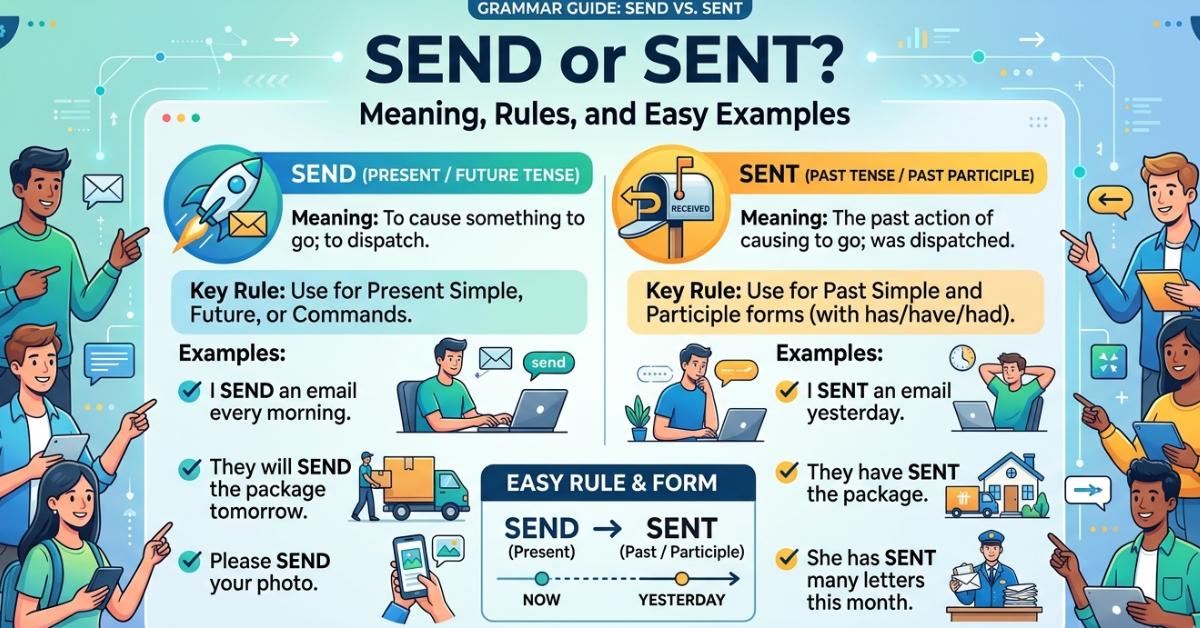
First of all, let’s break it down simply. Both words come from the verb “send,” but they change based on time.
- Send = present form (base verb)
- Sent = past form and past participle
Therefore, the meaning depends on time. If the action happens now or in the future, you use send. However, if the action already happened, you use sent.
Simple understanding:
- Send → happening now or future action
- Sent → already completed action
For example:
- I send messages every day.
- I sent a message yesterday.
So, when people search send or sent meaning, they really want to understand tense usage. In short, send = present, and sent = past or completed action.
When Should You Use “Send”?
You should use send in several situations. Let’s understand them one by one.
1) Present simple tense
We use send for habits, routines, and general facts. For instance:
- I send emails daily.
- They send reports every week.
2) With modal verbs
However, when we use words like will, can, should, must, we always use the base form send, not sent.
- I will send the file.
- She can send the invitation.
- You should send the report.
3) For commands and requests
In addition, we use send when giving instructions:
- Please send me the details.
- Send the document quickly.
Therefore, remember: after modal verbs or in commands, always choose send.
When Should You Use “Sent”?
Now let’s look at sent, which we use for completed actions.
1) Past simple tense
We use sent when the action happened in the past.
- I sent the email yesterday.
- He sent the parcel last night.
2) Present perfect tense
Moreover, we use have/has + sent when the action connects to the present.
- I have sent the message.
- She has sent the form.
3) Passive voice
In passive structures, we also use sent.
- The letter was sent by courier.
- The files were sent this morning.
Therefore, whenever the action is completed or passive, sent is the correct choice.
Will Be Send or Sent? (Correct Usage)
Many learners often write will be send, but that is incorrect.
The correct form is will be sent.
Why? Because in passive voice, we always use the past participle form of the verb. Since the past participle, we must use it.
Correct examples:
- The report will be sent tomorrow.
- The email will be sent shortly.
Incorrect examples:
- The report will be send tomorrow
- The email will be send shortly
Therefore, always remember: after will be, use sent, not send.
I Have Send or Sent? (Correct Form)
Another common mistake is writing I have send.
However, the correct structure is I have sent.
This happens because present perfect tense requires the past participle form.
Correct:
- I have sent the file.
- We have sent the payment.
Incorrect:
- I have send the file
- We have send the payment
In addition, this rule also applies to all verbs in present perfect tense.
Quick Comparison Table
| Tense Type | Correct Form | Example |
| Present | send | I send emails daily |
| Past | sent | I sent the email yesterday |
| Present Perfect | have sent | I have sent the email |
| Passive Future | will be sent | The email will be sent tomorrow |
Common Mistakes with Send or Sent
Let’s now look at frequent errors learners make.
1) Wrong tense with time words
Many people write:
- Incorrect: I send the letter yesterday
However, “yesterday” requires past tense:
- Correct: I sent the letter yesterday
2) Using send after “have”
- Incorrect: I have send the file
- Correct: I have sent the file
3) Incorrect passive future
- Incorrect: The message will be send
- Correct: The message will be sent
Therefore, understanding tense is more important than memorizing the words.
How to Remember Send or Sent Easily
You can remember it using a simple logic:
- Use send → now, future, or command
- Use sent → past or completed action
In addition, you can follow this trick:
- If you see will, can, should → use send
- If you see have, has, was, were, yesterday → use sent
This simple method helps avoid confusion in real writing situations.
Real-Life Examples
Let’s make it more practical:
- A teacher says: Please send your homework.
- A student replies: I sent it yesterday.
- A company writes: Your order will be sent today.
- A user says: I have sent the payment.
Therefore, both forms appear daily in emails, messages, and professional communication.
Key Takeaways
- Send = present, future, or command form
- Sent = past, completed, or passive form
- Always use will be sent, not will be send
- Always use I have sent, not I have send
- Transition words and tense rules help you choose correctly
FAQ: Send or Sent
1) What is the difference between send or sent?
Send is the base form, while sent is the past form. Therefore, send works for present and future, while sent works for past actions.
2) Is “will be send” correct?
No, it is incorrect. The correct form is will be sent because passive voice requires the past participle.
3) Which is correct: I have send or sent?
The correct form is I have sent. Present perfect tense always uses the past participle.
4) When do we use send?
We use send with modal verbs, present tense, and commands. For example, “I will send it.”
5) When do we use sent?
We use sent for completed actions, past tense, and passive voice. For example, “I sent the email yesterday.”
6) How can I easily remember send or sent?
Use send for present or future actions, and use sent for past or completed actions.
Conclusion
To sum up, the difference between send or sent becomes easy when you focus on tense. Because English relies heavily on time structure, choosing the correct form improves both writing and speaking.
Therefore, always remember: send for present and future, sent for past and completion. With practice, you will naturally avoid mistakes like will be send or sent and i have send or sent, and your English will sound much more accurate and professional.