Modelled or Modeled: What’s the Difference?

Have you ever paused mid-sentence wondering whether to write modelled or modeled? It’s a surprisingly common doubt, especially for writers, students, and professionals working across different forms of English. The confusion around modelled or modeled often comes from regional spelling differences between British and American English.
In this guide, you’ll learn exactly what each form means, when to use them, and how to avoid common spelling mistakes. We’ll also explore real-world examples so you can confidently choose the correct version every time.
Understanding “Modelled or Modeled” in English
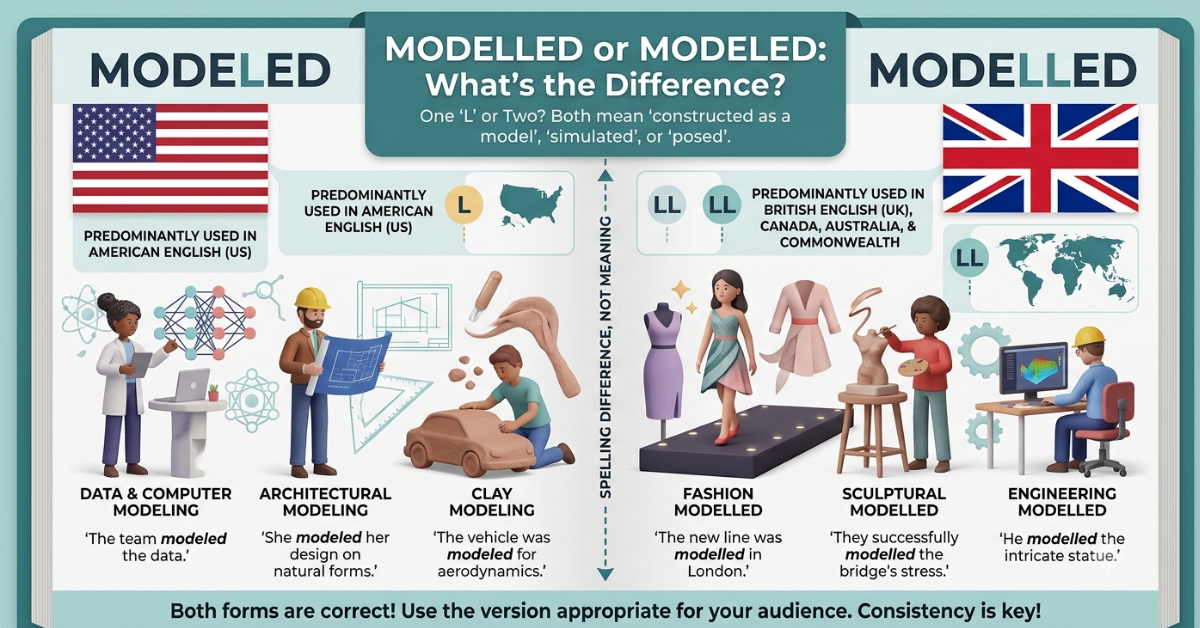
At its core, both modelled and modeled come from the verb “to model,” which means to represent, design, or imitate something.
The difference lies in spelling conventions:
- Modelled → British English (UK, Australia, New Zealand, India)
- Modeled → American English (USA)
So when comparing modelled or modeled, neither is wrong—they are simply regional variations of the same word.
Why Do Two Spellings Exist?
The variation in modelled or modeled comes from how English evolved across different countries. Over time, American English simplified many spellings, while British English retained older forms.
British English Preference: “Modelled”
In British English, doubling the final consonant is common when adding suffixes like -ed or -ing. That’s why you’ll see:
- Model → Modelled
- Travel → Travelled
- Cancel → Cancelled
This system follows a more traditional spelling structure.
American English Preference: “Modeled”
American English tends to simplify spelling rules by avoiding double consonants in many cases:
- Model → Modeled
- Travel → Traveled
- Cancel → Canceled
This makes writing slightly more streamlined and faster.
When Should You Use “Modelled or Modeled”?
Choosing between modelled or modeled depends entirely on your audience.
Use “Modelled” If You Are Writing For:
- UK-based publications
- Academic writing in Commonwealth countries
- Australian or Canadian audiences
- IELTS or British curriculum content
Use “Modeled” If You Are Writing For:
- US-based websites or clients
- American academic institutions
- SEO content targeting US readers
- Global tech companies using US English standards
In short, consistency is more important than preference.
Real-World Examples of Usage
Let’s look at how modelled or modeled appears in real sentences:
British English Examples (Modelled)
- The architect modelled the building using advanced software.
- She modelled the design after classical European styles.
- Scientists modelled climate change scenarios.
American English Examples (Modeled)
- The engineer modeled the bridge structure digitally.
- The company modeled customer behavior using AI tools.
- He modeled the prototype before production.
Both versions are grammatically correct—the spelling just changes based on region.
Common Mistakes Writers Make
Even experienced writers sometimes struggle with modelled or modeled. Here are a few frequent errors:
1. Mixing Both Spellings in One Document
Switching between modelled and modeled in the same article looks unprofessional.
2. Ignoring Audience Location
Using British spelling for a US audience (or vice versa) can reduce clarity and SEO performance.
3. Overthinking Grammar Rules
Some assume one version is “more correct,” but both are valid depending on context.
SEO Impact: Does Spelling Matter?
Yes—especially in digital writing.
Search engines recognize both modelled or modeled, but they also match user intent based on region. For example:
- US users search more for “modeled”
- UK users search more for “modelled”
Practical SEO Tip:
If you’re targeting a global audience, choose one version and stay consistent. Many international brands prefer American English for wider reach.
Quick Comparison Table
| Feature | Modelled | Modeled |
| English Type | British English | American English |
| Spelling Style | Double “l” | Single “l” |
| Usage Regions | UK, India, Australia | USA |
| Meaning | Same | Same |
Key Takeaways
- Modelled or modeled are both correct spellings.
- The difference depends on British vs American English.
- Always match your audience’s language preference.
- Consistency is more important than choosing one form.
- Both versions mean to represent or simulate something.
Practical Tips for Writers
If you’re still unsure about modelled or modeled, follow these simple rules:
- Pick either US or UK English before starting your document
- Use grammar tools like Grammarly or Hemingway Editor for consistency
- If writing for SEO, check your target region’s search behavior
- Avoid mixing spelling styles within the same content
These small habits can significantly improve writing clarity and professionalism.
FAQs About Modelled or Modeled
1. Is “modelled” correct English?
Yes, modelled is correct in British English and widely used in countries like the UK, India, and Australia.
2. Is “modeled” wrong?
No, modeled is the American English spelling and is completely correct in US usage.
3. Why do British and American English spell it differently?
The difference comes from historical spelling reforms. American English simplified many double-letter words over time.
4. Which spelling should I use for SEO?
It depends on your target audience. Use modeled for US traffic and modelled for UK or Commonwealth audiences.
5. Can I use both in the same article?
It’s not recommended. Choose one version and stay consistent throughout your content.
6. Does Google treat both spellings the same?
Google understands both, but ranking may vary slightly based on regional search intent.
Conclusion
The debate over modelled or modeled isn’t about right or wrong—it’s about language variation. Both spellings carry the same meaning and function, but their usage depends on where your audience is located.
If you’re writing professionally, the key is consistency. Choose one form, stick with it, and align it with your target readers. Once you understand this simple rule, you’ll never hesitate between modelled or modeled again.
For writers, marketers, and students alike, mastering these small differences can make your communication clearer, more polished, and more effective.