If you’ve ever paused while writing and wondered whether it should be Take Effect or Take Affect, you’re not alone. These two phrases look similar, sound close, and often confuse even fluent English speakers.
The main focus keyword Take Effect or Take Affect is all about understanding grammar clarity—because only one of these is correct in most situations.
In this guide, you’ll learn the difference, correct usage, real examples, and easy memory tricks so you never mix them up again.
What Does “Take Effect or Take Affect” Mean?
The confusion usually comes from the words effect and affect, which have different roles in grammar.
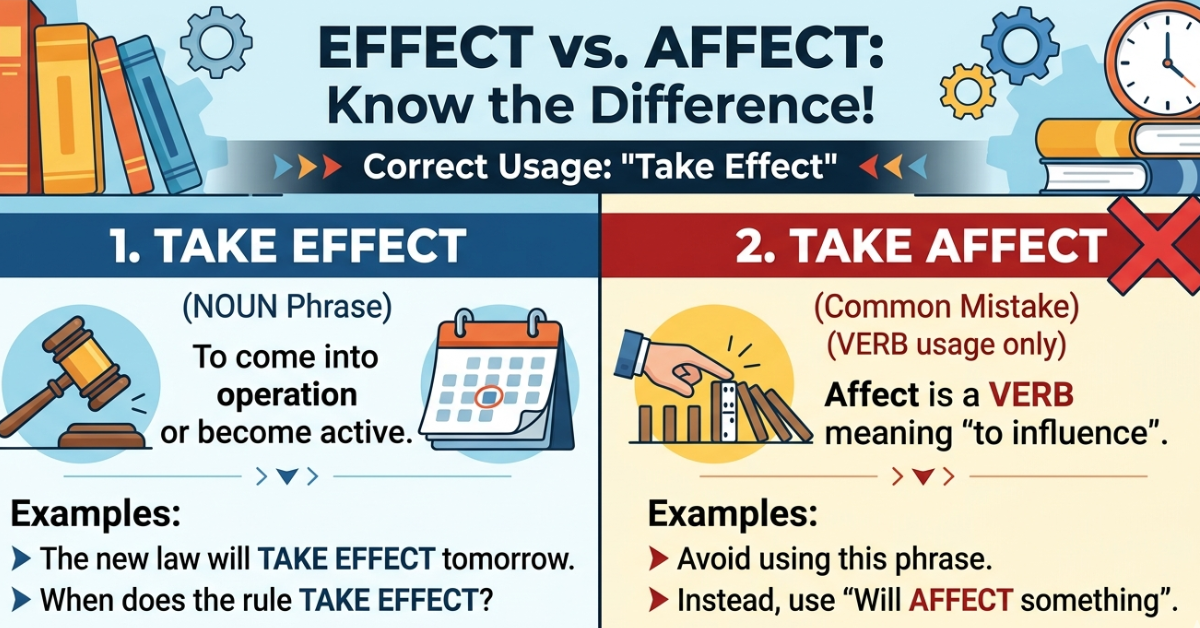
1. “Take Effect” – The Correct Phrase
Take effect means something begins to work or becomes active.
It is commonly used for:
- Laws
- Medicines
- Rules
- Policies
Examples:
- The new law will take effect from next month.
- The medicine takes effect within 30 minutes.
- The policy will take effect immediately.
In simple terms: something starts working.
2. “Take Affect” – Why It’s Incorrect
The phrase Take Affect is generally incorrect in standard English.
Why? Because “affect” is usually a verb, meaning to influence something, not to “start working.”
So saying “take affect” is grammatically wrong in most contexts.
Incorrect:
- The rule will take affect tomorrow.
Correct:
- The rule will take effect tomorrow.
Quick Grammar Breakdown: Effect vs Affect
To fully understand Take Effect or Take Affect, you need to know the difference between effect and affect.
Effect (Noun)
- Means result or outcome
- Example: The effect of the medicine was immediate.
Affect (Verb)
- Means to influence something
- Example: Cold weather affects crops.
Easy trick:
- Affect = Action (verb)
- Effect = End result (noun)
Why People Confuse Take Effect or Take Affect
There are a few reasons why this confusion happens:
- Both words sound similar
- Both are used in formal English
- People assume they are interchangeable
- Autocorrect sometimes doesn’t help
But once you understand the rule, the difference becomes very clear.
Simple Memory Trick to Remember
Here’s an easy way to remember it:
If something “starts working” → use Take effect
If something “influences something” → use affect
Think of it like this:
Effect = End result (what happens)
Affect = Action (what causes it)
Real-Life Examples of Take Effect
Let’s make it more practical so you can see how Take Effect or Take Affect is used correctly in real life:
- The new traffic rules will take effect next week.
- The contract takes effect once both parties sign it.
- The changes will take effect immediately after approval.
- The vaccine takes effect after a few days.
Notice how all of these show something becoming active or starting.
Common Mistakes to Avoid
When using Take Effect or Take Affect, avoid these errors:
- Mixing “affect” in place of “effect”
- Using “take affect” in formal writing
- Overthinking when “effect” simply means “start working”
Why Correct Usage Matters
Using the correct form isn’t just about grammar—it improves:
- Professional writing quality
- Academic accuracy
- Clear communication
- SEO performance in content writing
Even small errors like this can change how your writing is perceived.
FAQs About Take Effect or Take Affect
1. What is correct: Take effect or take affect?
The correct phrase is take effect, not take affect.
2. Can I ever use “take affect”?
No, in standard English it is considered incorrect.
3. What does take effect mean?
It means something begins to work or becomes active.
4. Why do people confuse effect and affect?
Because they sound similar and are often used in formal writing, but their meanings are different.
5. Is affect ever used correctly?
Yes. “Affect” is a verb meaning to influence something, but it is not used in the phrase “take effect.”
Conclusion
Understanding Take Effect or Take Affect is actually simple once you break it down. The correct phrase is always take effect, which means something begins to work or become active.
On the other hand, affect is a verb that means to influence something, so it doesn’t fit in this expression.
If you remember just one thing, let it be this:
“Effect = result, Affect = action.”
Mastering this small grammar rule can instantly improve your writing clarity and confidence.