Retract vs Redact: Key Differences Explained Simply

Have you ever come across the terms retract vs redact and wondered why they sound similar but mean completely different things? You’re not alone. These two words often confuse writers, students, and even professionals because both involve “taking something back” in some way—but not in the same context.
Understanding retract vs redact is important for clear communication, especially in writing, journalism, law, and official documentation. In this article, we’ll break down both terms in a simple, practical way so you never mix them up again.
What Does “Retract” Mean?
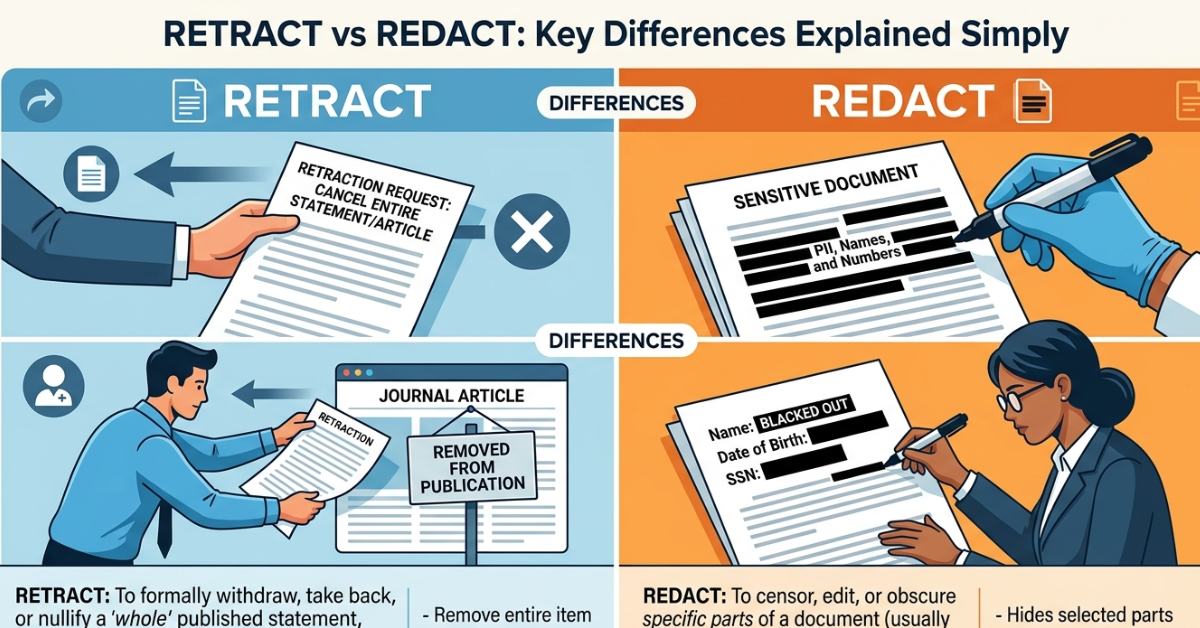
To retract means to take back something you previously said, published, or claimed.
It is often used when:
- A statement is proven wrong
- A person apologizes for misinformation
- An official correction is issued
Simple Definition:
Retract = Withdraw or take back a statement
Examples of Retract:
- A news reporter retracts a false news report
- A scientist retracts a published study due to errors
- Someone retracts a public apology or claim
Everyday Context:
If you say something in anger and later realize it was wrong, you might retract your statement.
What Does “Redact” Mean?
To redact means to edit a document by removing or hiding sensitive or confidential information.
It is commonly used in:
- Government documents
- Legal papers
- Military reports
- Confidential corporate files
Simple Definition:
Redact = Edit by removing sensitive information
Examples of Redact:
- A government releases a report with names redacted
- A legal document hides personal details for privacy
- A company redacts salary information before sharing records
Everyday Context:
Think of redaction like using a black marker to hide private details in a document.
Retract vs Redact: Key Differences Explained
Here’s the simplest way to understand retract vs redact:
| Feature | Retract | Redact |
| Meaning | Take back a statement | Hide or remove information |
| Use Case | Speech, writing, claims | Documents, reports |
| Purpose | Correct misinformation | Protect privacy/security |
| Action Type | Withdrawal | Editing |
Easy Memory Trick:
- Retract = Retrace your words and take them back
- Redact = Reduce visible information in a document
When Should You Use Retract or Redact?
Understanding the correct usage of retract vs redact depends on context.
Use “Retract” when:
- You made a wrong statement
- You want to correct public information
- You are withdrawing an opinion or claim
Use “Redact” when:
- You are editing a document
- You need to protect private data
- You are preparing official or legal records
Common Mistakes People Make
Many people mix up retract vs redact because both involve “removing” something. However, the intention is very different.
Frequent errors include:
- Saying “redact an apology” instead of retract
- Using “retract a document” instead of redact
- Confusing journalism terms in writing tasks
A quick reminder:
If it’s spoken or stated → retract
If it’s written and edited → redact
Real-Life Examples for Better Understanding
Retract in Action:
- “The politician retracted his statement after public backlash.”
- “The company retracted its earlier claim about the product.”
Redact in Action:
- “The report was released with sensitive names redacted.”
- “Financial details were redacted before publication.”
These examples clearly show how retract vs redact works in real life.
Why This Difference Matters
Using the wrong term can lead to confusion, especially in:
- Academic writing
- Journalism
- Legal documentation
- Professional communication
Understanding retract vs redact ensures clarity, accuracy, and professionalism in your writing.
FAQs About Retract vs Redact
1. What is the main difference between retract and redact?
Retract means to take back a statement, while redact means to remove or hide sensitive information from a document.
2. Can retract and redact be used interchangeably?
No, they cannot. They have completely different meanings and contexts.
3. Where is “redact” commonly used?
It is mostly used in legal, government, and confidential documents.
4. What does it mean to retract a statement?
It means to officially withdraw or correct something you previously said or published.
5. Is redaction only for secret information?
Not always secret, but often sensitive or private information that should not be publicly visible.
Conclusion
Understanding retract vs redact is all about context. One deals with correcting or withdrawing statements, while the other focuses on editing and hiding sensitive information in documents. Though they sound similar, their meanings are completely different and important in professional communication.
Now that you know the difference, you can confidently use both terms correctly in writing, studies, or daily conversations. If you found this helpful, exploring more grammar differences can further sharpen your language skills.