Have you ever received a quick “thx” and paused for a second, wondering what the best reply should be? In texting, the opposite of thx in texting is usually a polite response such as “you’re welcome,” “no problem,” or “anytime.” However, the right choice depends on the tone of the chat, the relationship, and how formal or casual the conversation feels.
In this article, you will learn what “thx” means, which replies work best, and how to choose the most natural response in different situations. As a result, you will know exactly what to say without sounding stiff or awkward.
What “Thx” Means in Texting
“Thx” is simply a short, informal version of “thanks.” Because people use it in fast-moving chats, it usually feels casual, friendly, and lightweight.
For example, someone might text:
- “Thx for helping me.”
- “Thx, I got it.”
- “Thx”
Since “thx” is an expression of gratitude, the reply usually acknowledges that gratitude rather than directly opposing it. In other words, texting has a conversational pattern here, not a strict opposite in the dictionary sense.
What Is the Opposite of Thx in Texting?
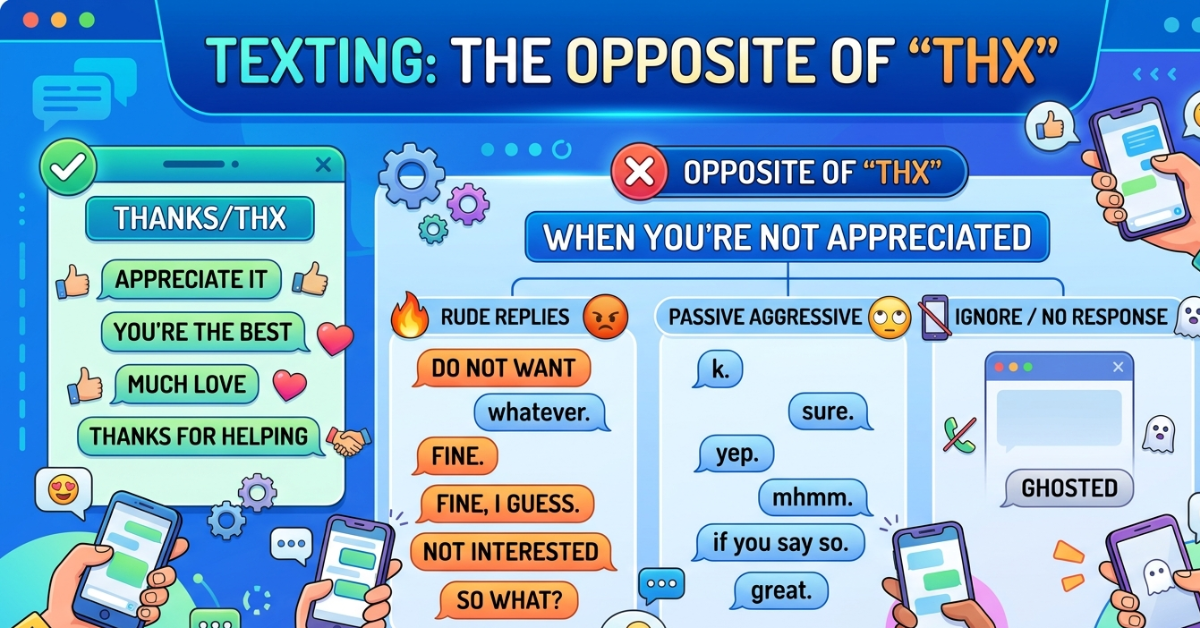
The most natural opposite of thx in texting is a response that accepts the thank-you politely. Common choices include:
- You’re welcome
- No problem
- No worries
- Anytime
- My pleasure
Each of these works in a slightly different tone. For instance, “you’re welcome” feels the most standard, while “no problem” sounds more relaxed. Meanwhile, “anytime” adds warmth, and “my pleasure” feels a little more polished.
Best Replies to “Thx”
Choosing the right response becomes much easier once you match the tone of the conversation. Here are the most common and natural options.
1. You’re welcome
This is the safest reply in almost any situation. Because it sounds polite and balanced, it works well in both personal and professional chats.
Example:
- A: “Thx for your help.”
- B: “You’re welcome.”
2. No problem
This phrase is very common in texting because it feels easy and casual. It suggests that helping was not a burden.
Example:
- A: “Thx for sending the notes.”
- B: “No problem.”
3. No worries
This reply feels friendly, calm, and reassuring. It is especially useful when someone sounds a little apologetic in their thank-you message.
Example:
- A: “Thx, sorry for the trouble.”
- B: “No worries.”
4. Anytime
This answer sounds warm and supportive. It also implies that you are happy to help again in the future.
Example:
- A: “Thx a lot!”
- B: “Anytime.”
5. My pleasure
This one feels a bit more refined, so it is often better for formal or respectful conversations. Even so, it still sounds natural when used correctly.
Example:
- A: “Thx for everything.”
- B: “My pleasure.”
When to Use Each Reply
The best response depends on context, and that is where many people overthink texting.
In casual chats
Use relaxed replies such as:
- no problem
- no worries
- anytime
- np
These work well with friends, family, and close contacts because they keep the conversation light.
In professional messages
Use more polished replies such as:
- you’re welcome
- my pleasure
- glad to help
- happy to assist
These sound respectful, especially in work chats, school messages, or customer service conversations.
In very short text exchanges
Sometimes a simple reply is enough. For example, “yw” means “you’re welcome,” and “np” means “no problem.” However, while these abbreviations are common, they are best left for informal texting.
Is There a True Opposite of Thx?
Strictly speaking, there is no single opposite in the traditional sense. “Thx” expresses gratitude, so the reply is more of an acknowledgment than an exact opposite.
Still, in everyday texting, people usually treat the reply as the conversational opposite because it completes the exchange. Therefore, the most accurate answer is that the opposite of “thx” is not a negative phrase, but a polite response such as “you’re welcome” or “no problem.”
Real-Life Text Examples
To make this clearer, here are a few realistic examples.
Friendly tone
- A: “Thx for waiting.”
- B: “No worries.”
Work tone
- A: “Thx for the update.”
- B: “You’re welcome.”
Supportive tone
- A: “Thx, that really helped.”
- B: “Anytime.”
Very casual tone
- A: “Thx bro.”
- B: “np”
As you can see, the reply changes with the relationship and setting, even though the purpose stays the same.
Common Mistakes to Avoid
Although replying to “thx” seems simple, a few mistakes can make your response feel off.
Being too cold
A reply like “k” or “ok” may come across as dismissive. Even if that is not your intention, it can feel rude in a thank-you exchange.
Using the wrong level of formality
“My pleasure” may sound excellent in a professional message, but it can feel a little stiff in a casual group chat.
Overusing slang
Abbreviations like “np” and “yw” are fine with friends, but they may seem too casual in formal situations.
Ignoring the emotional tone
Sometimes “thx” is just a quick thank-you. Other times, it carries real appreciation. Because of that, a warm reply often feels better than a dry one.
Quick Summary
- The opposite of thx in texting is usually a polite response like “you’re welcome,” “no problem,” or “anytime.”
- There is no single exact opposite, because texting depends on tone and context.
- Casual messages work best with relaxed replies.
- Formal situations call for more polished responses.
- Matching the mood of the conversation makes your reply sound natural.
FAQ: Opposite of Thx in Texting
What is the opposite of thx in texting?
The most common reply is “you’re welcome.” In casual chats, people also use “no problem,” “no worries,” or “anytime.”
Is “np” the opposite of thx?
Yes, “np” stands for “no problem,” and it is a very common casual reply to “thx.”
Is “yw” a reply to thx?
Yes, “yw” means “you’re welcome.” It is one of the shortest and most common answers to thanks.
What is the most polite reply to thx?
“You’re welcome” and “my pleasure” are usually the most polite choices. They sound respectful and clear.
Can I say “no worries” after thx?
Absolutely. “No worries” is a friendly and natural reply in informal texting.
Is there a slang opposite of thx in texting?
There is no exact slang opposite, but “np,” “yw,” and “anytime” are the most common informal replies.
Conclusion
The opposite of thx in texting is best understood as a polite reply that acknowledges gratitude. In most cases, “you’re welcome,” “no problem,” and “anytime” are the most natural choices, while “my pleasure” fits more formal moments.
Ultimately, the best response is the one that matches the tone of the conversation. Once you get that balance right, your texts will feel smoother, friendlier, and more confident.