Have you ever wondered why one small word can show up in grammar lessons, crossword puzzles, legal questions, and everyday conversation? Complain is one of those words. It can describe an ordinary expression of unhappiness, a formal grievance, or even a legal-style accusation in older usage. In this guide, you will learn the definition, common synonyms, how to say it in Spanish, the difference between complaint vs complain, and what the phrase means in real-life situations. Merriam-Webster defines it as “to express grief, pain, or discontent,” and also notes a second sense meaning to make a formal accusation or charge.
What Does Complain Mean?
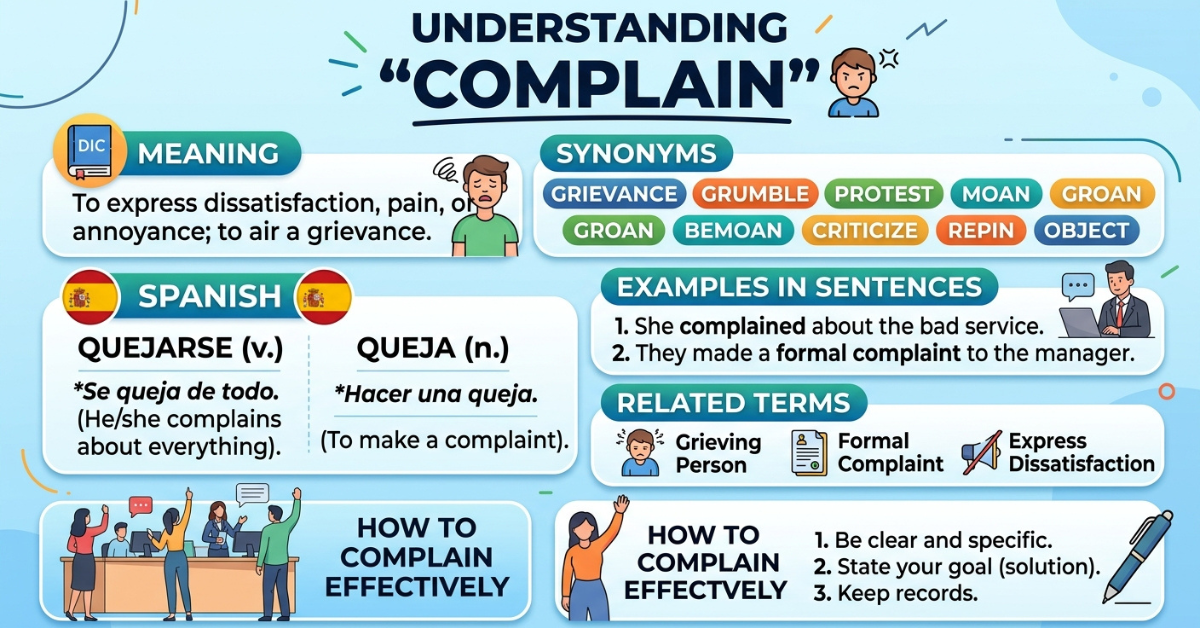
At its simplest, it means to express dissatisfaction, annoyance, pain, or unhappiness. You might complain about bad service, a loud neighbor, a headache, or a difficult schedule. In everyday English, the word is used when someone voices a problem rather than just silently feeling it.
A few natural examples:
- “She complained about the long wait.”
- “He complained that the room was too cold.”
- “They complained to the manager.”
Complain Synonym: Words That Carry a Similar Idea
The closest everyday synonym options depend on the tone you want. Merriam-Webster’s usage examples and crossword clue sources show that related words often include grumble, gripe, moan, whine, protest, object, and grumble-type expressions, though each has a slightly different flavor. Some sound informal and emotional, while others sound more formal or strong.
Here is the practical difference:
- grumble: quiet or low-level dissatisfaction
- gripe: casual annoyance
- moan / whine: more emotional or repetitive
- protest / object: firmer and more formal
- lament: sorrowful, often more literary
If you are writing naturally, choose the synonym that fits the mood. A friend “grumbles” about traffic; a resident “protests” a policy.
Complaint vs Complain: The Grammar Difference
This is one of the most common English mistakes. it is a verb; complaint is a noun. So you can say, “I want to complain,” or “I have a complaint,” but not “I have a complain.” Merriam-Webster lists complaint as the noun meaning an expression of grief, pain, resentment, or a reason for complaining.
A quick rule:
- complain = action
- complaint = thing, issue, or statement
Examples:
- Correct: “I will complain if the order is wrong.”
- Correct: “I filed a complaint.”
- Incorrect: “I filed a complain.”
Complain in Spanish
The most common Spanish translation is quejarse. Depending on context, it can also translate as reclamar or presentar una reclamación when the meaning is more formal. SpanishDict and Cambridge both give quejarse as the main everyday equivalent.
Useful examples:
- “I complain too much.” → Me quejo demasiado.
- “Stop complaining.” → Deja de quejarte.
- “You need to complain in writing.” → Tienes que presentar una reclamación por escrito.
Complain Crossword Clue: What Puzzles Usually Mean
In crossword puzzles, complain crossword clue answers often include short, punchy words such as moan, gripe, whine, gripe, grumble, or bellow-type variants depending on letter count and clue style. Crossword databases frequently list answers like MOAN, CARP, GRUMBLE, WHINE, GROUSE, and BEEF as common solutions.
That means the clue is usually testing your sense of tone as much as your vocabulary. If the clue is short, the answer is often short too. If it asks for a stronger or more colorful word, the answer may be something like grumble or bellyache.
“I Won’t Complain” and “I Can’t Complain”
The phrase is a common response meaning “I’m fine” or “things are going reasonably well.” Merriam-Webster defines it that way, and Dictionary.com similarly notes that it is used to answer questions like “How are you?” with the sense that nothing serious is wrong.
I won’t complain is slightly different in tone. It usually means the speaker is choosing not to express dissatisfaction, often because the issue is minor or because they want to stay positive. In everyday conversation, both phrases can sound calm, polite, and self-controlled.
“Never Complain, Never Explain”
The phrase is widely associated with British public life and royal-style reserve. A historical discussion of the phrase traces it to nineteenth-century political culture, with later association to the British royal family and the idea of keeping a stiff upper lip. The maxim is often used to describe a disciplined, private response to criticism.
In modern writing, the phrase is usually understood as a communication strategy: avoid unnecessary public defenses, and do not let every criticism pull you into a reaction. That does not mean silence is always best; it simply reflects a particular style of restraint.
Can Neighbors Complain About Noise During the Day?
Yes, neighbors can often complain about daytime noise, but the answer depends on local law. In the UK, councils can investigate complaints of statutory nuisance caused by noise at any time of day or night. In Toronto, noise bylaws include specific daytime and nighttime limits, showing that daytime noise can still be regulated. The Dutch government also notes that there are no statutory limits for neighbor noise in general, which is another reminder that rules vary by place.
The practical takeaway is simple: daytime does not automatically mean “free to make any noise.” If the sound is excessive, repeated, or disruptive, neighbors may still have grounds to complain under local nuisance rules, bylaw limits, or building regulations.
What usually matters
- how loud the sound is
- how long it lasts
- whether it is repetitive
- whether it affects sleep, work, or normal use of home
- what your local ordinance says
Key Takeaways
Complain is a verb that means to express dissatisfaction or make a formal grievance. Its noun form is complaint. In Spanish, the usual translation is quejarse, and in crossword puzzles, the clue may point to words like moan, gripe, or grumble. The phrase I can’t complain means things are fine, while never complain, never explain reflects a reserved public style.
FAQ
What is the definition of complain?
It means to express grief, pain, discontent, or dissatisfaction. In some older or formal usage, it can also mean to make a charge or accusation.
What is a good complain synonym?
Common choices include grumble, gripe, moan, whine, protest, and object. The best one depends on whether you want a casual, emotional, or formal tone.
How do you say complain in Spanish?
The most common translation is quejarse. In formal contexts, you may also see reclamar or presentar una reclamación.
What is the difference between complaint vs complain?
Complain is the verb; complaint is the noun. You complain about a problem, but you file or make a complaint.
Is “I can’t complain” rude?
Usually, no. It is a polite, informal way to say you are doing fine or that nothing major is wrong.
Can neighbors complain about noise during the day?
Yes. Many places allow noise complaints during daytime hours if the noise becomes a nuisance or breaks local rules, so the exact answer depends on your city or country.
Conclusion
The word is small, but its meaning stretches across grammar, everyday speech, translation, puzzles, etiquette, and even law. Once you understand its noun form, its synonyms, and its common phrases, the word becomes much easier to use with confidence. Apply the right version in the right context, and your writing will sound clearer, sharper, and more natural.