Have you ever typed “treck” and paused, wondering if it actually looks right? You’re not alone. It’s one of those words that feels like it could take a “c,” especially because English is full of tricky spellings like truck, trick, and track. But when it comes to treck or trek, only one spelling is standard in modern English.
If you’ve been unsure whether to write treck through the mountains or trek through the mountains, this guide clears it up. You’ll learn the correct spelling, what the word means, why people confuse it, how to use it in sentences, and whether “treck” is ever acceptable in any context.
Treck or Trek: Which One Is Correct?
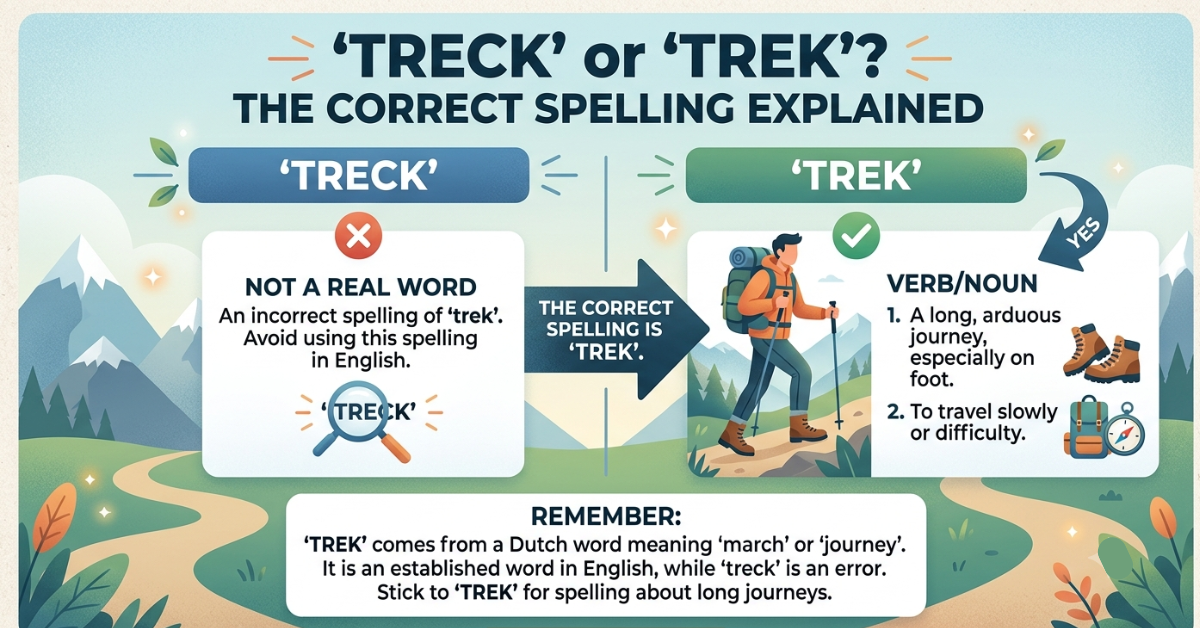
The correct English spelling is trek.
“Trek” is the standard word used in English as both a noun and a verb. It refers to a long, often difficult journey, especially one done on foot through rough terrain such as mountains, forests, or remote areas. Major dictionaries define trek this way and list forms such as trekking and trekked.
“Treck” is generally considered a misspelling in English when you mean a difficult journey or long hike. In most writing—whether it’s travel content, school work, blog posts, or social media—the correct form is trek.
Quick answer
- Correct: trek
- Incorrect in standard English: treck
- Example: We plan to trek across the valley at sunrise.
What Does “Trek” Mean?
The word trek can be used in two main ways:
1) Trek as a noun
A trek is a long, challenging journey.
Examples:
- The hike to the base camp was a trek of nearly eight hours.
- It took a long trek through the forest to reach the village.
- Carrying luggage across the city in the heat felt like a trek.
2) Trek as a verb
To trek means to travel slowly or with effort, often over a long distance.
Examples:
- We trekked through muddy trails all afternoon.
- Every winter, tourists trek into the mountains for snow views.
- The team trekked back to camp before sunset.
In modern usage, trek is common in discussions of hiking, travel, adventure tourism, backpacking, expeditions, and difficult journeys.
Why Do People Write “Treck” Instead of “Trek”?
The confusion around treck or trek usually comes down to how English spelling sounds rather than how it’s actually written.
Common reasons people type “treck”
1. The sound can be misleading
“Trek” has a short vowel sound, and many English words with a similar sound use -ck at the end. That makes treck feel plausible, even though it isn’t the standard spelling.
2. People are used to words like:
- back
- neck
- trick
- block
- truck
Because of that pattern, the brain sometimes expects treck instead of trek.
3. Typing habits and autocorrect confusion
People often spell by instinct, especially when writing quickly in captions, travel blogs, or messages. If they haven’t seen the word often in print, treck can slip in without them noticing.
Is “Treck” Ever a Real Word?
This is where things get a little more nuanced.
In standard English, if you’re talking about hiking, adventure travel, or a difficult journey, treck is not the correct spelling. You should use trek.
However, you may see Treck in other contexts:
1) As a surname or brand name
Some businesses, products, usernames, or family names may use Treck as a proper noun. In those cases, it’s not being used as the English word trek—it’s just part of a name.
2) In other languages
Some dictionary entries include Treck or related spellings in German-language contexts, where the word can refer to a column or movement of refugees or migrants. That doesn’t make treck the correct English spelling for “a long hike” or “difficult journey.”
So if your question is purely about English writing, the rule is simple:
Use trek, not treck.
Trek Meaning in Modern English
The word trek is used in both literal and figurative ways.
Literal use of trek
This is the most common meaning: a long walk or difficult journey, often outdoors.
Examples:
- a trek through the Himalayas
- a desert trek
- a jungle trek
- a mountain trekking route
- a three-day trek to the waterfall
Travel companies, hikers, and adventure writers use the word all the time when describing outdoor expeditions, backpacking routes, and physically demanding travel.
Figurative use of trek
People also use trek humorously or casually for any journey that feels long, tiring, or inconvenient.
Examples:
- It’s a real trek from the parking lot to the stadium.
- I had to trek across town for one document.
- Carrying groceries up five flights of stairs was a trek.
This figurative use is very common in everyday conversation.
Trek vs Hike vs Journey vs Expedition
If you’re writing about travel or movement, it helps to know how trek compares with similar words.
Hike
A hike usually refers to a walk for pleasure, exercise, or outdoor exploration. It can be short or long.
- Hike: often recreational
- Trek: usually longer, harder, and more demanding
Example:
A two-hour trail walk may be a hike.
A five-day mountain crossing is more likely a trek.
Journey
Journey is a broad word. It can describe almost any kind of travel—by foot, car, train, plane, or even metaphorically.
- Journey: general travel
- Trek: long, effortful travel, often on foot
Expedition
An expedition often suggests a planned trip with a purpose—scientific, exploratory, military, or adventurous.
- Expedition: organized mission or major adventure
- Trek: the act of making a long, difficult route, often on foot
Walk
A walk is the broadest and simplest term.
- Walk: any walking movement
- Trek: a long, tiring, or difficult walk
Trekked, Trekking, and Treks: Correct Word Forms
If you’re writing about trek or trek spelling, it helps to know the proper forms of the word.
Base form
- trek
Past tense
- trekked
Present participle / gerund
- trekking
Plural noun
- treks
Examples:
- Last year, we trekked through northern valleys.
- She loves trekking in cooler weather.
- Their favorite vacations are mountain treks.
Notice that while the base word is trek, the verb forms double the k:
- trek → trekked
- trek → trekking
That’s one reason some people mistakenly assume the base form should be treck. But it isn’t—the standard base form remains trek.
Treck or Trek in Sentences: Correct Examples
Here are side-by-side examples to make the difference crystal clear.
Incorrect
- We went on a treck through the mountains.
- They trecked for hours in the rain.
- The village is a long treck from here.
Correct
- We went on a trek through the mountains.
- They trekked for hours in the rain.
- The village is a long trek from here.
When to Use the Word “Trek”
Use trek when you want to describe:
1. A long hike or outdoor route
- a forest trek
- a mountain trek
- a desert trek
2. A physically demanding journey
- a difficult trek to the campsite
- a snowy trek across the pass
3. An informal long walk
- the office is a trek from the station
- getting to the venue was a trek
4. Travel writing and adventure content
If you write blogs, captions, itineraries, or destination guides, trek is the natural word for rugged, active travel.
Common Search Intent Behind “Treck or Trek”
When someone searches treck or trek, they usually want one of these answers:
- Which spelling is correct?
Answer: trek - Is treck a word?
In standard English for a long journey, no—use trek. - What does trek mean?
A long, difficult journey, often on foot. - How do you use trek in a sentence?
Example: We trekked across the hills before sunrise. - Why is trekking spelled with double k?
Because the inflected forms are trekking and trekked, even though the root word is trek.
Trek in Travel, Hiking, and Popular Culture
The word trek shows up often in travel and outdoor culture because it instantly suggests distance, effort, and adventure. You’ll see it in phrases such as:
- trekking boots
- guided trek
- high-altitude trek
- jungle trek
- winter trek
- trek route
- trek itinerary
It’s also familiar from pop culture because of the title Star Trek, though that’s a proper title rather than the hiking word itself. The shared idea is still movement or journey.
Practical Writing Tips: How to Remember the Correct Spelling
If you keep mixing up treck or trek, these quick tricks help.
Tip 1: Remember that the base word is short
Think:
- trek
- hike
- trip
- walk
All are simple base words. Trek follows that same pattern.
Tip 2: Link it to “trekking”
You’ve probably seen trekking more often than trek. Just remember:
- trek → trekking
- not treck → trecking
Tip 3: Read it in travel phrases
Try repeating:
- trek through the mountains
- jungle trek
- trekking trail
- long trek home
The more you see the correct form in context, the easier it sticks.
Treck or Trek: Quick Comparison Table
| Word | Correct in English? | Meaning | Example |
| trek | Yes | A long, difficult journey; to travel with effort | We went on a trek through the hills. |
| treck | No, not in standard English usage for this meaning | Usually a misspelling of trek | Incorrect: We went on a treck. |
Key Takeaways
If you only remember a few things about treck or trek, make them these:
- Trek is the correct spelling in English.
- It can be a noun or a verb.
- It usually refers to a long, difficult journey, often on foot.
- Treck is generally a misspelling when you mean hiking or a difficult journey.
- Correct forms include trek, trekked, trekking, and treks.
FAQs About Treck or Trek
Is it treck or trek?
It’s trek. In standard English, trek is the correct spelling for a long, difficult journey or the act of making one.
Is treck a real word?
Not in standard English for the meaning “long journey” or “hike.” In most cases, treck is just a misspelling of trek, though it may appear as a name or in non-English contexts.
How do you spell trekking?
The correct spelling is trekking with a double k. The base word is trek, and when it changes form, it becomes trekking and trekked.
What does trek mean?
Trek means a long, often difficult journey, especially one done on foot through hills, forests, mountains, or remote areas. It can also be used informally for any tiring trip.
Can I use trek for everyday situations?
Yes. While trek often refers to outdoor travel, it’s also used casually for any long or inconvenient trip, such as walking across a large campus or carrying bags across town.
Why do people confuse treck and trek?
Mostly because English contains many short words ending in -ck, so treck looks believable. But dictionary-standard English uses trek as the correct base spelling.
Conclusion
If you’ve been stuck on treck or trek, the answer is straightforward: trek is the correct spelling, and treck is almost always an error in English. Whether you’re writing about mountain travel, a difficult hike, or just a long walk that feels exhausting, trek is the word you want.
It’s a small spelling detail, but getting it right makes your writing look sharper and more credible—especially in travel blogs, essays, captions, and professional content. If you’re polishing your vocabulary or checking other commonly confused words, keep going; these small fixes add up fast.