
Have you ever paused while writing and wondered whether it should be naval vs navel? You are not alone. These two words look almost identical, sound close enough to confuse many writers, and yet they mean completely different things.
The good news is that once you understand the difference, you will rarely mix them up again. In this guide, you will learn what each word means, how to use it correctly, simple memory tricks, common mistakes, and real examples that make the difference easy to remember.
What Does “Naval” Mean?
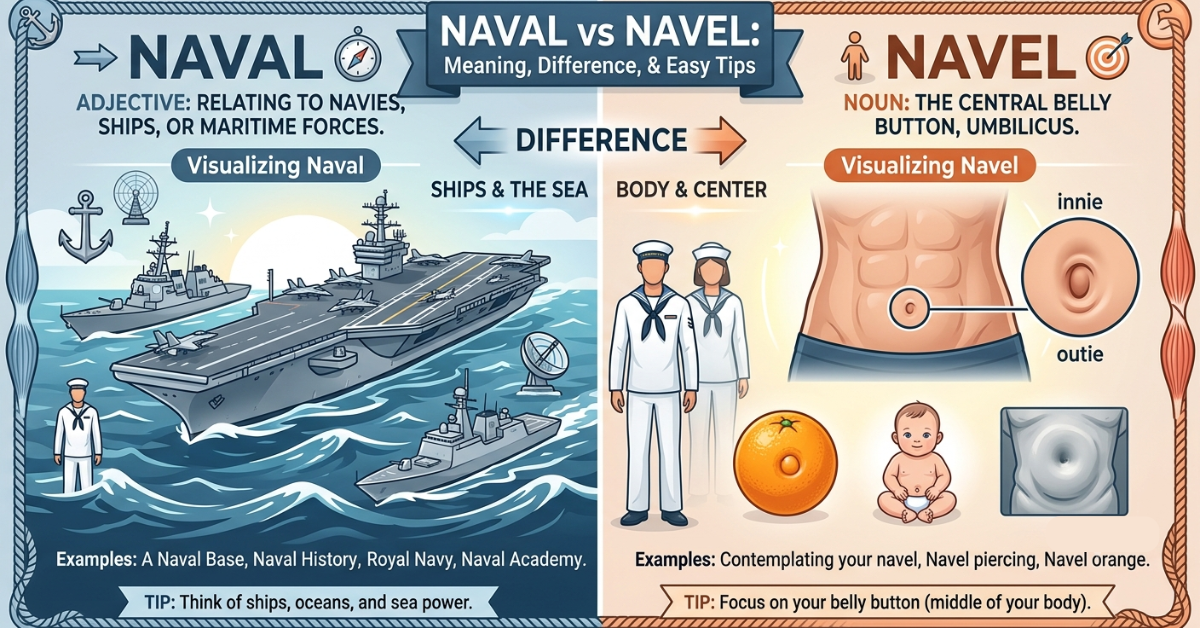
Naval is an adjective. It relates to the navy, ships, or anything connected to the sea and military forces.
Examples of “naval” in a sentence
- The country strengthened its naval defense system.
- She studied naval history at university.
- The ship entered a naval base for repairs.
When you see naval, think of the ocean, warships, fleets, officers, or maritime military matters.
What Does “Navel” Mean?
Navel is a noun. It refers to the belly button or the small scar in the center of the abdomen.
Examples of “navel” in a sentence
- The baby’s navel was carefully cleaned.
- She wore a dress that showed her navel.
- Some people have an outie navel, while others have an innie.
So, while naval has to do with the sea, navel has to do with the human body.
Naval vs Navel: The Easiest Way to Remember
A simple memory trick can save you from spelling errors:
- Naval → think navy
- Navel → think belly
Here is a quick way to remember it:
- Naval has a like army or admiral
- Navel has e like stomach center? Even easier: the e in belly button helps remind you it is the body-related word
Another trick is to say the sentence aloud:
- “A naval officer works at sea.”
- “A navel is on your stomach.”
The meaning will usually make the correct spelling obvious.
Why People Confuse Naval and Navel
The confusion happens because the words are nearly identical in spelling and pronunciation. In fast writing, typing, or proofreading, one letter can easily slip out of place.
That is why naval vs navel is such a common search phrase. People are often unsure which one fits a sentence, especially when they are writing essays, captions, reports, or professional content.
Naval vs Navel in Real Context
The best way to understand the difference is to see both words used side by side.
Correct uses of “naval”
- The naval forces arrived at dawn.
- He joined a naval academy after graduation.
- The museum displays old naval maps and equipment.
Correct uses of “navel”
- A piercing was placed above her navel.
- The doctor examined the newborn’s navel.
- She laughed when the baby touched its own navel.
If the sentence is about ships, military, or the sea, choose naval. If it is about the body, choose navel.
Common Mistakes to Avoid
Many people make spelling mistakes by using one word when they mean the other. Here are the most common errors:
- Writing navel when you mean naval in military or sea-related writing
- Writing naval when you mean navel in body-related writing
- Relying only on sound instead of checking meaning
- Forgetting that naval is an adjective, while navel is a noun
A quick proofreading habit can help:
- Ask yourself, “Is this about the sea or the body?”
- If it is about the sea, use naval.
- If it is about the body, use navel.
A Simple Comparison Table
| Word | Part of Speech | Meaning | Example |
| Naval | Adjective | Related to the navy or sea | Naval base |
| Navel | Noun | Belly button | Navel piercing |
This tiny comparison makes naval vs navel much easier to remember, especially when writing under pressure.
Practical Tip for Writers and Students
If you are writing an academic paper, article, or social media caption, always proofread words that sound similar. Spelling confusion is one of the fastest ways to make otherwise good writing look careless.
A useful habit is to read the sentence with meaning in mind:
- Does it talk about ships, fleets, or military strength? Use naval.
- Does it talk about the stomach or body? Use navel.
That one check will prevent most mistakes.
Key Takeaways
- Naval means related to the navy or sea.
- Navel means belly button.
- The words sound similar, but their meanings are completely different.
- The easiest memory trick is: naval = navy and navel = belly.
- Context is the best way to choose the right word.
FAQs About Naval vs Navel
1. Is “naval” related to the ocean?
Yes. Naval refers to the navy, ships, and sea-related military matters. It is commonly used in phrases like naval base or naval officer.
2. What does “navel” mean in simple words?
Navel means your belly button. It is the small center mark on the abdomen where the umbilical cord was attached before birth.
3. How can I remember naval vs navel?
Think of naval as connected to the navy and navel as connected to the body. That quick association usually makes the correct spelling easy.
4. Is it correct to say “naval piercing”?
No, that is incorrect. A piercing near the belly button is called a navel piercing, not a naval piercing.
5. Can “naval” be used as a noun?
No, naval is generally an adjective. It describes something related to the navy, such as a naval fleet or naval operation.
6. Why do people search for naval vs navel so often?
Because the words are nearly identical in spelling and pronunciation, people often confuse them while writing. The difference becomes easy once you remember their meanings.
Conclusion
The difference between naval vs navel is simple once you break it down: one belongs to the sea and military world, and the other belongs to the human body. A single letter changes the meaning completely, so context is everything.
Keep the memory trick in mind, check your sentence before publishing, and you will avoid one of the most common spelling mix-ups in English. Clear writing starts with small details like this, and getting them right makes your message stronger and more professional.