Have you ever read a sentence and paused for a second because muscle and mussel sounded exactly the same in your head? You’re not alone. These two English words are classic troublemakers because they’re pronounced alike but mean completely different things.
In Muscle vs Mussel, the confusion usually comes down to one thing: they are homophones—words that sound the same but have different spellings and meanings. One belongs to the world of anatomy, fitness, and physical strength. The other belongs to seafood menus, marine biology, and shellfish. In this guide, you’ll learn exactly what each word means, how to use it correctly, why people mix them up, and a few easy tricks to remember the difference for good.
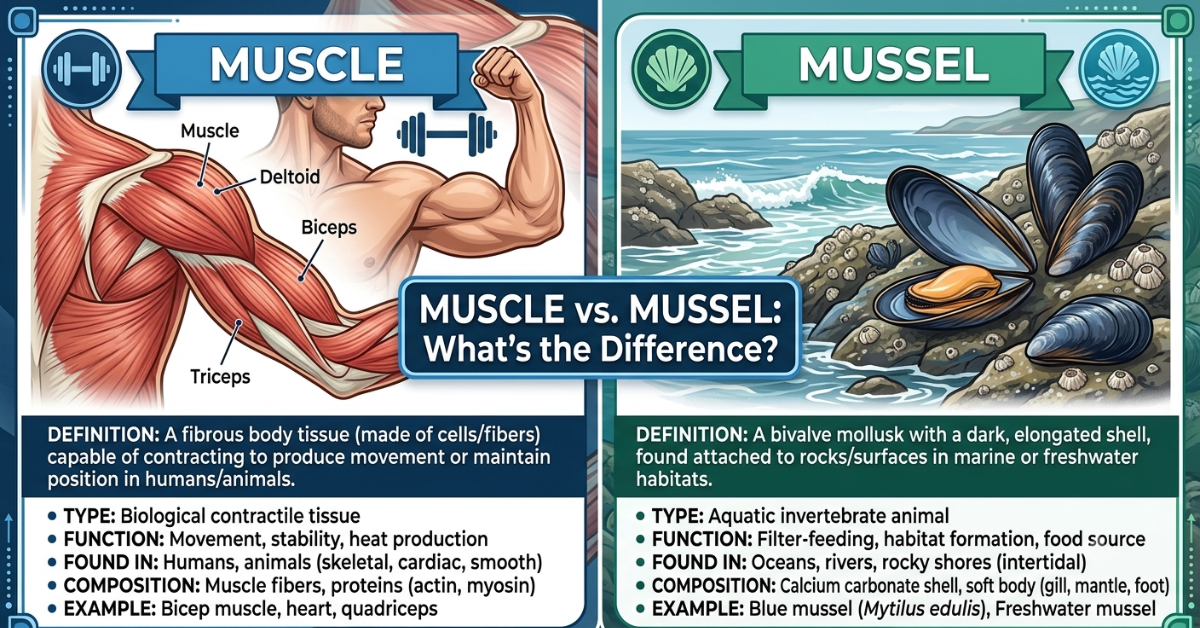
Muscle vs Mussel at a Glance
If you want the short answer first, here it is:
- Muscle = tissue in the body that helps movement, strength, and physical function
- Mussel = a type of edible shellfish with a dark shell, found in fresh or salt water
- They are pronounced the same in standard English: /ˈmʌsəl/
- They are not interchangeable
Quick comparison table
| Word | Meaning | Category | Example |
| Muscle | A body tissue used for movement and strength | Anatomy / fitness / figurative power | She pulled a muscle while lifting weights. |
| Mussel | A small shellfish with two hinged shells | Seafood / marine life | We ordered garlic butter mussels for dinner. |
What Does “Muscle” Mean?
The word muscle usually refers to the soft tissue in humans and animals that contracts to create movement. Muscles are essential for almost everything your body does—walking, smiling, breathing, lifting, and even pumping blood.
Muscle definition
A muscle is a body tissue made of fibers that contract and relax to produce movement or maintain posture.
Common uses of “muscle”
You’ll see muscle used in a few different ways:
1. Physical body tissue
This is the most common meaning.
Examples:
- I strained a muscle in my shoulder at the gym.
- Regular stretching helps keep your muscles flexible.
- The heart is also made of muscle tissue.
2. Strength or power
“Muscle” can also mean physical strength or force.
Examples:
- That team has the muscle to dominate the match.
- He used pure muscle to move the heavy sofa.
3. Influence or force in a figurative sense
Sometimes the word refers to power, authority, or pressure.
Examples:
- The company used its financial muscle to expand quickly.
- The government showed political muscle during the negotiations.
4. As a verb: “to muscle”
As a verb, it means to force your way in or push with strength.
Examples:
- They tried to muscle their way into the market.
- He muscled the door open.
What Does “Mussel” Mean?
A mussel is a shellfish—a type of bivalve mollusk that lives in water and has a two-part shell. Mussels are common in cooking and are also important in aquatic ecosystems.
Mussel definition
A mussel is a small aquatic shellfish with a dark shell, often eaten as seafood.
Where mussels are found
Mussels can live in:
- Saltwater environments such as oceans and coastal areas
- Freshwater rivers, lakes, and streams
They typically attach themselves to rocks, ropes, docks, or other surfaces.
Common uses of “mussel”
Unlike muscle, mussel is almost always used literally.
Examples:
- We had steamed mussels in white sauce.
- The chef served mussels with garlic bread.
- Freshwater mussels help filter water in river ecosystems.
Why Do People Confuse Muscle and Mussel?
The main reason is simple: they sound the same.
They are homophones
Muscle and mussel are pronounced alike in standard English, which makes them homophones. When words sound identical but have different spellings and meanings, mix-ups become very common—especially in writing.
They also look similar
At a quick glance, the words differ by only one letter:
- muscle
- mussel
That visual similarity makes typing mistakes even easier, especially if you’re writing fast or relying on autocorrect.
The confusion often happens in:
- school writing
- social media captions
- emails and texts
- English learning exercises
- food-related content written by non-native speakers
- fitness content with spelling mistakes
Muscle vs Mussel: The Core Difference
The easiest way to separate them is to think about context.
Use muscle when talking about:
- the human body
- anatomy
- exercise and fitness
- strength and power
- physical force
- influence used figuratively
Use mussel when talking about:
- seafood
- shellfish
- marine animals
- river or ocean ecosystems
- cooking or restaurant dishes
Side-by-side examples
Correct:
- I built leg muscle after months of training.
- We ate grilled mussels by the beach.
Incorrect:
- I built leg mussel after months of training.
- We ate grilled muscles by the beach.
The first incorrect sentence accidentally turns a fitness sentence into a seafood error. The second makes dinner sound like anatomy class.
Pronunciation: Do Muscle and Mussel Sound the Same?
Yes—in standard modern English, “muscle” and “mussel” are typically pronounced the same: /ˈmʌsəl/. That’s exactly why they’re considered homophones.
Pronunciation breakdown
Both are usually said like:
MUH-suhl
That means you generally can’t rely on pronunciation to tell them apart. You have to use meaning and context instead.
How to Remember Muscle vs Mussel
If you tend to mix these words up, memory tricks can help a lot.
Easy memory trick #1: Muscle has “cle” like “curl” and “exercise”
Think of muscle as the word connected to:
- gym
- body
- strength
- workouts
If the sentence is about movement, fitness, pain, strength, or anatomy, you almost certainly want muscle.
Easy memory trick #2: Mussel has “ss” like “sea shell”
This one isn’t perfect linguistically, but it works as a mental shortcut:
- mussel = shellfish
- picture a seafood dish or shells in the sea
If the sentence belongs on a restaurant menu or in an ocean documentary, use mussel.
Easy memory trick #3: Ask yourself one question
Before writing the word, ask:
Am I talking about a body part or a shellfish?
- Body part = muscle
- Shellfish = mussel
That one question solves the problem most of the time.
Examples of Muscle in Sentences
Here are more natural examples of muscle in context:
- She felt a sharp pain in her calf muscle after running.
- Building muscle takes time, protein, and resistance training.
- The surgeon examined the damaged muscle tissue.
- He relied on upper-body muscle to climb the wall.
- The brand used its marketing muscle to dominate the launch.
- She has more mental discipline than physical muscle, but both matter.
Common phrases with “muscle”
You may also see expressions like:
- muscle pain
- muscle strain
- muscle mass
- muscle recovery
- muscle memory
- muscle car
- flex your muscles
- use your muscle
Examples of Mussel in Sentences
Now let’s look at mussel in real-world usage:
- The restaurant is known for its creamy garlic mussels.
- We found mussels attached to the rocks near the shore.
- Freshwater mussels play an important role in water filtration.
- The chef cleaned the mussels before steaming them.
- She ordered mussels with lemon, herbs, and butter sauce.
- Some species of mussel are studied for their role in aquatic ecosystems.
Common phrases with “mussel”
Typical word pairings include:
- steamed mussels
- blue mussels
- freshwater mussels
- mussel shells
- mussel broth
- mussel dish
- mussel farming
Grammar and Usage: Is It Ever Okay to Swap Them?
No. In normal English usage, muscle and mussel are completely different words and should never be swapped.
Even though they share pronunciation, their meanings belong to entirely different semantic fields:
- muscle = anatomy, strength, force
- mussel = shellfish, food, aquatic life
This is one of those spelling choices where context matters more than sound.
Etymology: Are Muscle and Mussel Related?
Interestingly, yes—they are historically connected.
Both words trace back to Latin roots, and over time they developed into separate English words with different meanings. That’s part of why they look and sound so similar today. In fact, historical dictionaries trace both words to forms related to the Latin musculus, which was associated with both muscle and mussel in earlier language development.
This doesn’t affect modern usage, but it does explain why the pair feels oddly close despite referring to such different things.
Muscle vs Mussel in Everyday Writing
Here’s where writers, students, bloggers, and English learners most often get tripped up.
In fitness content
If you’re writing about:
- gym routines
- soreness
- bodybuilding
- physical therapy
- anatomy
- sports performance
the correct word is almost always muscle.
Correct:
- How to gain lean muscle
- Best foods for muscle recovery
- Signs of a pulled muscle
In food and restaurant content
If you’re writing about:
- seafood recipes
- shellfish dishes
- coastal cuisine
- marine food ingredients
the correct word is mussel.
Correct:
- Creamy garlic mussels
- Are mussels healthy to eat?
- How to clean mussels before cooking
In academic or environmental writing
If the topic is biology or ecosystems, you’ll need context:
- human/animal anatomy = muscle
- aquatic mollusks = mussel
Common Mistakes to Avoid
1. Using “mussel” in health or gym writing
Wrong: Protein helps repair damaged mussels.
Right: Protein helps repair damaged muscles.
2. Using “muscle” on a menu or recipe
Wrong: The chef prepared spicy tomato muscles.
Right: The chef prepared spicy tomato mussels.
3. Assuming spelling doesn’t matter because they sound the same
In speech, people may not notice. In writing, they absolutely will.
4. Relying only on autocorrect
Spellcheck won’t always catch homophone errors because both words are real and correctly spelled on their own.
Practical Tip: How to Proofread for Muscle vs Mussel
If you’re editing your own writing, use this quick 3-step check:
Step 1: Find the sentence topic
Ask what the sentence is about:
- body or strength?
- food or shellfish?
Step 2: Replace the word mentally
If you swap in a short phrase, the right answer becomes obvious:
- muscle = body tissue / strength
- mussel = shellfish / seafood
Step 3: Look at nearby words
Context clues make the answer easy.
Clues for “muscle”
- gym
- body
- pain
- workout
- tissue
- strength
- exercise
- injury
Clues for “mussel”
- shell
- seafood
- steamed
- ocean
- river
- recipe
- garlic butter
- shellfish
Muscle vs Mussel: Quick Summary
If you only remember one thing, make it this:
- Muscle belongs to the body
- Mussel belongs to the seafood world
They may sound identical, but their meanings are far apart. One helps you run, lift, breathe, and move. The other might show up in a bowl of white wine broth with crusty bread.
Key Takeaways
- Muscle and mussel are homophones: they sound the same but mean different things.
- Muscle refers to body tissue, strength, or force.
- Mussel refers to a shellfish, often eaten as seafood.
- The easiest way to choose the right word is to check the context.
- If the sentence is about anatomy, fitness, or strength, use muscle.
- If the sentence is about shellfish, cooking, or marine life, use mussel.
FAQs About Muscle vs Mussel
1. What is the difference between muscle and mussel?
The difference is meaning. Muscle refers to body tissue or strength, while mussel refers to a type of shellfish. They sound the same but are used in completely different contexts.
2. Are muscle and mussel pronounced the same?
Yes, in standard English they are generally pronounced the same way, which makes them homophones. That’s why the spelling mix-up is so common.
3. Is mussel a fish or a shellfish?
A mussel is a shellfish, not a fish. It is a type of bivalve mollusk that lives in fresh or salt water.
4. Can muscle be used as a verb?
Yes. Muscle can be used as a verb, as in “to muscle in” or “to muscle through,” meaning to force your way using strength, pressure, or influence.
5. How do I remember Muscle vs Mussel easily?
Use a context rule: if it relates to the body, strength, or exercise, choose muscle. If it relates to seafood, shells, or ocean life, choose mussel.
6. Why do people confuse muscle and mussel so often?
They’re confused because they are pronounced the same and look very similar in spelling. In fast writing, especially without context, it’s easy to choose the wrong one.
Conclusion
The Muscle vs Mussel confusion is a perfect example of how English can be simple and tricky at the same time. These words sound the same, but they live in completely different worlds: muscle belongs to anatomy, movement, and strength, while mussel belongs to shellfish, seafood, and aquatic life.
Once you tie each word to its context, the distinction becomes much easier to remember. So the next time you write about gym recovery, body tissue, or strength, go with muscle. And if you’re talking about seafood, shells, or a coastal dinner plate, it’s definitely mussel. Keep this distinction in mind, and you’ll avoid one of the most common homophone mix-ups in English.