Have you ever come across the confusion of Acceptions vs Exceptions and wondered which one is actually correct? You’re not alone—many English learners and even native speakers mix these two up because they look similar but mean completely different things.
In reality, Acceptions vs Exceptions is a comparison between a rarely used or mistaken form (“acceptions”) and a very common English word (“exceptions”). Understanding the difference can help you avoid spelling mistakes and improve your grammar accuracy in writing and communication.
Let’s break it down in a simple, human-friendly way.
What Does “Acceptions” Mean?
The word “acceptions” is not commonly used in modern English. In fact, it is often considered a mistaken or outdated form.
However, it is sometimes confused with the word “acceptation,” which refers to the meaning or interpretation of a word in a specific context.
In everyday usage:
- “Acceptions” is rarely correct in modern writing
- It is often used incorrectly instead of “acceptances” or “acceptation”
- Most style guides do not recommend using it
So, when people search for Acceptions vs Exceptions, they are usually trying to understand why “acceptions” doesn’t seem right.
What Does “Exceptions” Mean?
The word “exceptions” is widely used in English and has a very clear meaning. It refers to something that does not follow a rule or pattern.
For example:
- “Everyone passed the exam, with two exceptions.”
- “There are always exceptions to every rule.”
Common uses of “exceptions” include:
- Rules and regulations
- Grammar explanations
- Legal or official statements
- Everyday conversations
Unlike “acceptions,” this word is standard and essential in English vocabulary.
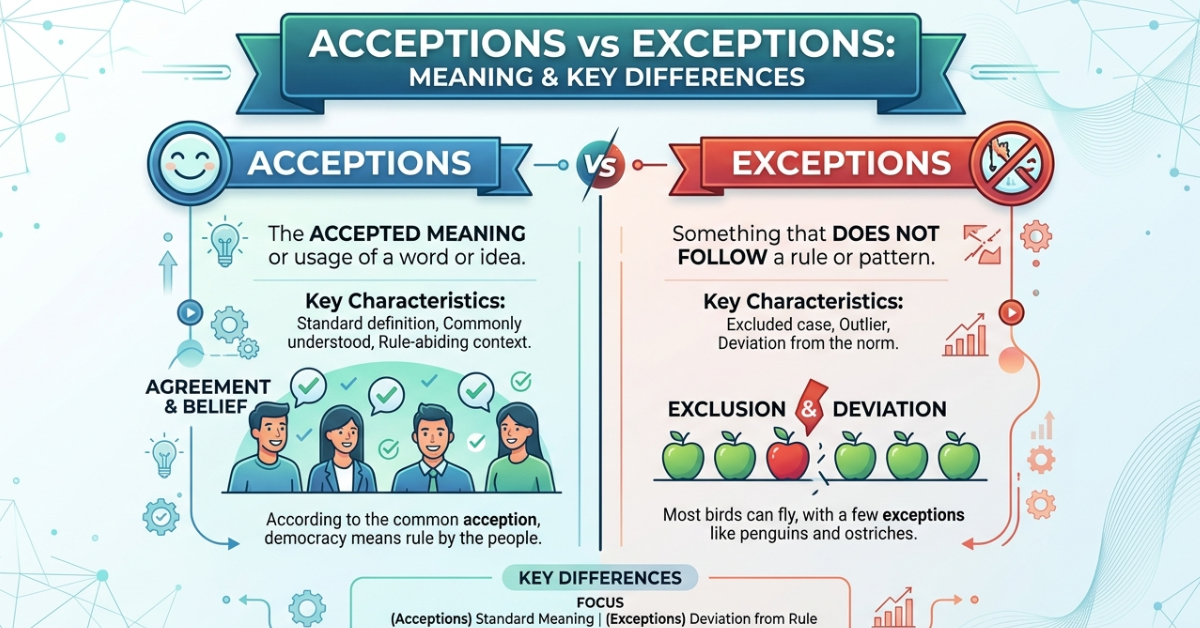
Acceptions vs Exceptions: Key Differences
Understanding Acceptions vs Exceptions becomes easy when you compare them side by side:
- Meaning:
- Acceptions: Rare, outdated, or incorrect usage
- Exceptions: Something that breaks a rule
- Usage:
- Acceptions: Not commonly used in modern English
- Exceptions: Frequently used in writing and speech
- Correctness:
- Acceptions: Often considered incorrect in standard English
- Exceptions: Fully correct and widely accepted
- Context:
- Acceptions: Mostly seen in confusion or misspellings
- Exceptions: Used in grammar, law, and everyday language
This comparison clears up the confusion behind Acceptions vs Exceptions in a simple way.
Common Mistakes People Make
Many learners confuse because of similar spelling patterns. Here are a few common mistakes:
- Using “acceptions” when they mean “exceptions”
- Assuming both words are interchangeable
- Misreading “acceptation” as “acceptions”
- Relying on sound instead of spelling accuracy
A simple trick is to remember: if it breaks a rule, it’s an exception.
Examples in Sentences
Let’s see how “exceptions” is used correctly in real sentences:
- “All students must attend class without exceptions.”
- “There are a few exceptions to this grammar rule.”
- “The policy allows no exceptions.”
For Acceptions vs Exceptions, remember that only “exceptions” works in these contexts.
How to Remember the Difference Easily
Here are a few quick memory tips:
- Ex = Exit the rule → Exceptions break rules
- Think of “exceptional” → something unusual
- Ignore “acceptions” in modern writing unless referring to rare historical usage
- Practice reading correct sentences regularly
These small tricks will help you never confuse Acceptions vs Exceptions again.
FAQs
1. Is “acceptions” a correct English word?
Not in modern standard English. It is mostly considered incorrect or outdated.
2. What is the correct word: Acceptions vs Exceptions?
“Exceptions” is the correct and widely accepted word.
3. Why do people confuse Acceptions vs Exceptions?
Because both words look similar and share a common spelling pattern.
4. Can “acceptions” ever be used in writing?
Only in very rare historical or linguistic contexts, but it is not recommended in modern usage.
5. What does “exceptions” mean in simple terms?
It means something that does not follow a rule or standard pattern.
Conclusion
To sum it up, the confusion between Acceptions vs Exceptions comes from spelling similarity, but their meanings are completely different. “Exceptions” is the correct, widely used word, while “acceptions” is mostly outdated or incorrect in modern English.
If you want to improve your grammar and writing skills, focusing on commonly used and standard terms like “exceptions” will always help. Keep practicing, and soon these differences will become second nature.