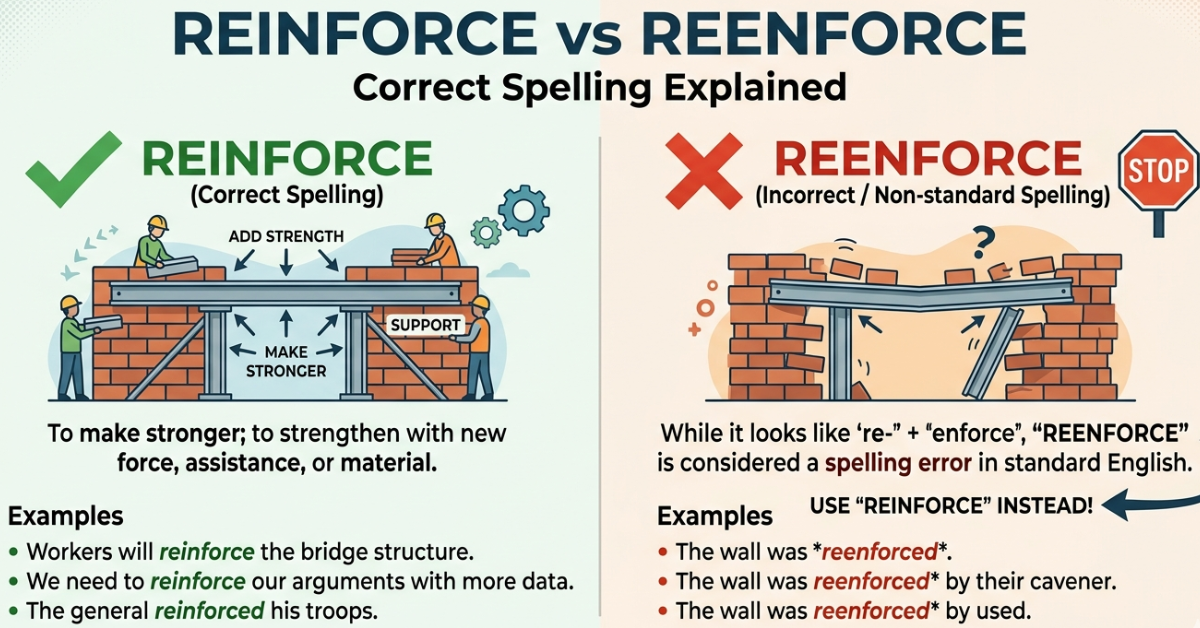
The confusion between reinforce vs reenforce is more common than you might think, especially for English learners and even native speakers. At first glance, both words look similar, but only one is widely accepted in modern English.
In this guide, we’ll break down the correct spelling, meaning, usage, and real-life examples so you never mix them up again. By the end, you’ll clearly understand why one form dominates and the other is rarely used today.
Let’s clear the confusion once and for all.
Reinforce vs Reenforce: What’s the Correct Spelling?
The correct and standard spelling in modern English is reinforce.
The alternative form, reenforce, does exist historically, but it is considered outdated and rarely used in contemporary writing.
So when you come across reinforce vs reenforce, remember:
- Reinforce → Correct, modern, widely accepted
- Reenforce → Old variant, mostly obsolete
The key takeaway is simple: always use reinforce in academic writing, professional communication, and everyday English.
What Does “Reinforce” Mean?
To understand the spelling debate better, let’s first understand the meaning of reinforce.
The word means to strengthen, support, or make something more effective.
Common meanings include:
- Strengthening physical structures (e.g., buildings, materials)
- Supporting ideas or beliefs
- Increasing effectiveness of behavior or habits
- Providing additional help or backup
Examples:
- The teacher used repetition to reinforce the lesson.
- Steel bars are used to reinforce concrete.
- Positive feedback can reinforce good behavior.
Once you understand the meaning, it becomes easier to see why reinforce vs reenforce is not really a true competition in modern usage.
Why Do People Still Search “Reenforce”?
A big reason for confusion is pronunciation. When spoken quickly, “reinforce” can sound like it has a double “e,” which leads some people to assume reenforce is correct.
However, linguistically:
- The prefix “re-” means “again” or “back”
- It combines with “enforce,” forming reinforce
So the correct structure is re + enforce → reinforce
The spelling reenforce is simply a historical variation that didn’t survive standardization.
Reinforce vs Reenforce in Modern English Usage
Today, if you compare reinforce vs reenforce in formal English usage, you’ll notice a clear pattern:
1. Academic Writing
Only reinforce is accepted in essays, research papers, and exams.
2. Professional Communication
Emails, reports, and business documents always use reinforce.
3. Digital Content & SEO
Search engines and dictionaries recognize only reinforce as standard.
4. Informal Usage
Even in casual writing, reenforce is rarely seen and may be considered incorrect.
In short, using reenforce today may look like a spelling error rather than a variation.
Common Mistakes People Make
Many learners get stuck in the reinforce vs reenforce confusion because of similar-sounding words and spelling patterns.
Here are some common mistakes:
1. Doubling the “e” unnecessarily
People assume “re-” should be repeated, forming reenforce.
2. Mixing with pronunciation
The spoken emphasis leads to incorrect spelling guesses.
3. Overgeneralizing prefixes
Not all “re-” words follow a doubled vowel pattern.
Easy Way to Remember the Correct Spelling
If you struggle with reinforce vs reenforce, use this simple trick:
Think of “enforce” inside the word
Add “re-” in front → reinforce
You are basically “enforcing again” or “strengthening again.”
This mental breakdown helps lock in the correct spelling naturally.
Real-Life Examples of “Reinforce”
Here are more practical examples to help you master usage:
- The coach used drills to reinforce teamwork.
- Schools often use revision tests to reinforce learning.
- Governments build laws to reinforce public safety.
- Designers use steel frames to reinforce structures.
These examples show how flexible and widely used the word is in real communication.
FAQs About Reinforce vs Reenforce
1. Is “reenforce” a correct English word?
No, reenforce is considered an outdated spelling and is not used in modern English.
2. Why do people write “reenforce” instead of “reinforce”?
It usually comes from pronunciation confusion and incorrect assumptions about the prefix “re-”.
3. Which word should I use in exams or formal writing?
Always use reinforce. It is the standard and accepted spelling worldwide.
4. Does “reinforce” have different meanings?
Yes, it can mean strengthening physical objects, ideas, behavior, or support systems.
5. Is there any situation where “reenforce” is acceptable?
In modern usage, no. It may appear in historical texts, but it is not recommended today.
Conclusion
The debate between reinforce vs reenforce is actually very simple once you understand the rule: only reinforce is correct in modern English. The other form is just an outdated variation that has faded from standard usage.
Whether you’re writing an essay, sending an email, or creating content, sticking with the correct spelling will always make your English look more polished and professional.
If you want to improve your grammar further, exploring similar commonly confused words can help you write with even more confidence and clarity.