Have you ever read a sentence and wondered whether it should say pear or pare? You’re not alone. These two words sound exactly alike but have completely different meanings, making them a classic example of English homophones.
Understanding Pear vs Pare is easier than it seems. Once you know what each word means and how it’s used in everyday language, you’ll never confuse them again. In this guide, you’ll learn clear definitions, practical examples, grammar tips, memory tricks, and common mistakes to avoid.
What Does “Pear” Mean?
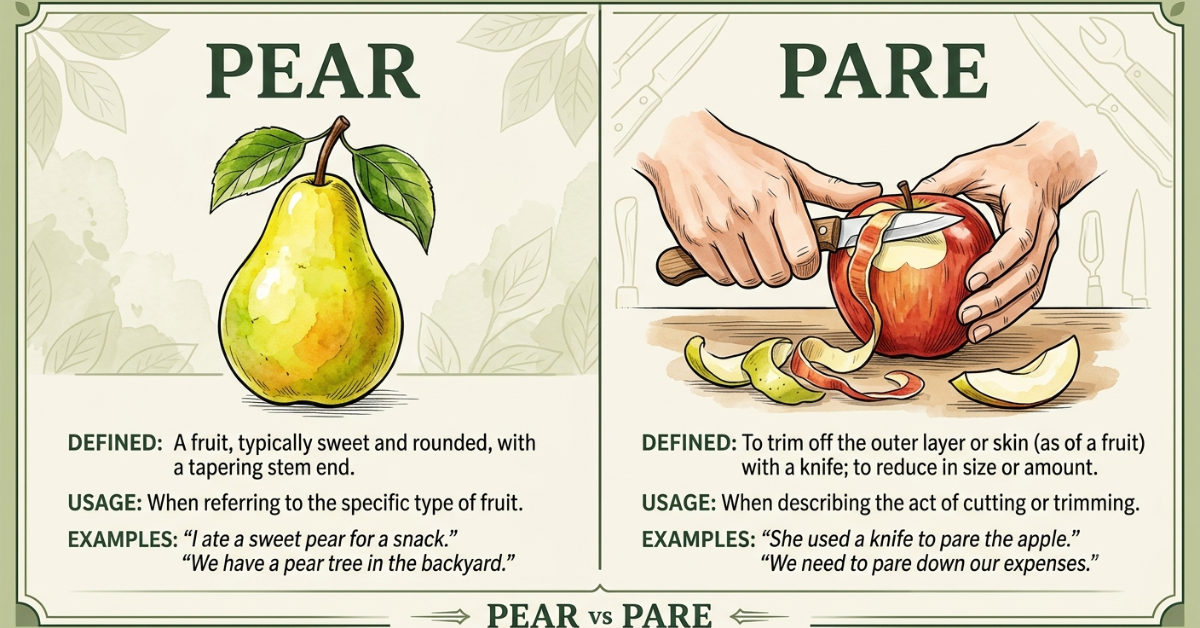
A pear is a sweet, edible fruit that typically has a rounded bottom and a narrower top. Pears belong to the rose family and are grown in many parts of the world.
Examples of “Pear”
- She packed a pear in her lunch.
- The recipe calls for two ripe pears.
- We picked fresh pears from the tree.
Common Uses
You’ll usually see pear in contexts involving:
- Food
- Fruit trees
- Recipes
- Nutrition
- Agriculture
What Does “Pare” Mean?
The verb pare means to trim, cut away, peel, or reduce something gradually. It often refers to removing the outer layer of fruits or vegetables, but it can also describe reducing costs, budgets, or unnecessary items.
Examples of “Pare”
- Please pare the apples before baking the pie.
- The company decided to pare its expenses.
- She carefully pared the excess wood.
Common Uses
The word pare commonly appears when talking about:
- Peeling fruits or vegetables
- Trimming materials
- Reducing budgets
- Cutting unnecessary features
- Simplifying something
Pear vs Pare: The Key Difference
The easiest way to remember the distinction is this:
| Word | Part of Speech | Meaning | Example |
| Pear | Noun | A fruit | I ate a juicy pear. |
| Pare | Verb | To trim, peel, or reduce | Pare the potatoes before cooking. |
In simple terms:
- Pear = something you can eat.
- Pare = something you do.
Why Do People Confuse Pear and Pare?
These words are homophones, meaning they share the same pronunciation but differ in spelling and meaning.
Because English relies heavily on context, it’s easy to accidentally choose the wrong spelling when writing.
For example:
Incorrect: She decided to pear the carrots.
Correct: She decided to pare the carrots.
Likewise:
Incorrect: I bought a ripe pare.
Correct: I bought a ripe pear.
Pear vs Pare in Everyday Sentences
Here are more examples showing each word in context.
Using “Pear”
- A pear contains plenty of dietary fiber.
- The fruit basket included apples, oranges, and pears.
- He sliced the pear into thin pieces.
Using “Pare”
- Pare away the rough edges.
- The editor pared the article to improve clarity.
- We need to pare the project budget before approval.
Pear vs Pare: Side-by-Side Comparison
| Feature | Pear | Pare |
| Meaning | A fruit | To trim or peel |
| Part of Speech | Noun | Verb |
| Used For | Food and plants | Cutting or reducing |
| Example | Eat a pear | Pare a potato |
Common Mistakes to Avoid
Many writers accidentally substitute one word for the other because they sound identical.
Incorrect
- I need to pear the potatoes.
- She bought a fresh pare.
Correct
- I need to pare the potatoes.
- She bought a fresh pear.
Remember to ask yourself:
- Is it an object? → Use pear.
- Is it an action? → Use pare.
Memory Tricks for Remembering the Difference
Simple memory devices can make these words much easier to remember.
Pear
Think of the letter A in pear as standing for Apple-like fruit.
Or simply remember:
Pear = Produce.
Pare
Think of pare as paring knife or paring away.
If you’re removing, trimming, peeling, or reducing something, the correct word is pare.
Pear vs Pair vs Pare
Many learners also confuse pair with these words.
| Word | Meaning |
| Pear | A fruit |
| Pare | To trim or peel |
| Pair | Two matching things |
Examples
- I ate a pear.
- Please pare the carrot.
- I bought a pair of shoes.
Although all three words sound the same, their meanings are completely unrelated.
When to Use Pear
Use pear whenever you’re referring to:
- The fruit itself
- Pear trees
- Pear-shaped objects
- Recipes involving pears
- Nutrition discussions
Example:
“The salad contains walnuts, cheese, and sliced pear.”
When to Use Pare
Use pare whenever you’re describing an action involving:
- Peeling
- Trimming
- Cutting away
- Simplifying
- Reducing
Example:
“The manager decided to pare unnecessary expenses.”
Practical Tips for Never Mixing Them Up
Keep these simple rules in mind:
- Pear is always a noun.
- Pare is always a verb.
- If you can eat it, it’s a pear.
- If you’re cutting or reducing something, it’s pare.
- Check whether the sentence needs an object or an action.
Why Correct Usage Matters
Choosing the correct word improves:
- Writing clarity
- Professional communication
- Academic assignments
- Business emails
- SEO content
- Grammar accuracy
Small spelling differences can completely change a sentence’s meaning, so using the correct homophone makes your writing more polished and credible.
Key Takeaways
- Pear is a fruit.
- Pare means to trim, peel, or reduce.
- They sound identical but have different meanings and spellings.
- Pear functions as a noun.
- Pare functions as a verb.
- Context determines which word is correct.
Frequently Asked Questions
Is pear or pare used for peeling vegetables?
Use pare. The verb pare means to peel or trim vegetables, fruits, or other materials.
Is pear a noun or a verb?
Pear is always a noun. It refers to the edible fruit or, in some cases, something shaped like that fruit.
What does pare mean in writing?
In writing, pare often means to reduce or remove unnecessary words to make text clearer and more concise.
Why are pear and pare confusing?
They are homophones, meaning they have the same pronunciation but different spellings and meanings. This makes them easy to confuse when writing.
What’s the easiest way to remember Pear vs Pare?
Remember:
- Pear = Fruit
- Pare = Peel or Reduce
If it’s something you eat, choose pear. If it’s something you do, choose pare.
Can pare mean reduce?
Yes. Besides peeling, pare commonly means to reduce gradually, such as paring expenses, budgets, or unnecessary details.
Conclusion
Understanding Pear vs Pare comes down to recognizing one simple distinction: pear is the fruit, while pare is the action of trimming, peeling, or reducing something. Although they sound identical, their meanings and grammatical roles are entirely different.
The next time you encounter these homophones, pause for a moment and consider the context. With the examples and memory tricks in this guide, you’ll be able to choose the correct word confidently and improve the accuracy of your writing. Keep practicing with real-world sentences, and these commonly confused words will soon become second nature.