Born vs Borne: Meaning, Difference & Usage Guide

If you’ve ever paused mid-sentence wondering “is it born or borne?”, you’re definitely not alone. The confusion around born vs borne is extremely common in English grammar because both words come from the same root but are used in very different situations. In this guide, we’ll break down born vs borne in the simplest way possible so you never mix them up again.
Understanding born vs borne is all about knowing context—whether you’re talking about life and birth, or carrying something (literally or figuratively). Let’s clear it up step by step.
Born vs Borne: Key Difference Explained
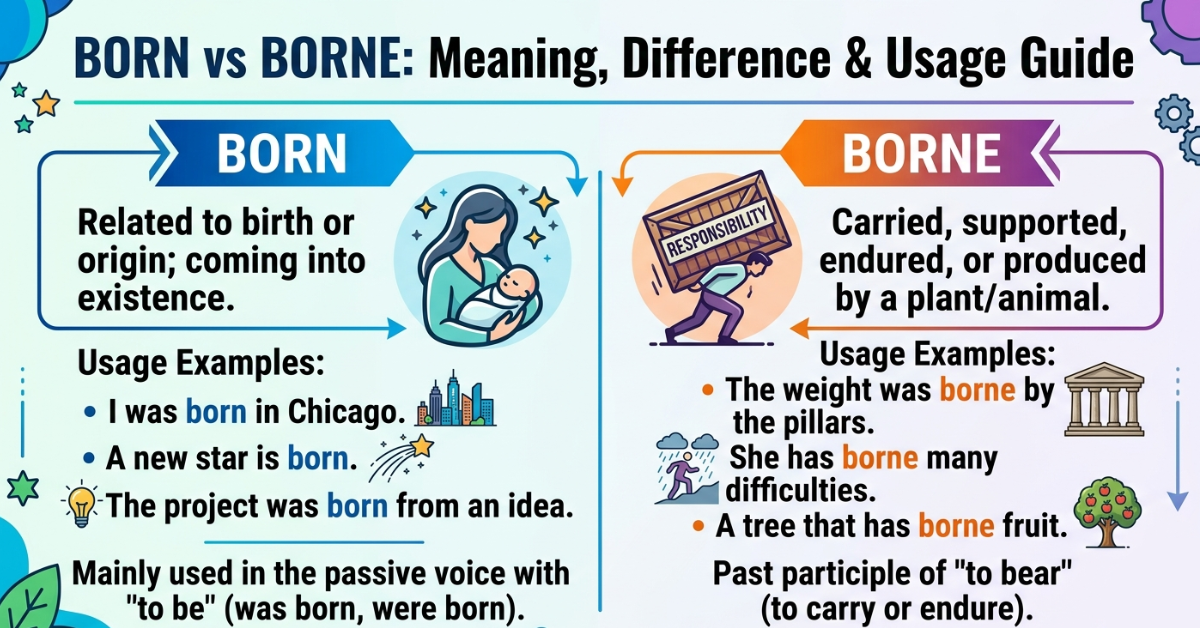
The main difference between born vs borne lies in meaning and usage:
Born
- Used only in the context of birth
- Refers to being brought into life
- Usually used with “be” (is born, was born)
Examples:
- She was born in 2001.
- Twins are often born early.
Borne
- Past participle of “bear”
- Means carried, تحمل کیا گیا, or endured
- Used in formal or figurative contexts
Examples:
- The pain was borne silently.
- The costs were borne by the company.
So simply put:
- Born = birth
- Borne = carry or endure
Born vs Borne vs Bourne: What’s the Difference?
Many people also search for born vs borne vs bourne, thinking “bourne” might be a variation. But here’s the truth:
Born
Related to birth and life.
Borne
Related to carrying, supporting, or enduring something.
Bourne
- An old English word meaning boundary or stream
- Rarely used in modern English
- Also appears in place names and surnames
So if you’re writing modern English, you’ll mostly only use:
- born
- borne
Born vs Borne in a Sentence (Clear Examples)
Understanding born vs borne in a sentence makes the difference much easier.
Using “Born” in sentences:
- He was born in a small village.
- I was born to be a designer.
- Many great leaders are born during difficult times.
Using “Borne” in sentences:
- The workers have borne heavy workloads this month.
- She has borne great responsibility since childhood.
- The virus is borne by mosquitoes.
Quick tip:
If you can replace the word with “given birth” meaning, use born.
If you can replace it with “carried” or “endured,” use borne.
Common Confusion Between Born and Borne
The confusion happens because both words come from the verb “bear,” but they serve different grammatical roles.
Here’s a simple breakdown:
Born (adjective / passive form)
- Always linked to birth
- Never used with “have/has” directly
Borne (past participle of bear)
- Used with actions like:
- responsibility
- burden
- pain
- costs
- diseases
Common mistakes:
In correct: She has born the pain.
Correct: She has borne the pain.
In correct: He was borne in Pakistan.
Correct: He was born in Pakistan.
Simple Memory Trick to Remember Born vs Borne
If you struggle, here’s an easy trick:
- Born = Baby (Birth begins with B)
- Borne = Burden (Both involve carrying something)
This small association can help you instantly pick the right word in writing.
Born vs Borne in Real-Life Writing
You’ll see it is used differently depending on the context.
Everyday English (Born)
- Biographies
- Personal introductions
- Historical facts
Formal or Academic English (Borne)
- Scientific writing
- Legal documents
- Economic or medical contexts
Example:
- “The disease is borne by water contamination.”
- “The scientist was born in Germany.”
Why People Get Confused Between Born and Borne
There are three main reasons:
- They sound similar in pronunciation
- Both come from the verb “bear”
- English grammar rules are not intuitive
This is why even advanced learners sometimes mix up in writing.
Quick Comparison Table
| Word | Meaning | Usage Example |
| Born | Related to birth | She was born in 1999 |
| Borne | Carried or endured | The cost was borne by him |
| Bourne | Boundary/old stream term | Rare usage |
FAQs About Born vs Borne
1. What is the main difference between born and borne?
Born refers to birth, while borne means carried or endured.
2. Can I use borne for birth?
No. For birth-related contexts, only born is correct.
3. Is bourne still used in English?
Rarely. It mostly appears in old texts or place names.
4. What is the correct sentence: “He was born or borne in 2000”?
Correct sentence: He was born in 2000.
5. Is borne used in daily conversation?
Not usually. It appears more in formal or academic writing.
Conclusion: Mastering Born vs Borne Easily
To wrap it up, understanding is not as complicated as it seems once you know the rule:
- Use born when talking about birth
- Use borne when talking about carrying or enduring something
- Ignore bourne in most modern writing unless specifically required
Once you get comfortable with these distinctions, your grammar becomes much cleaner and more professional. Keep practicing with examples like born vs borne in a sentence, and soon it will feel completely natural.
If you’re interested in improving your grammar further, exploring similar word pairs can make your writing even stronger and more confident.