Have you ever wondered whether you should say incoming call, upcoming meeting, or incoming meeting? Many English learners and even native speakers occasionally confuse these two words because both refer to something related to the future. However, they are not interchangeable.
Understanding incoming vs upcoming can make your writing and conversations much more accurate. Whether you’re writing emails, speaking professionally, or simply improving your English, knowing when to use each word helps you communicate naturally.
In this guide, you’ll learn the meanings of both terms, their key differences, practical examples, common mistakes, grammar rules, and easy tips to remember the correct usage.
What Does “Incoming” Mean?
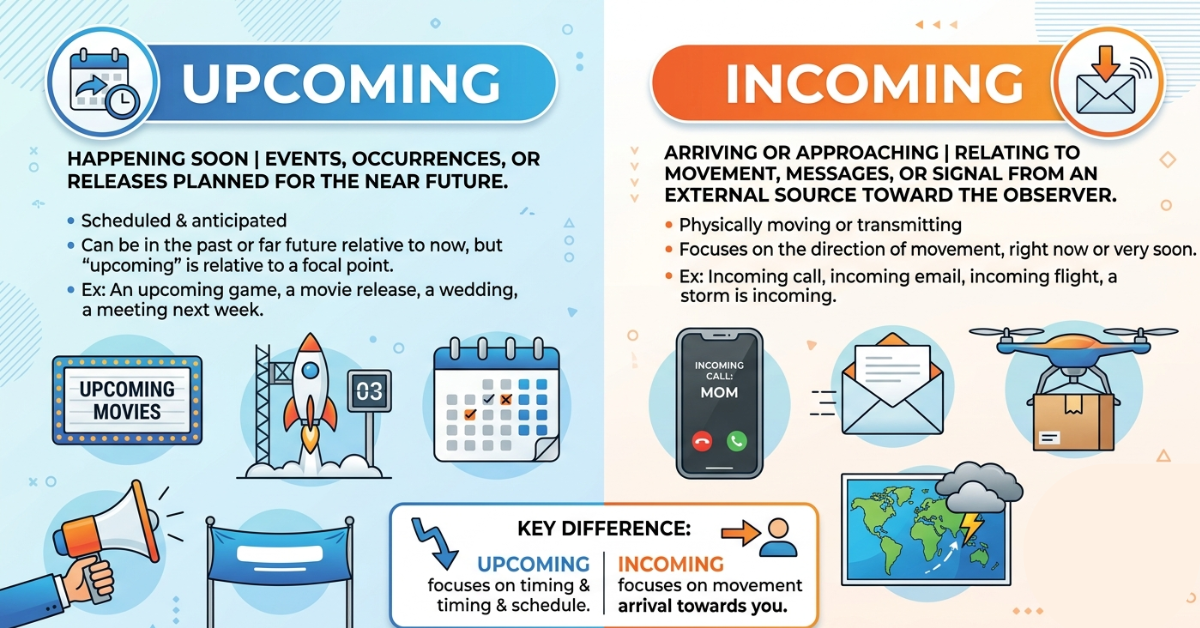
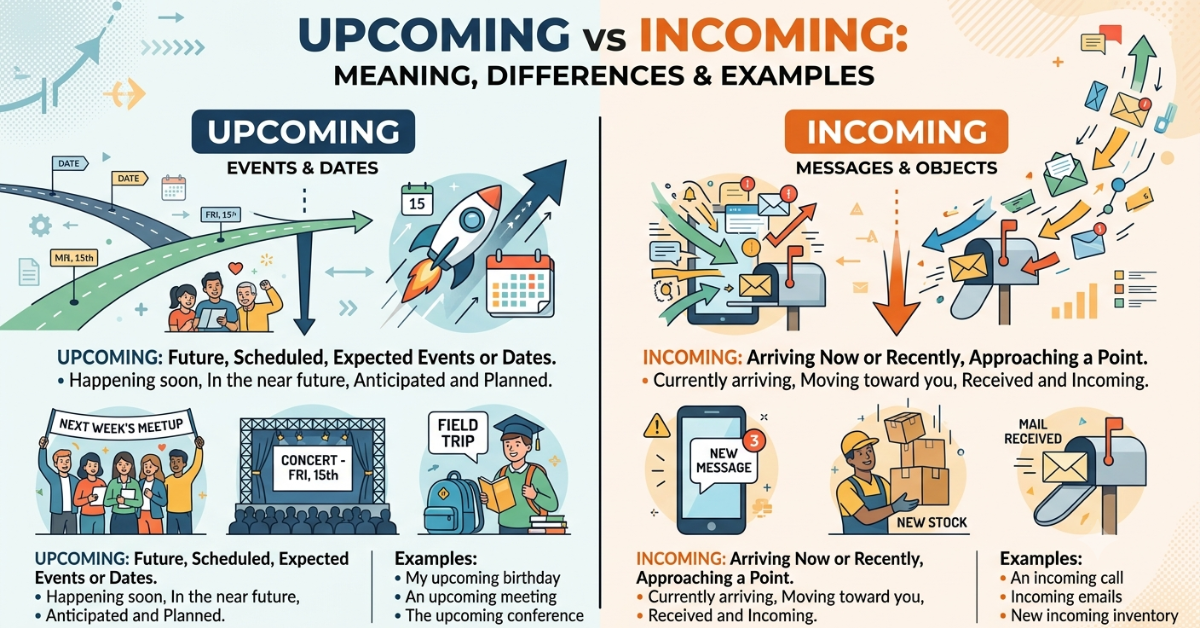
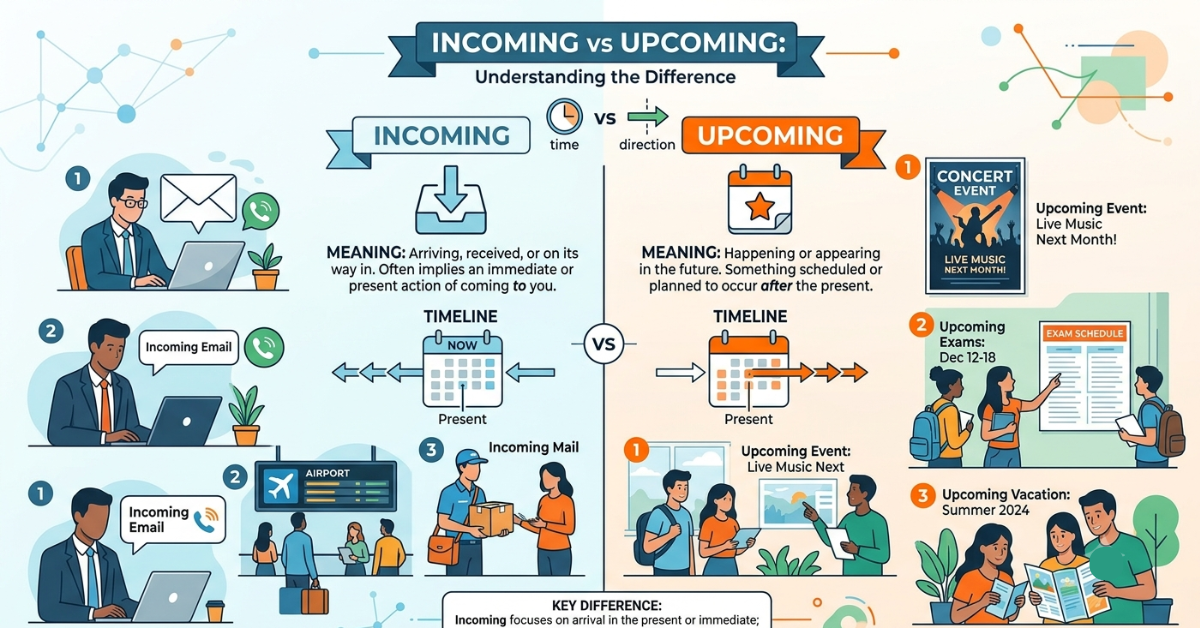
Incoming describes something that is coming toward you, arriving, or being received. It often refers to things that are physically or digitally arriving.
It emphasizes the act of arrival or reception, not simply something happening in the future.
Common Uses of Incoming
- Incoming calls
- Incoming messages
- Incoming emails
- Incoming flights
- Incoming students
- Incoming president
- Incoming payments
Examples
- I received an incoming call during the meeting.
- We have several incoming orders today.
- The airport is monitoring incoming flights.
- She is the incoming department manager.
In each example, something is arriving or about to be received.
What Does “Upcoming” Mean?
Upcoming refers to something that will happen soon in the future. It focuses on future events, occasions, or scheduled activities rather than something arriving.
Common Uses of Upcoming
- Upcoming event
- Upcoming exam
- Upcoming holiday
- Upcoming conference
- Upcoming release
- Upcoming interview
- Upcoming project
Examples
- We discussed the upcoming conference.
- She is preparing for her upcoming exam.
- The company announced its upcoming product launch.
- Everyone is excited about the upcoming festival.
The emphasis here is on future occurrence, not arrival.
Incoming vs Upcoming: The Main Difference
The easiest way to distinguish the two is to ask one simple question:
- Is something arriving or being received? → Use incoming.
- Is something scheduled to happen soon? → Use upcoming.
Feature Incoming Upcoming Meaning Arriving or being received Happening soon Focus Arrival Future event Common With Calls, emails, students, flights Meetings, events, exams, holidays Indicates Movement Yes Usually No Refers to Schedule Sometimes Yes
Incoming vs Upcoming in Everyday English
Let’s compare similar sentences.
Incoming
- Incoming email
- Incoming shipment
- Incoming customer
- Incoming aircraft
- Incoming notification
These all involve something reaching you.
Upcoming
- Upcoming vacation
- Upcoming webinar
- Upcoming deadline
- Upcoming workshop
- Upcoming movie
These describe planned future events.
Side-by-Side Examples
| Correct Usage | Why It’s Correct |
| Incoming message | The message is arriving. |
| Upcoming meeting | The meeting is scheduled. |
| Incoming payment | Money is being received. |
| Upcoming holiday | The holiday will occur soon. |
| Incoming train | The train is arriving. |
| Upcoming interview | The interview is scheduled. |
Can They Ever Be Used Together?
Yes. Sometimes both words appear in the same conversation because they describe different things.
Example:
Our upcoming seminar already has hundreds of incoming registrations.
Here:
- The seminar is a future event.
- The registrations are arriving.
Common Mistakes People Make
Saying “Incoming Meeting”
Usually incorrect.
Instead say:
Upcoming meeting
A meeting doesn’t “arrive”; it takes place.
Saying “Upcoming Email”
Usually incorrect.
Instead say:
Incoming email
Emails arrive in your inbox.
Confusing Future With Arrival
Many learners assume both simply mean “future.”
Actually:
- Incoming = arriving
- Upcoming = scheduled to happen
Grammar and Usage Tips
Incoming as an Adjective
Incoming almost always modifies nouns that receive or arrive.
Examples:
- incoming passengers
- incoming shipment
- incoming request
Upcoming as an Adjective
Upcoming modifies future events or planned activities.
Examples:
- upcoming competition
- upcoming semester
- upcoming deadline
Real-World Examples
In Business
Incoming:
- incoming invoices
- incoming customer inquiries
- incoming inventory
Upcoming:
- upcoming board meeting
- upcoming quarterly review
- upcoming product launch
In Technology
Incoming:
- incoming notifications
- incoming data
- incoming messages
Upcoming:
- upcoming software update
- upcoming feature release
- upcoming maintenance window
In Education
Incoming:
- incoming freshmen
- incoming exchange students
Upcoming:
- upcoming examinations
- upcoming semester
- upcoming assignments
In Travel
Incoming:
- incoming flights
- incoming passengers
Upcoming:
- upcoming trip
- upcoming vacation
- upcoming departure schedule
Easy Memory Trick
Here’s a simple way to remember the difference.
Incoming = In
Think of something coming in.
Examples:
- email comes in
- phone call comes in
- package comes in
Upcoming = Up Next
Think of something that’s coming up next.
Examples:
- meeting
- exam
- event
- holiday
This small trick makes choosing the correct word much easier.
Which One Should You Use?
Ask yourself these questions:
Is something arriving?
Use incoming.
Examples:
- incoming package
- incoming customer
- incoming payment
Is something scheduled to happen?
Use upcoming.
Examples:
- upcoming interview
- upcoming event
- upcoming exam
Practical Tips for Using Incoming and Upcoming Correctly
- Associate incoming with arrival or reception.
- Use upcoming for calendars, schedules, and plans.
- Think about whether the noun “comes to you” or “happens later.”
- Read business emails and news articles to see both words used naturally.
- Practice by replacing the words in example sentences to understand why one fits better than the other.
Quick Comparison Summary
| Incoming | Upcoming |
| Arriving | Happening soon |
| Being received | Scheduled |
| Emails | Meetings |
| Calls | Events |
| Flights arriving | Vacations |
| Payments | Deadlines |
Key Takeaways
- Incoming means arriving or being received.
- Upcoming means expected to happen soon.
- Use incoming for things like emails, calls, flights, and packages.
- Use upcoming for meetings, exams, holidays, and events.
- The two words are related to the future but describe different situations.
Frequently Asked Questions
Is incoming the same as upcoming?
No. Incoming refers to something arriving or being received, while upcoming refers to something scheduled to happen in the near future.
Can I say “incoming event”?
Generally, no. Most future events are described as upcoming events. “Incoming event” is uncommon unless you’re emphasizing something approaching in a specialized context.
Why do we say incoming calls but upcoming meetings?
Calls are received by your phone, so they are incoming. Meetings are planned for a future time, making them upcoming.
Is “incoming students” correct?
Yes. Universities often refer to newly admitted students as incoming students because they are joining the institution.
Is “upcoming email” grammatically correct?
Usually not. Emails arrive in your inbox, so incoming email is the correct expression.
How can I easily remember incoming vs upcoming?
Remember this rule: Incoming comes in. Upcoming comes next. If something arrives, use incoming. If something is scheduled, use upcoming.
Conclusion
Understanding incoming vs upcoming is easier once you recognize the difference between arrival and future occurrence. Although both words relate to things connected with the future, incoming describes something that is arriving or being received, while upcoming refers to an event or activity that is scheduled to happen soon.
By applying this simple distinction, you’ll write more confidently, speak more naturally, and avoid one of the most common vocabulary mistakes in English. Keep practicing with real-life examples, and choosing between these two words will soon become second nature.