Peace vs Piece: What’s the Difference and When to Use Each?

Have you ever written a sentence, paused, and wondered whether it should be peace or piece? You’re not alone. These two words sound exactly the same, yet they have completely different meanings, making them one of the most commonly confused pairs in English.
Understanding peace vs piece isn’t just about avoiding spelling mistakes—it helps you communicate more clearly and confidently in school, work, and everyday conversations. In this guide, you’ll learn the meanings, pronunciation, grammar, examples, memory tricks, and common errors so you’ll never confuse these homophones again.
Why Do People Confuse Peace and Piece?
The confusion exists because peace and piece are homophones—words that share the same pronunciation but differ in spelling and meaning.
Both words are pronounced as:
/piːs/ (“peece”)
Since they sound identical, people often choose the wrong spelling while writing, especially if they’re typing quickly or relying on pronunciation alone.
The good news is that once you understand what each word represents, the distinction becomes much easier.
What Does Peace Mean?
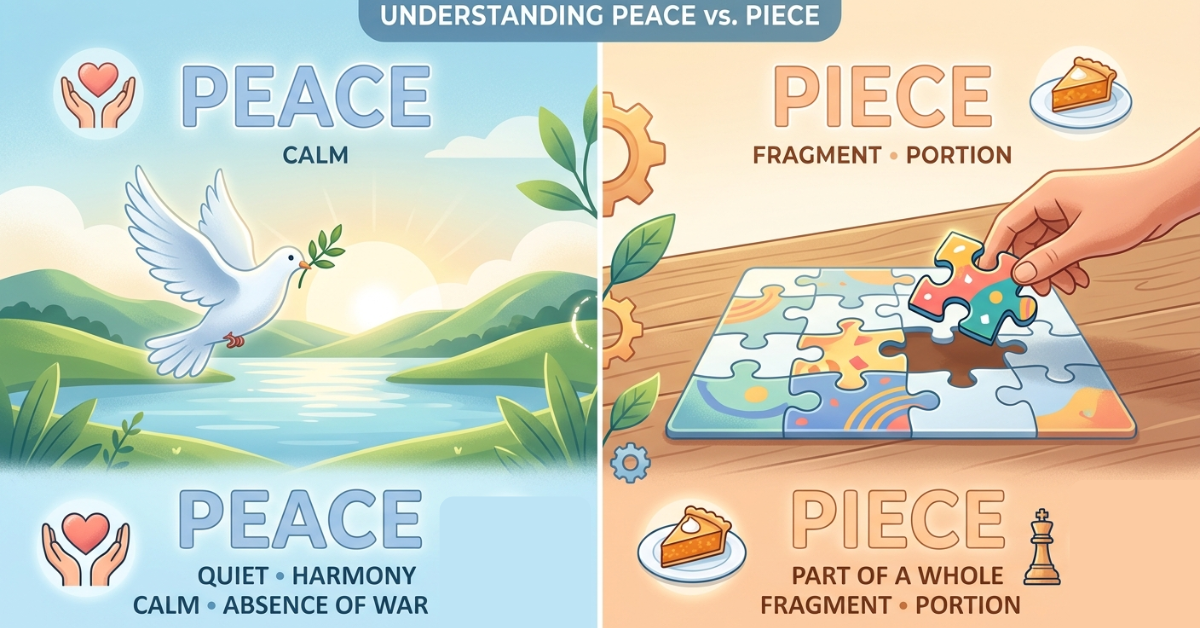
Peace is a noun that refers to:
- Freedom from war or conflict
- Calmness and tranquility
- Harmony between people
- Inner emotional balance
In simple terms, peace describes a state where conflict, stress, or disturbance is absent.
Common Meanings of Peace
- World peace
- Inner peace
- Peace of mind
- Living peacefully
- Peace agreement
Examples
- Everyone hopes for peace after years of conflict.
- Meditation helps many people find inner peace.
- The neighborhood finally returned to peace after the storm.
- She values peace of mind more than money.
- They signed a peace treaty.
Common Expressions Using Peace
Some everyday expressions include:
- Peace of mind
- Rest in peace
- Make peace
- At peace
- Peace and quiet
- Keep the peace
- Peace talks
These phrases all relate to calmness, harmony, or the absence of conflict.
What Does Piece Mean?
Piece is also a noun, but it refers to:
- A part of something larger
- An individual item
- A section or fragment
- A creative work such as music, writing, or artwork
Unlike peace, piece is about physical or conceptual parts.
Common Meanings of Piece
- A piece of cake
- Puzzle piece
- Piece of paper
- Furniture piece
- Art piece
Examples
- She ate one piece of pizza.
- I found the missing puzzle piece.
- Can I have another piece of chocolate?
- He wrote a beautiful musical piece.
- The broken vase was missing one piece.
Peace vs Piece: Quick Comparison
| Feature | Peace | Piece |
| Meaning | Calm, harmony, absence of conflict | Part of something larger |
| Part of Speech | Noun | Noun |
| Pronunciation | /piːs/ | /piːs/ |
| Refers To | Emotional or social state | Physical object or section |
| Example | We hope for peace. | I need one piece of paper. |
Peace vs Piece in Sentences
Seeing them in context makes the difference much clearer.
Peace
- She finally found peace after forgiving herself.
- The countries worked toward lasting peace.
- The children slept in complete peace.
- Nature brings me peace.
- Everyone deserves peace and safety.
Piece
- Give me a piece of bread.
- This painting is my favorite art piece.
- Every piece of evidence matters.
- The machine has one broken piece.
- He completed the puzzle one piece at a time.
How to Remember the Difference
Simple memory tricks can prevent future mistakes.
Remember Peace
Think of:
Peace = Calm
Both words relate to emotional well-being and harmony.
Also notice:
Peace contains “ea,” like “easy.”
Peace makes life easier.
Remember Piece
Think of:
Piece = Part
A piece is always one section of a whole.
Another trick:
When someone asks for a piece of cake, they’re asking for one part of the cake—not calmness.
Common Mistakes People Make
Many writers accidentally swap these words.
Incorrect
- I need some peace of pizza.
- She found a missing peace of the puzzle.
- Can I have another peace of cake?
Correct
- I need a piece of pizza.
- She found a missing piece of the puzzle.
- Can I have another piece of cake?
Likewise:
Incorrect
- Everyone deserves piece.
- We hope for world piece.
Correct
- Everyone deserves peace.
- We hope for world peace.
Peace vs Piece in Everyday Writing
Both words appear frequently in daily communication.
Use peace when discussing:
- Relationships
- Mental health
- Meditation
- Conflict resolution
- Harmony
- International relations
Examples:
- Peace negotiations
- Peaceful community
- Peace of mind
- World peace
Use piece when discussing:
- Food
- Clothing
- Furniture
- Art
- Music
- Construction
- Objects
Examples:
- Piece of furniture
- Piece of advice
- Piece of information
- Chess piece
- Piece of jewelry
Are Peace and Piece Different Parts of Speech?
No.
Both words are primarily nouns, but they represent different ideas.
| Word | Part of Speech | Meaning |
| Peace | Noun | Harmony or calm |
| Piece | Noun | Portion or part |
Although piece occasionally appears in phrasal verbs like piece together, its core meaning remains “part.”
Peace vs Piece in Academic and Professional Writing
Choosing the correct spelling is important in formal writing because the wrong word changes the meaning entirely.
For example:
Correct:
The organization promotes peace worldwide.
Incorrect:
The organization promotes piece worldwide.
Similarly:
Correct:
Attach one piece of supporting evidence.
Incorrect:
Attach one peace of supporting evidence.
Spell-check tools may not always catch this error because both words are valid English words.
Other Homophones Similar to Peace and Piece
English has many homophones that create similar confusion.
Examples include:
- Their vs There vs They’re
- Brake vs Break
- Flour vs Flower
- Right vs Write
- Hear vs Here
- Weather vs Whether
- Principal vs Principle
- Sale vs Sail
Learning these pairs improves both writing accuracy and reading comprehension.
Practical Tips to Never Confuse Them Again
Follow these simple habits:
- Ask yourself whether you’re talking about calm or a part.
- If it’s about harmony or tranquility, choose peace.
- If it’s about one section of something, choose piece.
- Read your sentence aloud while thinking about the meaning, not just the sound.
- Proofread important emails, essays, and reports for commonly confused homophones.
Key Takeaways
- Peace means calm, harmony, or the absence of conflict.
- Piece means a portion, section, or individual item.
- Both words sound exactly the same but have different meanings.
- Context—not pronunciation—determines the correct spelling.
- Simple memory tricks can help you remember which word to use.
Frequently Asked Questions
Is it peace of mind or piece of mind?
The correct phrase is peace of mind because it refers to feeling calm, secure, and free from worry. Piece of mind is incorrect unless you’re literally referring to a physical part of a mind, which is not how the expression is used.
Why do peace and piece sound the same?
They are homophones, meaning they share the same pronunciation but have different spellings and meanings. English contains many homophones due to its historical development and borrowed vocabulary.
Is “piece of cake” correct?
Yes. Piece of cake is correct because it refers to one portion of a cake. It’s also an idiom meaning something is very easy to do.
Is world peace or world piece correct?
The correct phrase is world peace because it refers to harmony and the absence of war among nations. World piece would not make sense in this context.
How can I remember the difference between peace and piece?
Think of peace as calm or harmony and piece as a part of something. Associating peace with “peace of mind” and piece with “piece of pizza” makes the distinction easier to remember.
Can spell check catch mistakes between peace and piece?
Not always. Since both are correctly spelled English words, spell check may not flag them if the wrong one fits grammatically. Reviewing the meaning in context is the best way to avoid errors.
Conclusion
Although peace and piece sound identical, they represent entirely different ideas. Peace is about harmony, calmness, and the absence of conflict, while piece refers to a portion, fragment, or individual item. Understanding this distinction helps you write more accurately and avoid one of the most common homophone mistakes in English.
The next time you’re unsure which word to use, focus on the meaning rather than the pronunciation. With the examples, comparison table, and memory tricks in this guide, you’ll be able to choose the correct word with confidence and improve the clarity of your writing.