The confusion between broach vs brooch is more common than you might think, especially for English learners and even native speakers. These two words sound similar but have completely different meanings and uses.
Understanding broach vs brooch helps you avoid embarrassing mistakes in writing and conversation. One refers to introducing a topic, while the other is a decorative jewelry item. Let’s break it down in a simple, clear, and practical way so you never mix them up again.
What Does “Broach” Mean?
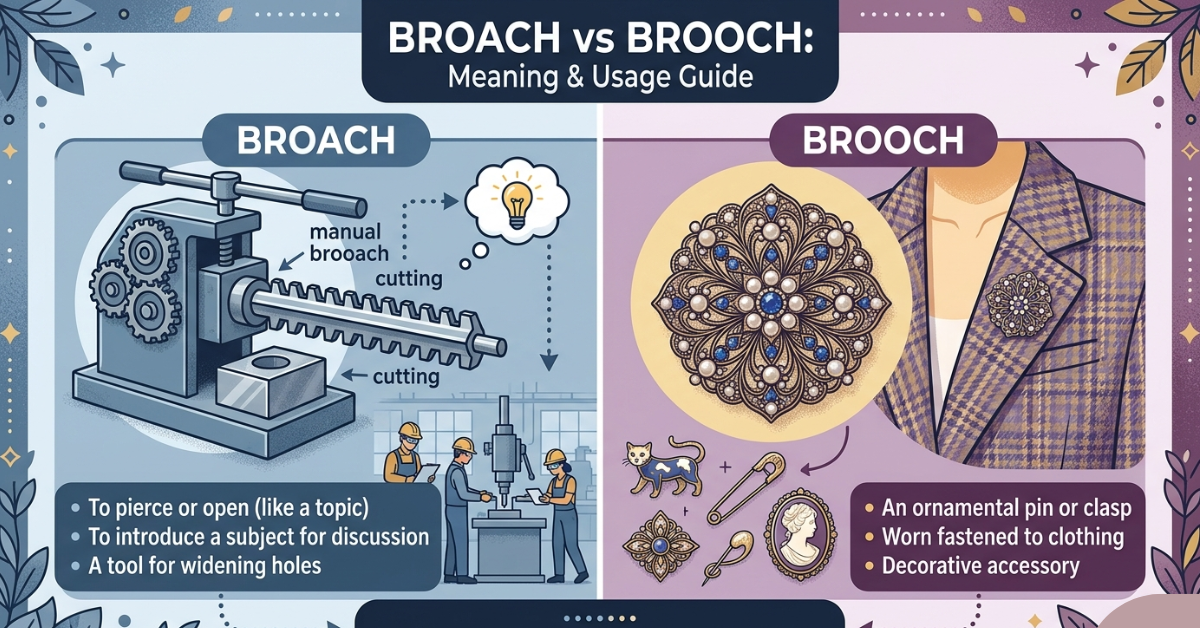
“Broach” is a verb, and it is mostly used in communication or discussion contexts. When you broach something, you are bringing up a subject, usually a sensitive or important one.
Common meanings of broach:
- To introduce a topic in conversation
- To raise a difficult issue
- To open up a subject for discussion
Example sentences:
- She decided to broach the subject of salary with her boss.
- He found it hard to broach the topic of moving abroad.
In short, “broach” is about speaking, discussing, or opening an idea.
What Does “Brooch” Mean?
A “brooch” is a noun, and it has nothing to do with conversation. Instead, it refers to a decorative piece of jewelry that is usually pinned to clothing.
Common features of a brooch:
- Worn on dresses, coats, or scarves
- Often made of metal, gems, or enamel
- Used for fashion or symbolic purposes
Example sentences:
- She wore a beautiful diamond brooch at the wedding.
- The antique brooch was passed down through generations.
So, while “broach” is about talking, a “brooch” is about style and fashion.
Broach vs Brooch: Key Differences
Understanding broach vs brooch becomes easier when you compare them side by side.
1. Part of Speech
- Broach → Verb
- Brooch → Noun
2. Meaning
- Broach → To introduce or bring up a topic
- Brooch → A decorative jewelry pin
3. Usage Context
- Broach → Communication, discussion, ideas
- Brooch → Fashion, accessories, clothing
4. Pronunciation Tip
Even though they sound similar, “broach” rhymes with “coach,” while “brooch” is closer to “coach” or “roach” depending on accent.
Easy Trick to Remember the Difference
Here’s a simple memory trick:
- Broach = “Approach a topic” (both are about talking)
- Brooch = “Looks like a brooch pin” (visual object you wear)
This small association can help you instantly recall the correct meaning.
Common Mistakes People Make
Many people mix up broach vs brooch because of their similar spelling and pronunciation. Here are some frequent errors:
- Writing “broach” when referring to jewelry
- Using “brooch” when talking about discussion
- Confusing both in spoken English
Avoiding these mistakes will instantly improve your writing accuracy.
Why This Confusion Happens
The English language is full of homophones—words that sound alike but have different meanings. Broach vs brooch is a classic example of this.
The confusion mainly happens because:
- Similar pronunciation
- Close spelling patterns
- Lack of context understanding
Once you learn their meanings, the difference becomes very easy to remember.
FAQs
1. What is the main difference between broach and brooch?
The main difference is that “broach” means to introduce a topic, while “brooch” is a piece of jewelry.
2. Is broach vs brooch a common spelling mistake?
Yes, it is a very common mistake because both words sound almost identical.
3. Can broach be used as a noun?
No, “broach” is mainly used as a verb in modern English.
4. What is a brooch used for?
A brooch is used as a decorative accessory, usually pinned to clothing.
5. How can I remember broach vs brooch easily?
Think of “broach” as talking about a topic and “brooch” as something you wear.
Conclusion
The confusion around broach vs brooch is understandable, but once you learn their meanings, it becomes easy to avoid mistakes. “Broach” relates to discussing or introducing a topic, while “brooch” refers to a stylish piece of jewelry.
By remembering the simple differences in usage, spelling, and context, you can confidently use both words correctly in writing and speech. If you enjoy learning confusing English word pairs like this, keep exploring similar language guides to strengthen your vocabulary even further.