If you’ve ever paused while writing and wondered extent vs extant—you’re not alone. These two words look almost identical, but their meanings are completely different, and mixing them up is a very common English mistake.
In this guide, we’ll break down extent vs extant in the simplest way possible so you can use both words confidently in writing, exams, or everyday communication.
Let’s clear the confusion once and for all.
What Does “Extent” Mean?
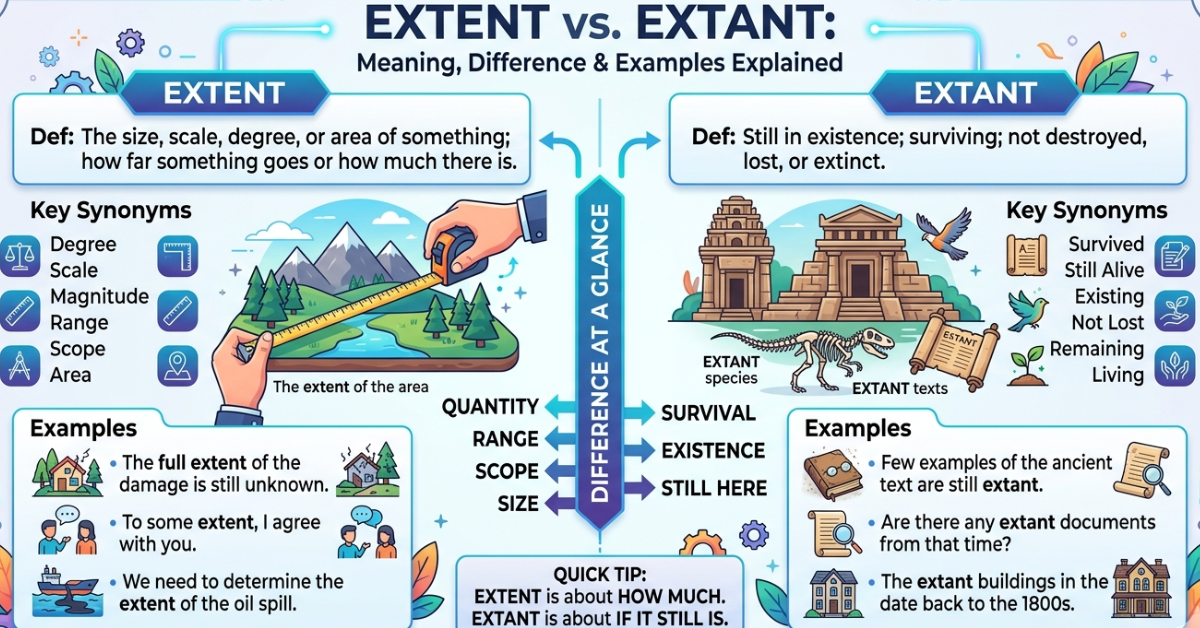
The word extent refers to the degree, range, or scope of something. It answers questions like how much? or to what level?
Simple Meaning:
Extent = how far or how much something exists or happens
Examples:
- The extent of the damage was surprising.
- I didn’t realize the extent of the problem.
- To what extent do you agree with this idea?
Common Usage Contexts:
- Measuring impact
- Describing size or level
- Expressing intensity
In short, “extent” is always about measurement or degree.
What Does “Extant” Mean?
Now let’s look at extant, which is much more specific and less commonly used in everyday conversation.
Extant means still existing or surviving, especially from the past.
Simple Meaning:
Extant = still alive, existing, or not destroyed
Examples:
- Only a few extant manuscripts from that period remain.
- This is one of the oldest extant species of its kind.
- The building is the only extant structure of its era.
Common Usage Contexts:
- History
- Biology
- Literature
- Archaeology
So, “extant” is used when something has survived over time.
Extent vs Extant: Key Differences Explained
Understanding extent vs extant becomes easy when you compare them side by side.
1. Meaning Difference
- Extent: degree or level of something
- Extant: still existing or surviving
2. Usage Difference
- Extent is used in daily language
- Extant is used in academic or formal writing
3. Context Difference
- Extent → measurement, scope, intensity
- Extant → existence, survival, history
Quick Memory Trick:
- Extent = Extend (how far something stretches)
- Extant = Exists (still alive or present)
Common Mistakes People Make
Many learners confuse the two because of their similar spelling. Here are common errors:
- The extant of the damage was huge (in correct)
Correct: The extent of the damage was huge - Only a few species are extent today (in correct)
Correct: Only a few species are extant today
A simple spelling check can save you from these mistakes.
When to Use Each Word
Use “Extent” when:
- Talking about size or level
- Describing impact or range
- Asking how much something applies
Use “Extant” when:
- Referring to something still existing
- Discussing history or ancient objects
- Talking about survival of species or documents
Why People Get Confused
The confusion between extent vs extant happens because:
- They look almost identical
- They share Latin roots
- They are rarely taught with clear examples
- One is common, the other is academic
But once you understand their meanings, the confusion disappears quickly.
FAQs
1. What is the main difference between extent vs extant?
“Extent” refers to degree or range, while “extant” means still existing or surviving.
2. Is extant a common English word?
Not really. It is mostly used in academic, historical, or scientific writing.
3. Can extent and extant be used in the same sentence?
Yes, but rarely. They have completely different meanings and contexts.
4. How can I remember extent vs extant easily?
Think of “extent” as “how far” and “extant” as “still exists.”
5. Which word is used more often in daily English?
“Extent” is far more common in everyday communication.
Conclusion
Understanding extent vs extant doesn’t have to be confusing. Once you remember that one is about degree and the other is about existence, the difference becomes very clear.
To recap:
- Extent = how much or how far
- Extant = still existing or surviving
With a little practice, you’ll never mix them up again. Keep these simple meanings in mind, and your writing will instantly become more accurate and confident.