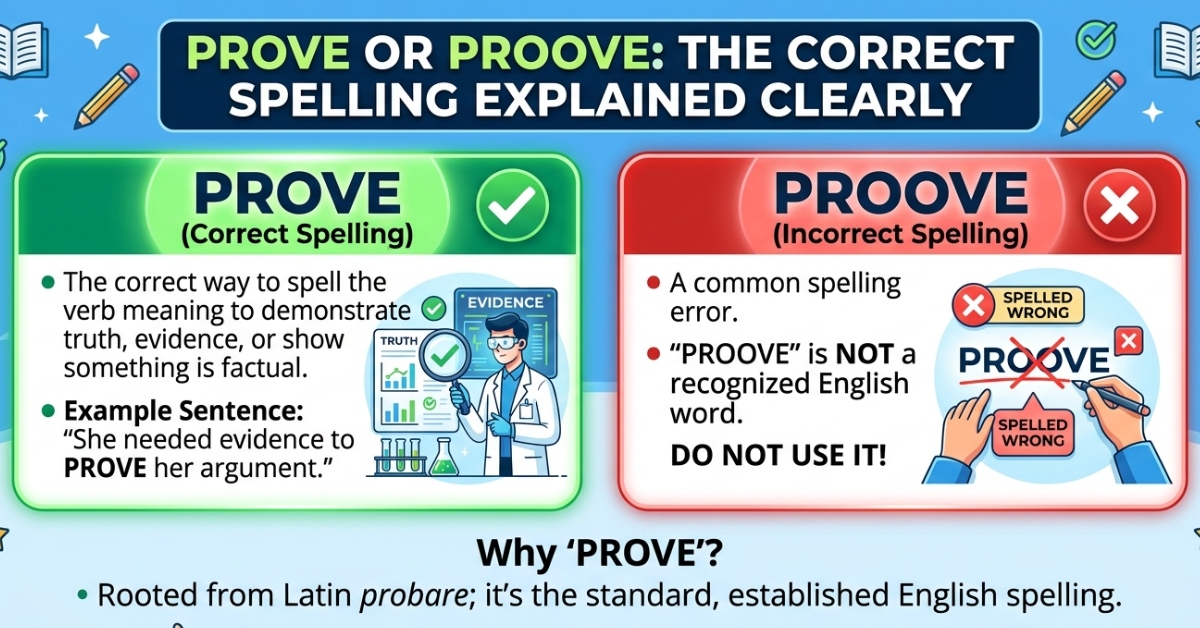
If you’ve ever wondered about Prove or Proove, you’re definitely not alone. Many writers accidentally get confused between these spellings, especially when writing quickly. However, the correct form is prove, while proove is simply a common spelling mistake.
Because English spelling rules can be tricky, it’s easy to assume both versions are acceptable. In reality, though, only one is recognized in standard English. In this article, we’ll clearly explain the difference so you can confidently use the correct form every time.
What Does “Prove” Mean?
The word prove is a verb that means to show or confirm that something is true using evidence or facts. In everyday communication, it is widely used in both formal and informal contexts.
In simple terms:
- It means to demonstrate truth
- It is used to confirm something logically
- It helps establish evidence or validity
Examples in sentences:
- She can prove her answer with calculations.
- Scientists often prove theories through experiments.
- He tried to prove his point during the discussion.
Importantly, the spelling “proove” does not exist in standard English dictionaries, so it should always be avoided.
Prove or Proove: Why People Get Confused
Interestingly, the confusion between Prove or Proove usually comes from how English words sound rather than how they are written.
For instance, words like move or groove include double vowels, which leads many learners to mistakenly assume prove should follow the same pattern. However, English does not always follow consistent spelling rules, which is why this error is so common.
Moreover, pronunciation does not clearly indicate spelling in this case, which further increases confusion among learners and writers.
Correct Spelling Rules You Should Follow
To avoid mistakes in the future, it helps to remember a few simple grammar rules.
First, remember the spelling:
- prove
In addition, keep verb forms consistent:
The word changes slightly depending on tense, but never doubles the “o”:
- prove → proving → proved
Finally, avoid common writing errors:
Many people accidentally write:
- “proove it”
- “I will proove this”
Instead, always use:
- “prove it”
- “I will prove this”
Real-Life Examples of “Prove”
To understand usage better, here are some practical examples from everyday situations.
In academics, students often need to prove their answers with proper reasoning. Similarly, in professional environments, employees may be asked to prove their skills through performance or results.
Meanwhile, in daily conversations, the word is commonly used when someone wants to show evidence or justify a statement.
Why Correct Spelling Matters
Using the correct form of prove is not just about grammar—it also affects clarity and credibility. When writing professionally, correct spelling helps create a strong impression.
Furthermore, accurate language improves readability and ensures your message is understood without confusion. On the other hand, spelling it as “proove” can make writing look careless or unprofessional.
Quick Tips to Remember the Correct Form
To make things easier, here are a few simple memory tricks:
- Think: “I prove, not I proove”
- Avoid doubling vowels unless you’re sure
- Always rely on spell-check tools when unsure
As a result, you’ll reduce errors and improve writing confidence over time.
FAQs
1. Which is correct: Prove or Proove?
The correct spelling is prove. “Proove” is incorrect in all standard English usage.
2. Why do people write proove?
Because they mistakenly apply spelling patterns from similar-sounding words like “groove” or “move.”
3. Is proove ever accepted?
No, it is not accepted in British or American English.
4. What is the past tense of prove?
The past tense is proved, although “proven” is sometimes used in specific contexts.
5. How can I stop making this mistake?
By practicing reading, using dictionaries, and paying attention to spelling patterns regularly.
Conclusion
In summary, the difference between Prove or Proove is simple but important. Only prove is correct, while proove is a common spelling error. Therefore, remembering this rule can significantly improve your writing accuracy.
Ultimately, mastering such small grammar details helps you communicate more clearly and confidently in both academic and professional settings.