Have you ever paused while writing and wondered whether it’s fir or fur? You’re not alone. The confusion between Fir vs Fur is surprisingly common because both words sound identical when spoken but mean completely different things.
In this guide on Fir vs Fur, we’ll break down their meanings, usage, pronunciation context, and real-life examples so you never mix them up again. Whether you’re a student, writer, or English learner, this simple explanation will clear up the confusion once and for all.
Fir vs Fur: Meaning Explained Simply
Let’s start by understanding what each word actually means.
What is “Fir”?
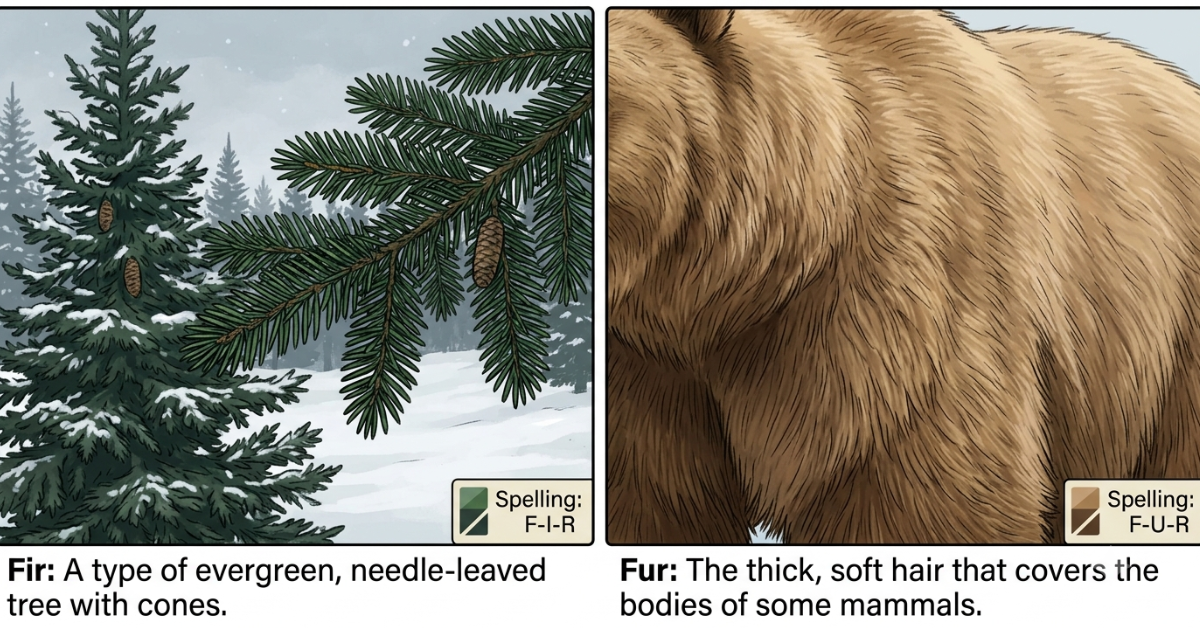
“Fir” refers to a type of evergreen tree, commonly found in colder regions. These trees are known for their needle-like leaves and are often used as Christmas trees.
Examples of Fir:
- Fir trees grow in mountainous areas.
- The forest was full of tall fir trees.
- Christmas decorations often use fir branches.
What is “Fur”?
“Fur” refers to the thick hair that covers the bodies of some animals. It is used for warmth and protection.
Examples of Fur:
- The cat has soft fur.
- Polar bears have thick fur to survive cold weather.
- Some jackets are lined with artificial fur.
Fir vs Fur: Key Differences You Should Know
Understanding becomes much easier when you compare them side by side.
1. Meaning Difference
- Fir: A type of tree
- Fur: Animal hair or covering
2. Category
- Fir belongs to botany (plants)
- Fur belongs to biology/zoology (animals)
3. Usage in Sentences
- Fir is used when talking about forests, trees, and nature landscapes.
- Fur is used when describing animals, clothing, or texture.
4. Visual Difference
- Fir = Tall green trees with needle-like leaves
- Fur = Soft, thick animal hair
Fir vs Fur: Easy Tricks to Remember
If you still get confused, here are some simple memory tricks:
- Fir = Forest = Tree
(All start with “F” but think of forests and fir trees) - Fur = Furry animals
(Think of cats, dogs, bears, and their soft coats) - “Fir” is always plant-related
- “Fur” is always animal-related
Common Mistakes People Make
Many learners confuse these words because:
- They sound exactly the same when spoken
- They are spelled with similar letters
- They are rarely used together in everyday conversation
But once you understand the context, the confusion disappears quickly.
Fir vs Fur in Real-Life Usage
Here’s how both words appear in real life:
- A holiday park decorated with fir trees looks beautiful in winter.
- A winter jacket lined with fur keeps you warm.
- Wildlife photographers often capture animals with thick fur in cold regions.
- Hiking trails often pass through forests filled with fir trees.
FAQs about Fir vs Fur
1. Why are Fir and Fur confusing?
They are homophones, meaning they sound the same but have different meanings and spellings.
2. Is Fir vs Fur related to pronunciation?
Yes, both are pronounced the same, which is why people often mix them up.
3. What is Fir used for?
Fir refers to evergreen trees commonly used in landscaping and Christmas decorations.
4. What does Fur mean in animals?
Fur is the thick coat of hair covering animals, helping them stay warm.
5. How can I easily remember Fir vs Fur?
Think: Fir = tree (forest), Fur = animal coat (furry).
Conclusion
Understanding Fir vs Fur is simple once you break it down. One refers to a tree found in nature, while the other describes animal hair used for warmth and protection.
Next time you write or speak, remember: Fir belongs to forests, and fur belongs to furry animals. With this easy distinction, you’ll never confuse them again.
If you’re learning English, keep practicing with similar word pairs to improve your vocabulary and confidence.