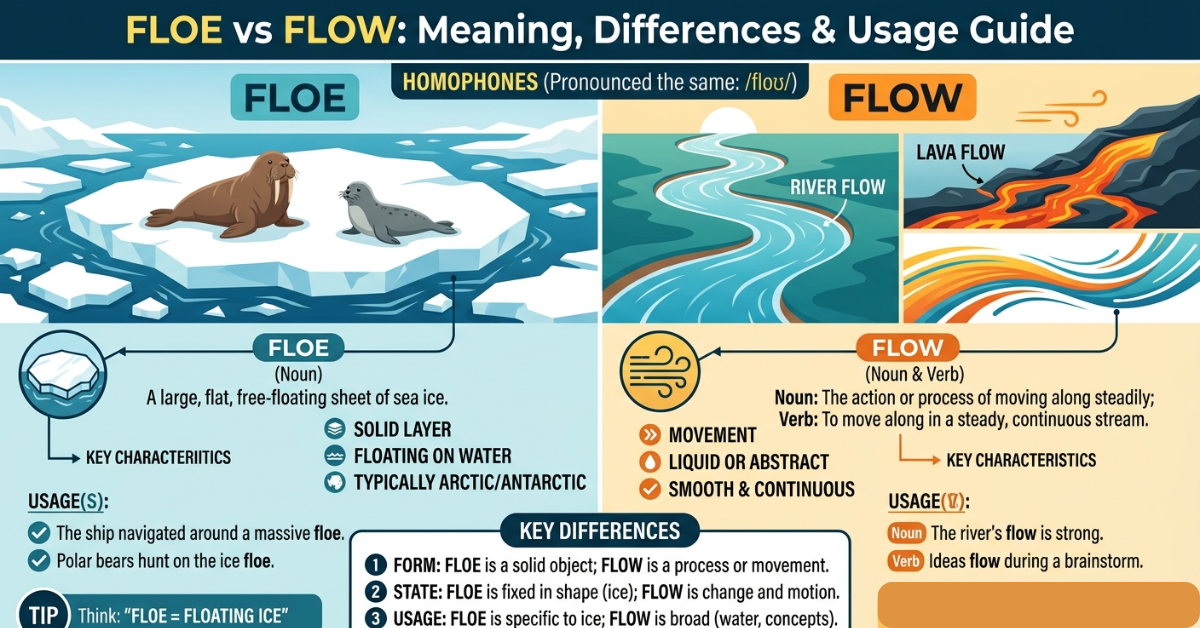
Language can be tricky, especially when two words sound almost identical but mean completely different things. One such confusing pair is Floe vs Flow. If you’ve ever paused while writing and wondered which one is correct, you’re not alone.
In this guide, we’ll break down Floe vs Flow, explain their meanings, usage, and real-life examples so you never mix them up again.
What Does “Flow” Mean?
Let’s start with the more commonly used word: flow.
Flow refers to movement—usually smooth, continuous, or steady. It can describe water, ideas, energy, or even conversations.
Common meanings of flow:
- The movement of liquids or gases
- A smooth sequence of actions or thoughts
- The way something progresses naturally
Examples of “flow” in sentences:
- The river began to flow rapidly after the rain.
- Her thoughts had a natural flow during the presentation.
- The music had a calming flow that relaxed everyone.
In short, “flow” is all about movement, rhythm, and continuity.
What Does “Floe” Mean?
Now let’s look at the less common word in the Floe vs Flow comparison: floe.
A floe refers to a large, flat sheet of floating ice, usually found in polar seas or icy oceans.
Key characteristics of a floe:
- Made of ice
- Floats on water
- Common in Arctic and Antarctic regions
Examples of “floe” in sentences:
- The polar bear rested on a drifting ice floe.
- Scientists studied the melting floe in the Arctic Ocean.
Unlike “flow,” which is abstract and general, “floe” is very specific and physical.
Floe vs Flow: Key Differences Explained
Understanding Floe vs Flow becomes easy when you compare them side by side.
1. Meaning
- Flow: Movement or smooth progression
- Floe: A floating sheet of ice
2. Usage
- Flow: Used in everyday language (writing, speech, science, emotions)
- Floe: Used mainly in geography or environmental science
3. Context
- Flow: Abstract and versatile
- Floe: Concrete and specific
4. Pronunciation
- Both sound similar, but spelling changes the meaning completely.
Why People Confuse Floe and Flow
The confusion in Floe vs Flow mostly comes from pronunciation. Since both words sound alike, they are called homophones.
Other reasons include:
- Lack of exposure to the word “floe”
- Overuse of “flow” in daily language
- Similar spelling structure
But once you remember their meanings, the confusion disappears quickly.
Easy Trick to Remember Floe vs Flow
Here’s a simple memory hack:
- Flow = movement (think “go with the flow”)
- Floe = frozen ice (both have “o-e” like cold ice shape)
Another way:
- Flow = fluid
- Floe = frozen
This small trick makes it easier to avoid mistakes in writing.
Real-Life Usage Examples
To fully understand Floe vs Flow, here are practical examples:
Flow in daily life:
- Water flow in pipes
- Traffic flow on roads
- Creative flow in writing
- Emotional flow in communication
Floe in science and nature:
- Ice floes in the Arctic Ocean
- Climate studies involving melting floes
- Wildlife resting on ice floes
These examples show how different the two words actually are.
Common Mistakes to Avoid
When using Floe vs Flow, people often:
- Spell “flow” when referring to ice
- Misread “floe” as a typo
- Use the words interchangeably in writing
To avoid mistakes:
- Always check the context
- Ask yourself: Is it movement or ice?
FAQs about Floe vs Flow
1. What is the main difference between floe and flow?
The main difference is meaning: “flow” refers to movement, while “floe” refers to floating ice.
2. Is floe a commonly used word?
No, “floe” is mostly used in scientific and geographical contexts.
3. Can flow and floe be used interchangeably?
No, they have completely different meanings and cannot replace each other.
4. Why do floe and flow sound the same?
They are homophones, meaning they are pronounced similarly but spelled differently.
5. Which word is more common in everyday English?
“Flow” is far more common and used in multiple contexts.
Conclusion
Understanding Floe vs Flow is simple once you break it down. One represents smooth movement and natural progression, while the other describes a floating sheet of ice found in cold regions.
The key takeaway? Always focus on context. If it’s about movement, rhythm, or progress—use flow. If it’s about ice in polar regions—use floe.
Mastering such small differences can significantly improve your writing accuracy and confidence. Keep learning, keep practicing, and explore more confusing word pairs to sharpen your English skills.