
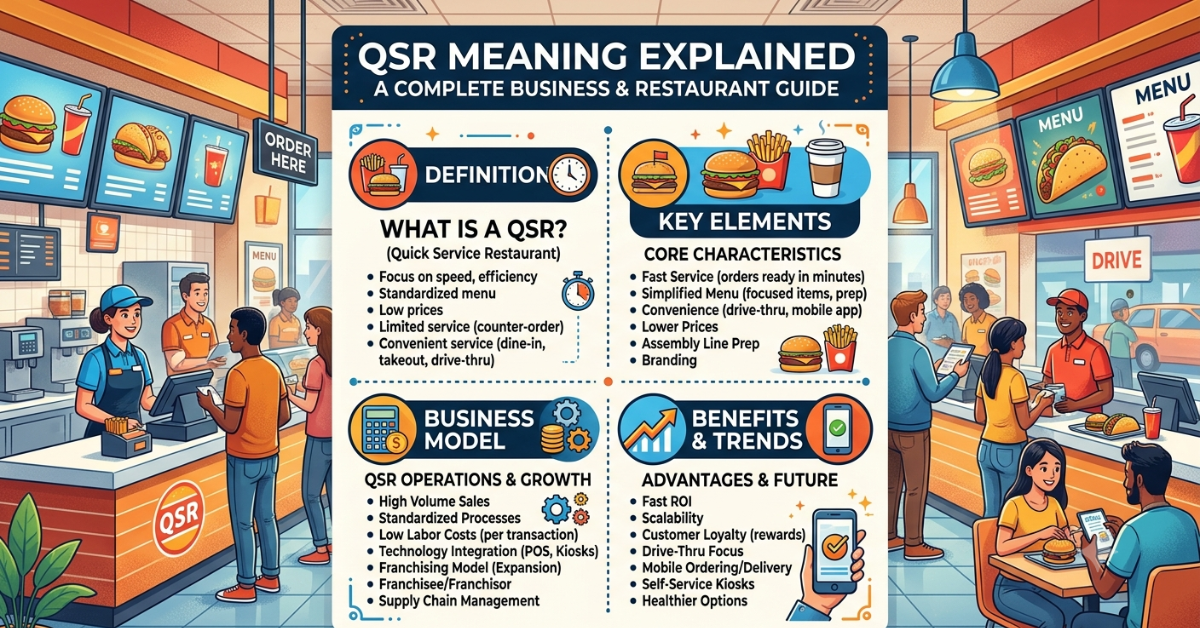
The term qsr meaning is widely used in the food and business industry, especially when talking about fast food chains and modern restaurant models. Simply put, QSR refers to Quick Service Restaurants, but there’s much more to it than just “fast food.”
Understanding qsr meaning in business helps explain how these highly efficient restaurant models operate, scale, and generate profit. In this article, we’ll break down everything in a simple, human way—what QSR is, how it works in restaurants, and why it matters in today’s food industry.
What is QSR Meaning?
The basic qsr meaning stands for Quick Service Restaurant. These are food outlets designed to serve customers quickly, with minimal wait time and a focus on convenience.
In simple terms:
- You order fast
- Food is prepared quickly
- You usually eat on the go or take it away
Common examples include fast food chains, burger shops, pizza outlets, and coffee drive-thrus.
The idea behind qsr meaning in restaurant settings is speed, consistency, and affordability.
QSR Meaning in Business
When we talk about, it refers to a structured, high-efficiency food service model that prioritizes volume and speed over fine dining experience.
Key Business Aspects of QSR:
- High customer turnover
- Standardized menu across locations
- Cost-efficient operations
- Heavy reliance on automation and systems
- Strong branding and franchising models
This business model works because it focuses on selling large quantities of affordable meals in a short time.
In modern food industry economics, In business is closely tied to scalability and global expansion.
QSR Meaning in Restaurant Industry
In the restaurant world, it refers to outlets that operate with a limited-service format. Customers typically order at a counter, kiosk, or drive-thru instead of being served at a table.
Main Characteristics:
- Self-service or counter ordering
- Limited seating or takeaway focus
- Pre-prepared or quickly cooked food items
- Standardized recipes for consistency
These restaurants are designed for customers who prioritize speed over dining experience.
Key Features of Quick Service Restaurants
To better understand, here are the defining features:
1. Fast Service
Food is prepared and delivered in minutes.
2. Limited Menu
Menus are simple, focusing on high-demand items.
3. Affordable Pricing
Designed to attract mass customers.
4. Standardization
Every branch offers the same taste and quality.
5. Technology Integration
Many QSRs use:
- Self-order kiosks
- Mobile apps
- Digital payment systems
Why QSR Models Are So Popular
The rise of QSRs is not random. Their success comes from changing lifestyles.
Reasons for popularity:
- Busy urban schedules
- Demand for quick meals
- Affordable pricing
- Easy accessibility
- Delivery apps and online ordering growth
The industry has evolved significantly with technology and customer expectations.
Advantages and Challenges of QSRs
Advantages:
- Fast service and high efficiency
- Low operational costs
- Easy scalability through franchises
- Consistent food quality
Challenges:
- High competition
- Pressure to maintain speed and quality
- Limited customer experience
- Dependence on location and foot traffic
FAQs about QSR Meaning
1. What is the basic qsr meaning?
QSR means Quick Service Restaurant, a food outlet focused on fast preparation and service.
2. What does qsr meaning in business refer to?
It refers to a scalable restaurant business model focused on speed, efficiency, and high sales volume.
3. What is qsr meaning in restaurant industry?
It describes restaurants that serve fast food with limited service and quick order fulfillment.
4. Is QSR the same as fast food?
Yes, but QSR is a broader industry term that includes fast food and modern quick dining formats.
5. Why are QSRs successful?
Because they offer affordable, fast, and convenient meals to a large customer base.
Conclusion
Understanding qsr meaning gives a clear picture of how modern food service operates. Whether we look at qsr meaning in business or qsr meaning in restaurant contexts, the core idea remains the same—speed, efficiency, and consistency.
QSRs continue to dominate the global food industry because they match today’s fast-paced lifestyle. If you’re exploring food businesses or simply curious about how your favorite fast food chains work, QSRs are a perfect example of smart, scalable business design.