Have you ever come across terms like “Dev,” “Dvlp,” or “Devt.” in documents, project reports, business plans, or addresses and wondered what they mean? You’re not alone. Many people search for the abbreviation for development when they encounter shortened forms in professional, academic, technical, or everyday contexts.
Understanding these abbreviations can help improve communication, save space in documents, and ensure consistency across industries. In this guide, you’ll learn what is the abbreviation for development, the most commonly accepted forms, when to use them, industry-specific variations, and practical examples that make the concept easy to understand.
What Is the Abbreviation for Development?
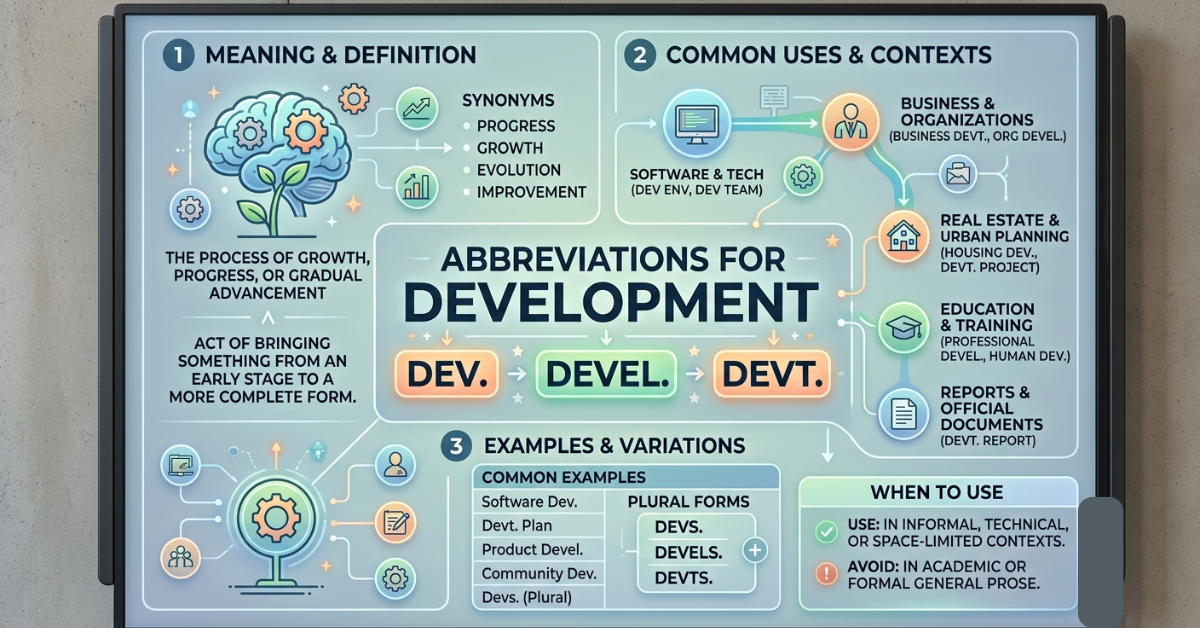
The most common abbreviation for development is:
Dev.
This shortened form is widely recognized across various industries, including software development, business development, real estate development, and community development.
Other abbreviations that may be used include:
- Dev. – Most common and widely accepted
- Devt. – Common in business, government, and administrative documents
- Dvlp. – Less common; used when space is limited
- DVP – Occasionally used as an internal organizational abbreviation
Among these, Dev. remains the standard abbreviation in most professional settings.
Why Is Development Abbreviated?
The word “development” contains eleven letters, making it relatively long for forms, reports, charts, tables, and technical documents.
Abbreviations help:
- Save space in documents
- Improve readability in charts and spreadsheets
- Standardize terminology
- Simplify project naming conventions
- Make internal communication more efficient
For example:
- Business Development → Business Dev.
- Software Development Team → Software Dev. Team
- Product Development Department → Product Dev. Department
Common Meanings of Development
Before discussing abbreviations further, it’s important to understand what “development” means.
Development generally refers to:
Growth or Improvement
The process of becoming more advanced, mature, or effective.
Example:
Economic development helps improve living standards.
Creation of Something New
The process of designing, building, or producing something.
Example:
Product development involves creating new products for customers.
Construction and Infrastructure
The building of residential, commercial, or industrial projects.
Example:
The housing development includes hundreds of new homes.
Technological Advancement
The process of designing software, applications, or digital systems.
Example:
Mobile app development requires coding, testing, and deployment.
Most Common Abbreviations by Industry
Different industries may use slightly different abbreviations depending on context.
Software Development
In technology, the abbreviation is usually:
- Dev.
- Dev Team
- Dev Environment
- Dev Server
Examples:
- Dev Team Meeting
- Dev Environment Setup
- Front-End Dev Position
Business Development
Business professionals commonly use:
- Biz Dev
- Business Dev.
- BD (Business Development)
Examples:
- Business Dev Manager
- BD Strategy
- Business Dev Department
Real Estate Development
In real estate, you’ll often see:
- Dev.
- Property Dev.
- Land Dev.
Examples:
- Property Dev Company
- Land Dev Project
Government and Public Planning
Administrative and government agencies often use:
- Devt.
- Dev.
Examples:
- Rural Devt Program
- Urban Dev Authority
Dev. vs Devt.: Which One Is Correct?
Both abbreviations are technically correct, but their usage differs.
| Abbreviation | Usage Frequency | Common Industries |
| Dev. | Very High | Technology, business, education |
| Devt. | Moderate | Government, administration, planning |
| Dvlp. | Low | Internal shorthand |
| Development | Highest Formality | Academic and official writing |
Best Practice
Use Dev. when abbreviating in general professional communication.
Use Development in formal reports, academic papers, contracts, and publications unless space limitations require abbreviation.
Examples of Development Abbreviations in Sentences
Here are practical examples:
Business
- The Business Dev. team secured three new partnerships.
- She works as a Business Development Manager.
Technology
- The Dev. team released a software update.
- We need access to the Dev. server before testing.
Construction
- The new property Dev. project begins next month.
- Land Dev. regulations have changed recently.
Education
- Student Dev. programs help improve leadership skills.
- Career Dev. workshops are available throughout the semester.
When Should You Avoid Abbreviating Development?
Although abbreviations are useful, there are situations where writing the full word is preferable.
Avoid abbreviations in:
- Academic research papers
- Legal contracts
- Formal proposals
- Official government publications
- First mentions in professional documents
For example:
First mention:
“The company focuses on sustainable development initiatives.”
Later mentions:
“The Dev. initiatives generated positive results.”
This approach maintains clarity while reducing repetition.
Abbreviation Standards in Professional Writing
To use abbreviations effectively, follow these guidelines:
Define the Term First
Introduce the complete word before using the abbreviation.
Example:
“The Development Department (Dev. Department) oversees project execution.”
Be Consistent
Avoid switching between multiple abbreviations in the same document.
Incorrect:
- Development
- Dev.
- Devt.
- Dvlp.
Correct:
Choose one format and use it consistently.
Consider Your Audience
Technical teams may understand abbreviations immediately, while external stakeholders may prefer the full term.
Related Terms Often Abbreviated
Many development-related terms are also shortened in professional environments.
| Full Term | Common Abbreviation |
| Development | Dev. |
| Business Development | BD or Biz Dev |
| Software Development | SD or Dev |
| Product Development | PD |
| Research and Development | R&D |
| Professional Development | PD |
These abbreviations are especially common in corporate reports and project documentation.
Key Takeaways
- Dev. is the most widely accepted abbreviation for development.
- Devt. is commonly used in administrative and government contexts.
- The abbreviation helps save space and improve efficiency in communication.
- Software, business, real estate, and education sectors frequently use abbreviated forms.
- Formal documents generally benefit from using the full word “development.”
- Consistency is essential when using abbreviations in professional writing.
Frequently Asked Questions
What is the abbreviation for development?
The most common abbreviation for development is Dev. It is widely used in business, technology, education, and construction industries.
Is “Dev” a correct abbreviation for development?
Yes. “Dev.” is the most widely recognized and accepted abbreviation for development in professional communication.
What does Dev stand for?
Dev typically stands for development. In technology, it may also refer to software development teams, development environments, or development servers.
Is Devt short for development?
Yes. Devt. is another abbreviation for development and is often found in government, planning, and administrative documents.
Should I use Dev. or write out development?
Use the full word in formal documents and academic writing. Use Dev. when space is limited or when communicating in professional and technical settings.
What is the abbreviation for business development?
Business development is commonly abbreviated as BD or Business Dev. depending on the organization and context.
Conclusion
Knowing the abbreviation for development can make professional communication more concise and effective. If you’ve ever wondered what is the abbreviation for development, the answer is usually Dev., the most widely accepted and recognized form across industries.
While abbreviations are useful for reports, presentations, project documentation, and internal communication, it’s important to choose the right format based on your audience and purpose. By using abbreviations consistently and appropriately, you can improve clarity while maintaining a professional standard in your writing.