Have you ever seen a strange little symbol in a legal document, textbook, or editor’s notes and wondered what it meant? If you’ve come across § or para. and asked yourself what is the abbreviation for paragraph, you’re not alone. This is one of those small writing details that appears simple on the surface but can mean very different things depending on the context.
In this guide, you’ll learn the standard abbreviation for paragraph, the difference between paragraph abbreviations and paragraph symbols, where each one is used, and how to write them correctly in academic, legal, editorial, and everyday contexts. Whether you’re a student, writer, researcher, or just trying to format a document properly, this article will clear up the confusion.
What Is the Abbreviation for Paragraph?
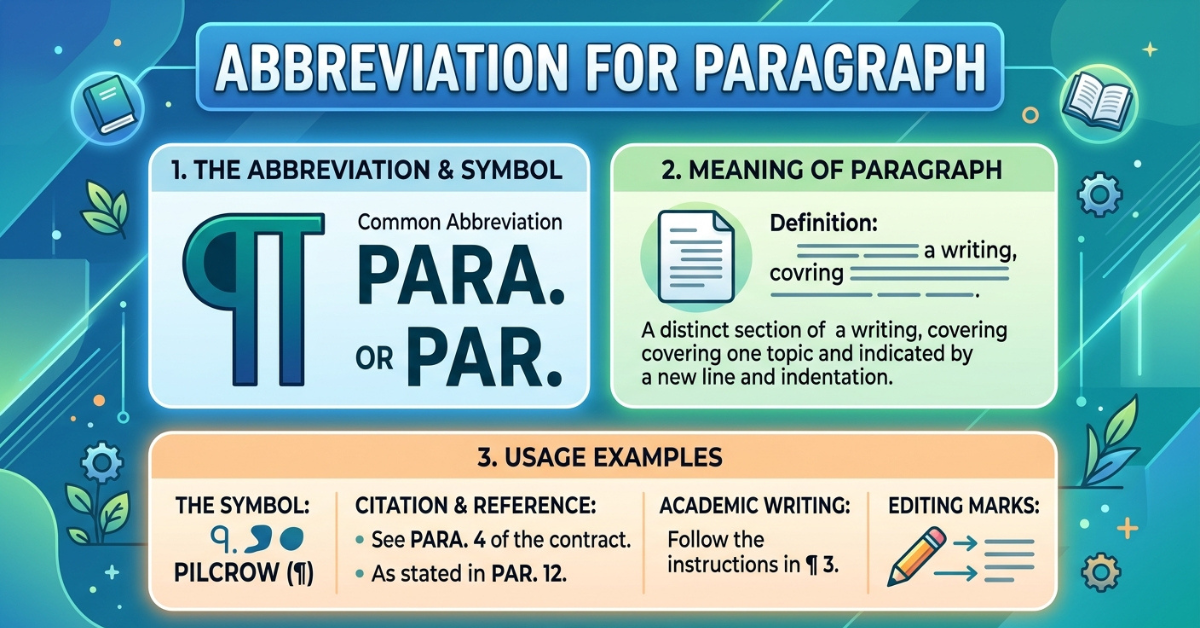
The most common abbreviation for paragraph is:
- para. = paragraph
- paras. = paragraphs (plural)
For example:
- See para. 4 for the main argument.
- The explanation appears in paras. 2–5.
This is the standard short form used when referring to one or more paragraphs in formal writing, editing, academic references, and legal documents.
Quick answer
If someone asks, “what is the abbreviation for paragraph?” the short answer is:
- para. for paragraph
- paras. for paragraphs
However, there’s one important twist: in some contexts, especially law and publishing, people also use the paragraph symbol. That’s where confusion often begins.
The Two Main Ways Paragraph Is Shortened
When people search for the abbreviation for paragraph, they may actually be referring to one of two things:
- The word abbreviation: para.
- The paragraph symbol: ¶
These are related, but they are not the same thing.
1) “para.” as the abbreviation
This is the standard written abbreviation of the word paragraph. It is commonly used in:
- essays
- reports
- academic citations
- editorial notes
- proofreading comments
- legal references
Example:
- Revise para. 3 for clarity.
- The author explains the theory in para. 7.
2) “¶” as the paragraph symbol
The symbol ¶ is called the pilcrow or paragraph mark. It is a typographical symbol used to indicate a paragraph or paragraph break. In some legal, editorial, and publishing contexts, it may stand in place of the word “paragraph.”
Example:
- See ¶ 12 of the judgment.
- The issue is discussed in ¶¶ 4–6.
So if you’re asking what is the abbreviation for paragraph, the answer is usually para., but depending on the context, you may also encounter ¶.
Abbreviation for Paragraph vs Paragraph Symbol: What’s the Difference?
This is where many people get tripped up. The abbreviation and the symbol serve similar purposes, but they’re used differently.
| Term | Form | Meaning | Common Use |
| Paragraph abbreviation | para. | Shortened form of the word paragraph | Academic, business, editing, general writing |
| Paragraph abbreviation plural | paras. | Shortened form of paragraphs | Formal references to multiple paragraphs |
| Paragraph symbol | ¶ | Symbol marking a paragraph | Legal writing, publishing, editorial work |
| Paragraph symbols plural | ¶¶ | Multiple paragraphs | Legal citations and case references |
In simple terms
- Use para. when you’re writing the word in abbreviated form.
- Use ¶ when the style guide, profession, or document format prefers the symbol.
What Does “Para.” Mean in Writing?
Para. is a shortened form of the noun paragraph. A paragraph is a group of sentences focused on one main idea. When writers, editors, teachers, and researchers need to refer to a specific paragraph without writing the full word each time, they often use para.
Common examples
- Please rewrite para. 2 to improve flow.
- The key evidence appears in para. 9.
- The conclusion is weak in para. 5.
- Refer to paras. 1–3 before answering.
This form saves space while keeping the meaning clear.
What Is the Paragraph Symbol (¶)?
The symbol ¶ is known as the pilcrow. It’s an old editorial and typographic mark used to indicate a paragraph. Today, it still appears in:
- legal documents
- court opinions
- statutes and regulations
- editing software
- publishing and proofreading
- word processors when formatting marks are enabled
Example usage
- The witness statement in ¶ 8 contradicts the earlier claim.
- The court discussed the issue in ¶¶ 15–17.
Why the symbol matters
The pilcrow is not just decorative. In legal writing and formal referencing, it helps point to exact sections of a document. That’s especially useful when page numbers change across digital and print versions, but paragraph numbering remains consistent.
Is “§” the Abbreviation for Paragraph?
No — and this is a very common mistake.
The symbol § does not mean paragraph. It stands for section.
Here’s the difference:
- para. = paragraph
- ¶ = paragraph symbol
- § = section symbol
Example
- § 4 = Section 4
- para. 4 = paragraph 4
- ¶ 4 = paragraph 4
This distinction matters a lot in legal, academic, and technical writing. If you use § when you mean paragraph, your reference can become inaccurate.
When to Use the Abbreviation for Paragraph
The best form depends on the type of writing you’re doing. In most situations, para. is the safest and clearest option.
Use “para.” in academic and general writing
In essays, assignments, reports, articles, or editorial comments, para. is the standard choice.
Examples:
- Expand the evidence in para. 3.
- The author’s strongest point appears in para. 6.
- Compare paras. 2 and 4.
Best for:
- student writing
- essays and dissertations
- internal reports
- article editing
- teacher feedback
- style notes
When to Use the Paragraph Symbol (¶)
Use ¶ only when the writing style, field, or publication convention supports it.
Common settings where ¶ is used
Legal writing
Lawyers, judges, and legal researchers often cite paragraphs using ¶.
Example:
- See ¶ 23 of the ruling.
Case law and judgments
Court decisions frequently number paragraphs for easier citation.
Example:
- The court’s reasoning is set out in ¶¶ 31–34.
Publishing and editing
Editors sometimes use the pilcrow to indicate paragraph breaks or formatting marks.
Word processing tools
In programs like Microsoft Word, the pilcrow may appear when “Show/Hide formatting marks” is turned on.
How to Write Paragraph in Singular and Plural Form
Here’s the standard format:
Singular
- para. = paragraph
- ¶ = paragraph
Plural
- paras. = paragraphs
- ¶¶ = paragraphs
Examples
Singular
- See para. 1.
- The issue appears in ¶ 1.
Plural
- Review paras. 2–4.
- The court explains this in ¶¶ 10–12.
Examples of the Abbreviation for Paragraph in Real Sentences
To understand how it works in practice, it helps to see it in context.
Academic writing
- The thesis statement appears in para. 1.
- The evidence becomes stronger in paras. 4–6.
Editing and proofreading
- Cut the repeated sentence in para. 3.
- The transition between paras. 5 and 6 needs improvement.
Legal writing
- The court clarified the standard in ¶ 18.
- The contradiction appears in ¶¶ 7–9.
Business or workplace writing
- Please shorten para. 2 in the report.
- The policy is explained in para. 8 of the memo.
How the Abbreviation for Paragraph Is Used in Different Fields
The phrase abbreviation for paragraph may seem universal, but the preferred format can vary by industry.
Academic writing
In schools, colleges, and research papers, para. is more common than the paragraph symbol. It’s straightforward, readable, and familiar to most instructors and readers.
Example
- The author introduces the concept in para. 2 and develops it in para. 5.
Legal writing
Law is one of the few fields where the paragraph symbol ¶ is heavily used. Legal citations often refer to numbered paragraphs in judgments, witness statements, and contracts.
Example
- The interpretation was challenged in ¶ 14.
Editing and publishing
Editors may use both para. and ¶ depending on house style. The pilcrow is also used visually to show paragraph breaks or formatting marks.
Corporate and business documents
In reports, proposals, and internal comments, para. is generally preferred because it’s clear to all readers, even those with no legal or editorial background.
Style Guide Considerations: Which Form Is More Correct?
There isn’t one universal rule for every type of document. The “correct” form depends on style, audience, and context.
In most general writing, use:
- para.
- paras.
In legal citations or documents with numbered paragraphs, use:
- ¶
- ¶¶
A practical rule of thumb
If your audience is broad and you want maximum clarity, use para. rather than the symbol. The symbol can be unfamiliar to casual readers, while para. is easier to understand instantly.
Common Mistakes People Make
When looking up what is the abbreviation for paragraph, people often run into misleading or mixed explanations. Here are the most common errors to avoid.
1. Confusing paragraph with section
As mentioned earlier:
- Paragraph = para. or ¶
- Section = §
These are not interchangeable.
2. Using “pg.” instead of paragraph
Pg. means page, not paragraph.
Wrong:
- See pg. 4 for paragraph 4.
Correct:
- See para. 4 for paragraph 4.
3. Using “para” without punctuation in formal writing
In many formal styles, para. includes a period because it is an abbreviation. Some style systems may vary, but para. is the safest standard form in formal English.
4. Using the pilcrow in casual writing
The symbol ¶ can look overly technical or legal in a normal blog post, essay, or workplace email. If you’re not writing in a legal or editorial context, para. is usually the better choice.
How to Type the Paragraph Symbol (¶)
If you need the symbol rather than the word abbreviation, here are a few practical ways to access it.
In Microsoft Word
- Go to the Home tab
- Look for the ¶ icon in the Paragraph group
- Click it to show or hide formatting marks
On a keyboard
Typing the pilcrow directly depends on your operating system and keyboard layout. Many users simply copy and paste ¶ when needed, especially in legal notes or citations.
On phones and tablets
It may not appear on the main keyboard, but you can usually find it in the symbols section or insert it by copying it from another source.
Abbreviation for Paragraph in Citations and References
Sometimes a citation style requires you to point readers to a specific paragraph rather than a page. This is especially common in:
- online articles without stable page numbers
- legal judgments
- government documents
- policy manuals
- digital reports
Example reference notes
- See para. 6 for the definition.
- The exception is discussed in paras. 10–12.
- The court addressed this in ¶ 22.
If a document already numbers its paragraphs, using paragraph references can be much more precise than page references.
Should You Use “Para.” or Write Out “Paragraph”?
Both are correct, but they serve different purposes.
Use “paragraph” in full when:
- you’re introducing the concept for the first time
- the sentence is meant for a broad audience
- clarity matters more than brevity
- you’re writing for beginners or school-level readers
Example:
- Each paragraph should focus on one central idea.
Use “para.” when:
- you’re referring to a specific paragraph number
- you’re annotating, editing, or citing a document
- you want to save space in formal notes or references
Example:
- Revise para. 5 for stronger evidence.
Quick Comparison Table
Here’s a simple reference table you can use anytime.
| Term | Meaning | Use Example |
| paragraph | Full word | Read the first paragraph carefully. |
| para. | Abbreviation for paragraph | See para. 3. |
| paras. | Abbreviation for paragraphs | Review paras. 2–5. |
| ¶ | Paragraph symbol | See ¶ 7. |
| ¶¶ | Multiple paragraph symbols | See ¶¶ 7–10. |
| § | Section symbol, not paragraph | See § 4. |
Practical Tips for Using the Abbreviation for Paragraph Correctly
If you want to use the abbreviation for paragraph accurately and professionally, keep these tips in mind.
1. Match the context
Use para. for general writing and ¶ only when the document style calls for it.
2. Stay consistent
Don’t switch between para. and ¶ randomly in the same document unless there’s a clear reason.
3. Don’t confuse paragraph and page references
- para. = paragraph
- p. = page
- pp. = pages
4. Check your style guide
If you’re writing a thesis, legal brief, research paper, or journal article, check whether your style guide has a preference.
5. Think about your reader
If the audience may not recognize ¶, use para. for clarity.
Key Takeaways
If you only remember a few things, make them these:
- The standard abbreviation for paragraph is para.
- The plural form is paras.
- The paragraph symbol is ¶, also called the pilcrow
- ¶ is often used in legal and editorial contexts
- § means section, not paragraph
- In most everyday, academic, and professional writing, para. is the clearest choice
Frequently Asked Questions
What is the abbreviation for paragraph?
The standard abbreviation for paragraph is para. If you’re referring to more than one paragraph, the plural form is paras. In legal or editorial contexts, the paragraph symbol ¶ may also be used.
Is “para” or “para.” correct?
In formal writing, para. is generally the correct abbreviation because it includes the period that marks it as shortened from “paragraph.” Some informal notes may drop the period, but para. is the safer standard.
What is the symbol for paragraph?
The symbol for paragraph is ¶, called the pilcrow. It is often used in legal writing, publishing, and formatting tools to represent a paragraph or paragraph reference.
Is § used for paragraph?
No. § is the symbol for section, not paragraph. If you want the abbreviation for paragraph, use para. or, in some contexts, the paragraph symbol ¶.
What is the plural abbreviation for paragraph?
The plural abbreviation is paras. For example, you might write: “See paras. 3–5.” In legal citations, the plural symbol form is ¶¶.
Should I use para. or paragraph in an essay?
If you’re discussing paragraph structure generally, writing out paragraph is often clearer. But if you’re referring to a specific numbered paragraph in comments or notes, para. is perfectly appropriate.
Conclusion
So, what is the abbreviation for paragraph? In most cases, the answer is simple: para. for one paragraph and paras. for more than one. If you work with legal documents, editing marks, or specialized references, you may also see the paragraph symbol ¶, which serves a similar purpose in a different format.
Understanding the difference between para., ¶, and § can save you from small but important writing mistakes. And if you regularly write essays, reports, citations, or formal documents, using the right form makes your work look more polished and precise. Keep this guide handy the next time you need to reference a paragraph correctly—and you’ll never have to second-guess it again.