Have you ever read the words “pail” and “pale” and wondered whether they’re interchangeable? You’re not alone. These two words sound exactly alike, making them a common source of confusion for students, writers, and even native English speakers.
Understanding pail vs pale is easier than it seems. While they share the same pronunciation, their meanings, spellings, and uses are completely different. In this guide, you’ll learn the definition of each word, practical examples, memory tricks, common mistakes, and when to use the correct spelling with confidence.
Understanding Homophones
Before comparing the two words, it’s helpful to know why they’re confusing.
Pail and pale are homophones—words that sound the same but have different spellings and meanings. English contains many homophone pairs, such as:
- Flour and flower
- Right and write
- Pair and pear
- Sea and see
Recognizing homophones is an important step toward improving both writing accuracy and vocabulary.
What Does “Pail” Mean?
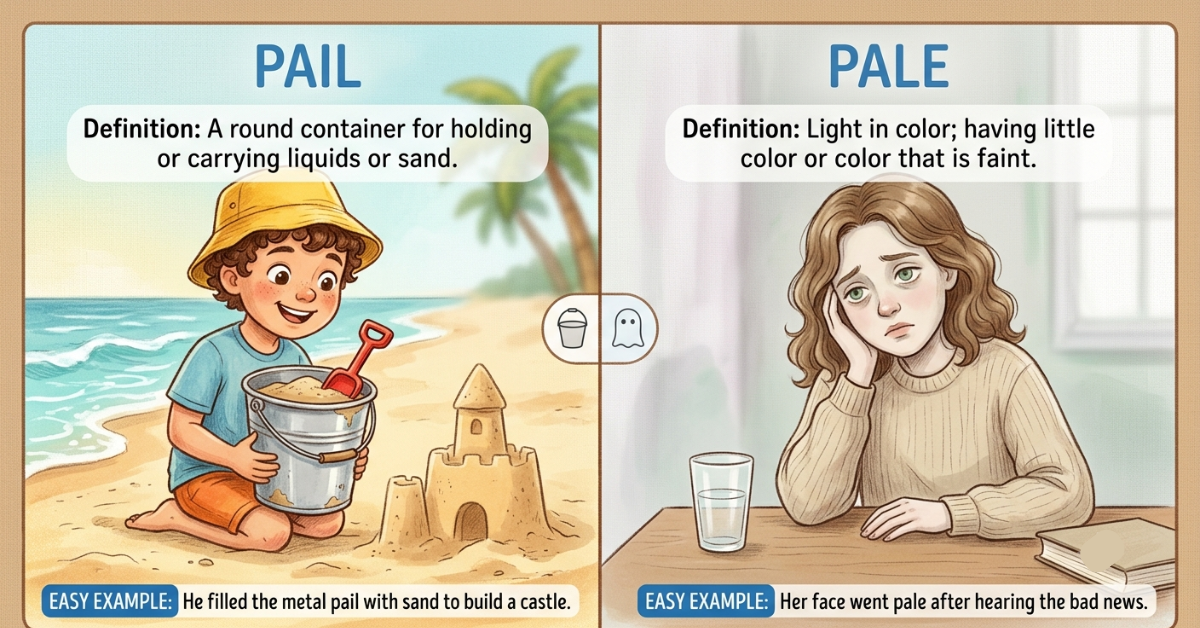
A pail is a bucket or container, usually with a handle, used to carry or store liquids, sand, soil, or other materials.
Definition
Pail (noun): A bucket, often made of plastic or metal, designed for carrying or holding something.
Examples
- She filled the pail with water from the well.
- The child carried a colorful pail to the beach.
- The gardener used a metal pail for compost.
- We kept cleaning supplies inside a large pail.
Common Uses of “Pail”
You may see this word in situations involving:
- Gardening
- Cleaning
- Construction
- Farming
- Beach activities
- Household chores
What Does “Pale” Mean?
Pale usually describes something that lacks strong color or brightness. It can also refer to someone’s appearance when they’re sick, frightened, or tired.
Definition
Pale (adjective): Light in color or lacking healthy color.
Examples
- Her face became pale after hearing the news.
- The walls were painted a pale blue.
- The moon gave off a pale glow.
- His skin looked unusually pale during winter.
Other Meanings of “Pale”
Although less common, pale can also function as:
A Verb
To become less important or less noticeable.
Examples:
- Their achievements paled in comparison.
- The stars paled as the sun rose.
A Noun (Historical)
Historically, a pale referred to a fence, boundary, or enclosed area. This usage is uncommon today but survives in expressions such as “beyond the pale,” meaning outside acceptable limits.
Pail vs Pale: Side-by-Side Comparison
| Feature | Pail | Pale |
| Part of speech | Noun | Adjective, verb, noun |
| Meaning | A bucket or container | Light in color or lacking color |
| Pronunciation | Payl | Payl |
| Common context | Carrying water, sand, paint | Skin color, light shades, brightness |
| Example | A bucket of water | A pale yellow flower |
Pronunciation: Why They’re Confusing
One reason people mix up these words is that they’re pronounced exactly the same.
Pail: /peɪl/
Pale: /peɪl/
Because pronunciation offers no clue, writers must rely on spelling and context to choose the correct word.
Memory Tricks to Remember the Difference
Simple memory devices can help prevent mistakes.
Remember “Pail”
Think of the letter “i” in pail as standing for inside.
Things go inside a pail.
Remember “Pale”
Think of pale as describing a person’s appearance or paint color.
If you’re talking about color, shade, skin, or brightness, choose pale.
Common Mistakes People Make
Here are some frequent errors.
Incorrect
- She carried a pale of water.
Correct
- She carried a pail of water.
Incorrect
- He looked pail after the marathon.
Correct
- He looked pale after the marathon.
Incorrect
- We bought a pail pink dress.
Correct
- We bought a pale pink dress.
When Should You Use “Pail”?
Use pail whenever you’re referring to a physical container.
Examples include:
- Water pail
- Sand pail
- Paint pail
- Metal pail
- Plastic pail
- Bucket pail
If you can replace the word with bucket, then pail is almost certainly correct.
When Should You Use “Pale”?
Use pale whenever you’re describing:
- Colors
- Skin tone
- Light
- Brightness
- Weak appearance
- Something becoming less significant
Examples:
- Pale green
- Pale yellow
- Pale skin
- Pale moonlight
- Pale complexion
Real-World Examples
Imagine you’re at the beach.
Correct sentence:
The child filled a pail with sand while wearing a pale blue hat.
Here, the first word refers to a bucket, while the second describes the hat’s color.
Another example:
The firefighter carried a heavy pail, but his face became pale from exhaustion.
Each word serves a completely different purpose despite sounding identical.
Why Mixing Them Up Matters
Although readers often understand what you mean, using the wrong spelling can:
- Make writing appear less polished
- Cause confusion
- Reduce credibility in professional communication
- Lead to spelling mistakes in academic work
Learning common homophones strengthens overall writing quality.
Similar Word Pairs Worth Learning
If you’re studying English vocabulary, you may also encounter these commonly confused words:
- Accept vs Except
- Affect vs Effect
- Compliment vs Complement
- Stationary vs Stationery
- Principal vs Principle
- Desert vs Dessert
- Peek vs Peak vs Pique
Mastering these pairs improves grammar, spelling, and confidence.
Quick Practice Quiz
Choose the correct word.
1. She carried a ______ of fresh water.
Answer: Pail
2. The room was painted ______ yellow.
Answer: Pale
3. His face turned ______ after the accident.
Answer: Pale
4. The children filled their ______ with seashells.
Answer: Pails
5. The moon gave a ______ silver light.
Answer: Pale
Practical Tips for Remembering the Difference
- Replace pail with bucket. If the sentence still makes sense, you’ve chosen the right word.
- If you’re describing a color, use pale.
- Think about whether you’re discussing an object or an appearance.
- Read your sentence aloud and identify the context rather than relying on pronunciation.
- Practice with example sentences to reinforce the distinction.
Key Takeaways
- Pail is a noun meaning a bucket or container.
- Pale usually describes something light in color or lacking color.
- Both words are pronounced the same, making them homophones.
- Context—not pronunciation—determines the correct spelling.
- A simple memory trick is that things go inside a pail, while pale relates to color or appearance.
Frequently Asked Questions
Is pail the same as a bucket?
Yes. A pail is essentially a bucket, although “bucket” is more commonly used in everyday conversation.
Why do pail and pale sound the same?
They are homophones in English, meaning they share the same pronunciation but have different spellings and meanings.
Can pale be used as a verb?
Yes. Pale can mean to become less important, less impressive, or less noticeable. For example, “His accomplishments paled beside hers.”
Is it “pale blue” or “pail blue”?
The correct phrase is pale blue because you’re describing a light shade of blue.
How do I remember pail vs pale?
Remember that pail holds things like a bucket, while pale describes colors, light, or someone’s appearance.
Which word is more common in everyday English?
Pale is generally more common because it appears frequently when describing colors, skin tone, and light. Pail is mostly used when referring to buckets or containers.
Conclusion
Understanding pail vs pale is straightforward once you focus on context rather than pronunciation. A pail is a container used for carrying or storing things, while pale describes light colors, faded appearances, or something becoming less noticeable. Since they’re homophones, careful spelling is essential for clear communication.
The next time you encounter these words, remember the simple distinction: objects go in a pail, while colors and complexions can be pale. With a little practice, you’ll never confuse them again, making your writing more accurate, polished, and professional.