It’s one of those small English mix-ups that can quietly change the meaning of a sentence. You’re writing an email, a school assignment, or even a social media caption, and suddenly you pause: is it “overdo” or “overdue”? They sound similar, but they mean completely different things. And using the wrong one can make a sentence look awkward—or worse, confusing.
If you’ve ever searched overdo vs overdue, you’re not alone. These two words are commonly confused because they share the same opening sound and are both used in everyday English. But grammatically and semantically, they live in different worlds. In this guide, you’ll learn the meaning of each word, how to use them correctly, the key differences between them, common mistakes people make, and easy tricks to remember which one belongs in your sentence.
Overdo vs Overdue: The Quick Answer
Here’s the short version:
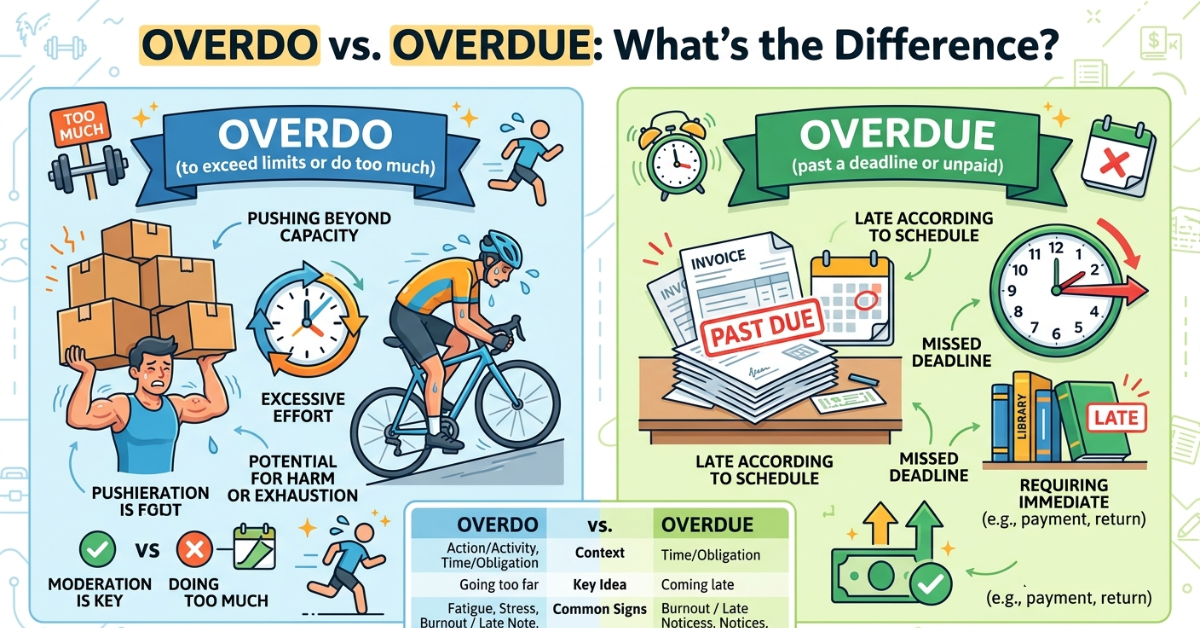
- Overdo is a verb. It means to do something too much or to exaggerate.
- Overdue is an adjective. It means late or not done by the expected time.
Example:
- Don’t overdo it at the gym.
= Don’t do too much exercise. - My library book is overdue.
= The return date has passed; it’s late.
That’s the core of overdo vs overdue in one glance: one is about excess, and the other is about lateness.
Why “Overdo” and “Overdue” Get Confused
At first glance, the confusion makes sense. Both words begin with over-, and both are common in writing and speech. But the endings change everything:
- do relates to doing
- due relates to deadline, obligation, or expected time
Because they’re pronounced somewhat similarly in fast speech, writers sometimes type one when they mean the other—especially when they’re writing quickly or relying on autocorrect less than they should.
This confusion shows up a lot in:
- emails
- school assignments
- office communication
- captions and comments
- informal messaging
For example, someone might write:
- “My assignment is overdo.” (incorrect)
when they really mean: - “My assignment is overdue.” (correct)
That one-letter difference completely changes the sentence.
What Does “Overdo” Mean?
Overdo means to do something excessively, go too far, or exaggerate something beyond what is necessary or appropriate.
It is a verb, so it describes an action.
Basic definition of overdo
Overdo (verb): to do, use, or say something too much.
Common ways “overdo” is used
You can use overdo in several contexts:
1. Doing too much of an activity
- Don’t overdo your workout on the first day.
- She tends to overdo things when she gets excited.
- I overdid it with the cleaning and ended up exhausted.
2. Using too much of something
- He overdid the salt in the soup.
- They overdid the decorations for a simple dinner party.
3. Exaggerating behavior, emotion, or style
- The actor overdid the accent.
- You don’t need to overdo the apology.
- Sometimes people overdo enthusiasm in interviews.
Forms of “overdo”
Since overdo is a verb, it changes form depending on tense:
- Base form: overdo
- Past tense: overdid
- Past participle: overdone
- Present participle: overdoing
Examples:
- Try not to overdo the makeup.
- I overdid the caffeine yesterday.
- The room was beautifully styled, but the lighting felt overdone.
- She’s overdoing the drama a little.
What Does “Overdue” Mean?
Overdue means late, past the expected time, or not completed by the deadline. It is an adjective, not a verb.
Basic definition of overdue
Overdue (adjective): not having arrived, happened, or been done by the expected date or time.
Common ways “overdue” is used
1. Missed deadlines
- My assignment is overdue.
- The electricity bill is overdue.
- The project submission became overdue after Friday.
2. Borrowed items returned late
- Your library books are overdue.
- She had to pay a fine because the DVDs were overdue.
3. Something delayed longer than expected
- The train is overdue by 20 minutes.
- Rain is overdue after such a dry season.
- A serious conversation about finances is long overdue.
That last example is important because overdue is not limited to bills and assignments. It can also describe something that should have happened a long time ago.
Examples of overdue in different contexts
- The payment is overdue.
- His medical checkup is overdue.
- Their apology was long overdue.
- The package seems overdue, but the courier hasn’t updated the tracking.
Overdo vs Overdue: Side-by-Side Comparison
The easiest way to understand overdo vs overdue is to compare them directly.
| Word | Part of Speech | Meaning | Used For | Example |
| Overdo | Verb | To do too much; exaggerate | actions, effort, style, emotion, food, exercise | Don’t overdo the spices. |
| Overdue | Adjective | Late; past the expected time | bills, assignments, books, tasks, conversations, payments | My rent is overdue. |
In simple terms:
- If the sentence is about too much, use overdo.
- If the sentence is about too late, use overdue.
That’s the real difference in overdo vs overdue.
How to Know Which One to Use
If you’re stuck in the moment and need a quick test, ask yourself one of these two questions:
Ask Question #1: Am I talking about excess?
If yes, you probably need overdo.
Examples:
- Did I use too much makeup?
- Did he talk too much?
- Did we decorate too heavily?
- Did I push myself too hard?
All of these point toward overdo.
Ask Question #2: Am I talking about lateness or a missed deadline?
If yes, you probably need overdue.
Examples:
- Is the payment late?
- Is the homework past the due date?
- Has the package not arrived on time?
- Is the report still unfinished after the deadline?
All of these point toward overdue.
Sentence Examples: Overdo vs Overdue in Real Use
Sometimes the best way to lock in meaning is through examples. Here’s how the two words behave in real sentences.
Examples with “overdo”
- Don’t overdo the perfume before the event.
- He overdid the presentation and made it longer than necessary.
- I know you want to help, but don’t overdo it.
- She overdoes the dramatic pauses when telling a story.
- We overdid the spending during the holiday season.
Examples with “overdue”
- My credit card payment is overdue.
- The team’s final report is already overdue.
- Your dental appointment is long overdue.
- Several invoices are overdue this month.
- The bus was overdue, so everyone at the stop was getting impatient.
Common Mistakes People Make
Mistake 1: Using “overdo” when talking about a late assignment
Incorrect: My assignment is overdo.
Correct: My assignment is overdue.
Why? Because an assignment being late is about time, not doing too much.
Mistake 2: Using “overdue” when talking about excess effort
Incorrect: Don’t overdue the decorations.
Correct: Don’t overdo the decorations.
Why? Because the sentence is about doing too much, not being late.
Mistake 3: Assuming both words are interchangeable
They are not interchangeable at all. This is not a minor spelling variation. It’s a completely different word pair with different grammar roles.
Grammar Breakdown: Verb vs Adjective
A major reason this confusion happens is that people focus on sound rather than grammar. But grammar makes the distinction very clear.
“Overdo” Is a Verb
A verb expresses an action.
Examples:
- I overdid the workout.
- Don’t overdo the sarcasm.
- She is overdoing the glitter.
Because it’s a verb, it can change tense and work with subjects.
“Overdue” Is an Adjective
An adjective describes a noun or a state.
Examples:
- The payment is overdue.
- An overdue bill arrived in the mail.
- His response was long overdue.
Because it’s an adjective, it usually describes something like:
- payment
- assignment
- rent
- book
- conversation
- response
- appointment
So if your sentence needs an action, overdo may fit. If it needs a description of something late, overdue is the right word.
Easy Memory Trick for Overdo vs Overdue
If you keep mixing them up, use this simple memory trick:
Overdo = do too much
The word literally contains do, which can remind you of doing something excessively.
Overdue = past the due date
The word contains due, which connects directly to deadline, payment due, or assignment due.
That one mental shortcut can save you from making the mistake again.
When “Overdue” Is Used Figuratively
One interesting thing about overdue is that it often appears in figurative or emotional contexts—not just literal deadlines.
Examples:
- A break from work is long overdue.
- The city’s public transport system is overdue for improvement.
- She felt an honest conversation was overdue.
- Their success was long overdue after years of hard work.
In these cases, overdue means something should have happened sooner. It adds a sense of delay, anticipation, or even relief.
When “Overdo” Has a Tone of Warning
Overdo often appears in advice, warnings, or cautionary statements. That’s because it usually suggests someone has gone beyond a healthy, reasonable, or effective limit.
Examples:
- Don’t overdo your back exercises.
- Try not to overdo the spending this month.
- It’s great to be enthusiastic, but don’t overdo it in the interview.
- You can decorate the room beautifully without overdoing the gold accents.
This makes overdo especially common in:
- health and fitness advice
- beauty and fashion discussions
- parenting guidance
- cooking instructions
- workplace feedback
Overdo vs Overdue in Everyday Writing
Here’s where these words commonly appear in real life.
You’ll likely use overdo in:
- fitness advice
- cooking directions
- style or makeup discussions
- performance reviews
- casual speech about effort or exaggeration
You’ll likely use overdue in:
- school and university assignments
- invoices and payments
- libraries and rentals
- project management
- medical checkups and appointments
- delayed conversations or life decisions
If you’re writing emails, reports, or captions, understanding overdo vs overdue helps you sound more polished and precise.
Mini Comparison Examples
Here are some quick pairs that make the contrast obvious:
- Don’t overdo the sugar.
= Don’t add too much sugar. - The payment is overdue.
= The payment is late. - He overdid the speech.
= He made it too long or dramatic. - Her assignment is overdue.
= She missed the submission deadline. - You can celebrate without overdoing it.
= Enjoy it, but don’t go too far. - That repair is overdue.
= It should have been done earlier.
Quick Rules to Remember
If you want a simple checklist, keep this in mind:
Use overdo when:
- someone is doing too much
- something is exaggerated
- effort, style, food, exercise, or emotion is excessive
- the word functions as a verb
Use overdue when:
- something is late
- a deadline has passed
- a bill, task, assignment, or payment is unpaid or unfinished
- something should have happened already
- the word functions as an adjective
Key Takeaways
Here’s the difference in one clean snapshot:
- Overdo = do too much
- Overdue = late / past due
And grammatically:
- Overdo is a verb
- Overdue is an adjective
So:
- Don’t overdo the decorations
- The rent is overdue
Once you tie overdo to doing too much and overdue to due dates, the confusion becomes much easier to avoid.
FAQs About Overdo vs Overdue
Is it “my assignment is overdo” or “my assignment is overdue”?
The correct phrase is “my assignment is overdue.” An assignment can be late, so you need overdue, not overdo.
What is the difference between overdo and overdue?
The difference is simple: overdo means to do something too much, while overdue means something is late or past its due date. One refers to excess; the other refers to delay.
Is “overdo” a real word?
Yes, overdo is a real word and a common verb. It means to go too far, exaggerate, or do more than necessary.
Can overdue be used for things other than bills?
Absolutely. Overdue can describe assignments, books, appointments, repairs, conversations, or anything that should have happened by a certain time but didn’t.
How do I remember overdo vs overdue?
A simple trick is this: overdo contains do, so think do too much. Overdue contains due, so think past the due date.
Is “overdue” always about deadlines?
Not always. It often refers to deadlines, but it can also be used more broadly to describe something that should have happened sooner, like an apology, a vacation, or a serious discussion.
Conclusion
The confusion around overdo vs overdue is understandable, but the distinction is actually very straightforward once you break it down. Overdo is about excess—doing something too much, pushing too far, or exaggerating. Overdue is about time—something being late, delayed, or past the expected date.
If you remember just one thing, make it this: overdo = too much, overdue = too late. That one rule will help you write more accurately in emails, assignments, professional communication, and everyday conversation. And if you’re trying to sharpen your English even further, keep an eye out for word pairs like this—they’re small, but mastering them makes a big difference in how polished your writing feels.