English grammar can be tricky, especially when words look similar but behave differently. One common confusion is raise vs rise. These two verbs are often mixed up because they both relate to upward movement—but they are not interchangeable.
In this guide, we’ll break down their differences and how to use them correctly in everyday writing and speech. By the end, you’ll never confuse them again.
What is the Difference Between Raise vs Rise?
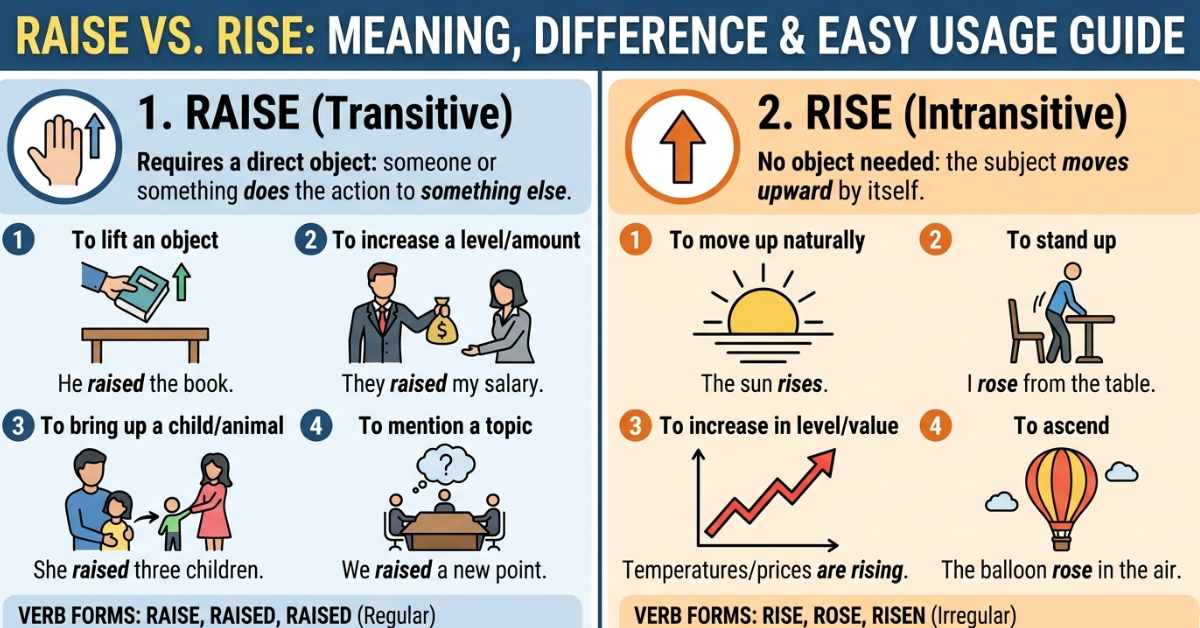
The main difference lies in whether the action needs an object or not.
- Raise → a transitive verb (needs an object)
- Rise → an intransitive verb (does NOT take an object)
In simple terms:
- You raise something
- Something rises on its own
This is the core rule that helps eliminate confusion.
Raise vs Rise Meaning Explained
1. Meaning of Raise
The word raise means to lift, move upward, or increase something. It always requires an object.
Common meanings:
- To lift something physically
- To increase levels (salary, prices, etc.)
- To bring something to attention
Examples:
- Please raise your hand.
- The company will raise salaries next year.
- She raised the box from the floor.
2. Meaning of Rise
The word rise means to move upward on its own or increase without an object.
Common meanings:
- To go up physically
- To increase naturally (sun, prices, emotions)
- To stand up
Examples:
- The sun rises in the east.
- Hot air rises.
- He rose from his chair.
Raise vs Rise: Key Differences at a Glance
| Feature | Raise | Rise |
| Object needed | Yes | No |
| Type | Transitive verb | Intransitive verb |
| Past tense | Raised | Rose |
| Example | She raised her voice | The voice rose |
Understanding this table makes meaning much easier to remember.
Common Mistakes People Make
Even advanced English learners confuse these words. Here are common errors:
- Incorrect: The sun raises in the east
Correct: The sun rises in the east - Incorrect: He rose his hand
Correct: He raised his hand - Incorrect: Prices are rising the government
Correct: The government is raising prices
A simple trick: if something is doing the action itself, use rise. If someone is doing it to something else, use raise.
Easy Memory Trick
Here’s a quick way to remember:
- R-A-I-S-E = has an “A” → Action on something else
- R-I-S-E = no “A” → Action happens on its own
This small trick can help you avoid confusion in exams, writing, and daily conversation.
Real-Life Usage Examples
Everyday English
- Please raise your voice so I can hear you.
- The temperature is rising today.
Academic Writing
- The researcher raised an important question.
- Crime rates have risen in urban areas.
Workplace Communication
- The manager decided to raise the budget.
- Productivity levels rose last quarter.
Why People Confuse Raise vs Rise
The confusion mainly happens because both words:
- Indicate upward movement
- Are commonly used in formal and informal English
- Have irregular past forms (raise → raised, rise → rose)
But once you understand the object rule, the difference becomes clear.
FAQs About Raise vs Rise
1. What is the main difference between raise vs rise?
The main difference is that raise requires an object, while rise does not.
2. Can raise vs rise be used interchangeably?
No, they cannot be used interchangeably because their grammar structure is different.
3. What is the past tense of raise vs rise?
- Raise → Raised
- Rise → Rose
4. Is it correct to say “rise the flag”?
No, the correct form is “raise the flag” because someone is doing the action.
5. How can I easily remember raise vs rise meaning?
Remember:
- Raise = you lift something
- Rise = something goes up on its own
Conclusion
Understanding raise vs rise is all about grammar structure and object usage. While both words involve upward movement, their usage is different and not interchangeable.
To quickly recap:
- Use raise when there is an object receiving the action
- Use rise when something moves upward on its own
Mastering raise vs rise meaning will improve your writing clarity, boost your grammar confidence, and help you avoid common English mistakes. If you’re learning grammar step by step, this is one distinction worth remembering for life.