Have you ever wondered how some drivers can travel long distances without constantly pressing the accelerator pedal? The answer often lies in a feature called cruise control. Understanding the cruise control meaning can help drivers make better use of this technology and enjoy a more comfortable driving experience.
Cruise control has become a standard feature in many modern vehicles, helping drivers maintain a steady speed without continuous foot pressure on the gas pedal. Whether you’re planning a road trip or simply curious about vehicle technology, knowing how cruise control works can improve both convenience and efficiency on the road.
What Is Cruise Control?
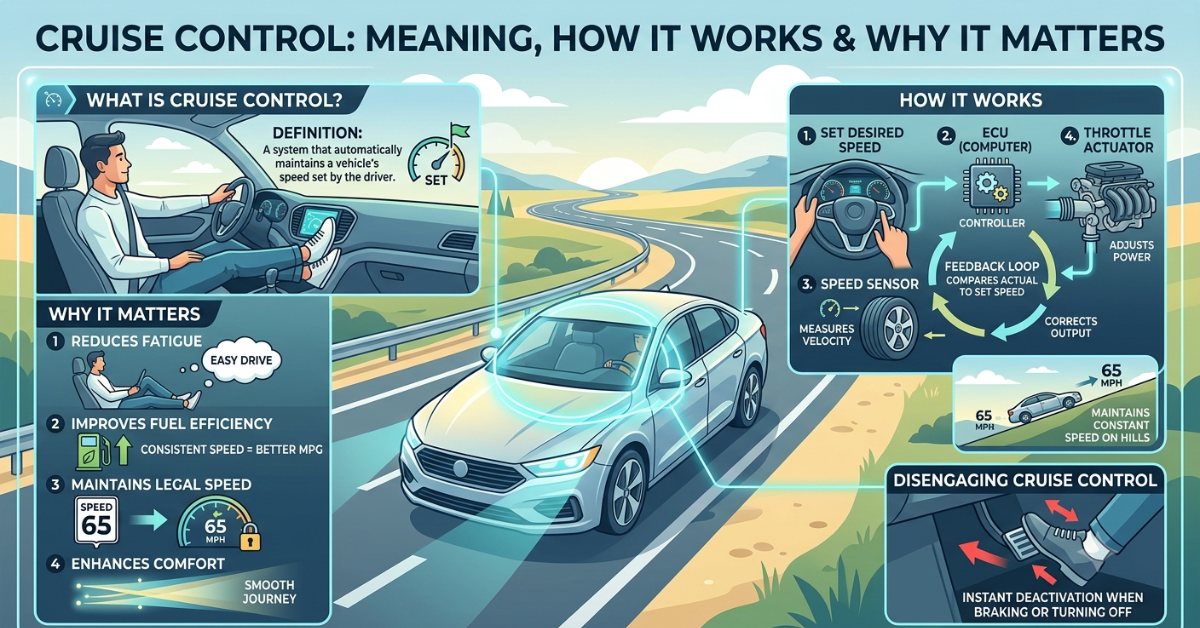
The cruise control meaning refers to a vehicle system that automatically maintains a driver-selected speed without requiring the driver to keep pressing the accelerator pedal.
Once activated, the system controls the throttle to keep the vehicle moving at a constant speed. This feature is especially useful on highways and long stretches of road where speed changes are minimal.
Simple Definition
Cruise control is an electronic driving assistance system that:
- Maintains a constant speed automatically
- Reduces the need for continuous accelerator input
- Helps minimize driver fatigue during long trips
How Does Cruise Control Work?
Cruise control uses sensors and electronic controls to monitor the vehicle’s speed. When the driver sets a desired speed, the system adjusts engine power as needed to maintain that speed.
Basic Working Process
- Accelerate to your desired speed.
- Press the cruise control activation button.
- Set the current speed.
- The system takes over throttle control.
- The vehicle maintains the selected speed until the driver intervenes.
Drivers can usually deactivate the system by:
- Pressing the brake pedal
- Pressing the clutch pedal in manual vehicles
- Turning off the cruise control function
- Pressing the cancel button
The History of Cruise Control
Cruise control was first introduced to improve driving comfort and speed consistency. Over time, advancements in automotive technology transformed it from a luxury feature into a common standard in many vehicles.
Modern versions have evolved into sophisticated systems capable of adjusting speed automatically based on traffic conditions.
Types of Cruise Control Systems
Not all cruise control systems function in the same way. Modern vehicles may offer several variations.
Traditional Cruise Control
This basic system maintains a fixed speed selected by the driver.
Best for:
- Open highways
- Light traffic conditions
- Long-distance travel
Adaptive Cruise Control (ACC)
Adaptive cruise control is a more advanced version that uses radar, cameras, or sensors to detect vehicles ahead.
Features include:
- Automatic speed adjustments
- Maintaining a safe following distance
- Reduced need for manual braking
Intelligent Cruise Control
Some modern vehicles combine adaptive cruise control with lane-keeping assistance and traffic monitoring systems.
These systems can:
- Slow down in traffic
- Resume speed automatically
- Improve driving convenience
Benefits of Using Cruise Control
Cruise control offers several advantages for drivers.
Reduced Driver Fatigue
Holding the accelerator for hours can become tiring. Cruise control allows drivers to relax their leg muscles during long journeys.
Improved Fuel Efficiency
Maintaining a constant speed often helps reduce unnecessary acceleration and deceleration, which can improve fuel economy.
Better Speed Management
Cruise control helps drivers stay within speed limits by preventing accidental speeding.
Enhanced Driving Comfort
Long highway trips become more comfortable when drivers do not have to constantly adjust the accelerator.
Potential Drawbacks of Cruise Control
Although useful, cruise control is not appropriate for every driving situation.
Reduced Driver Engagement
Some drivers may become less attentive when relying too heavily on automated driving features.
Not Ideal in Heavy Traffic
Frequent speed changes make cruise control less practical in congested areas.
Challenging Weather Conditions
Rain, snow, ice, or fog can make constant-speed driving unsafe.
Avoid using cruise control when:
- Roads are slippery
- Visibility is poor
- Traffic is unpredictable
When Should You Use Cruise Control?
Cruise control works best under specific conditions.
Ideal Situations
- Long highway drives
- Light traffic
- Dry road surfaces
- Consistent speed zones
Situations to Avoid
- City driving
- Mountain roads
- Heavy traffic
- Wet or icy roads
- Construction zones
Cruise Control vs Adaptive Cruise Control
Many people confuse standard cruise control with adaptive cruise control.
| Feature | Cruise Control | Adaptive Cruise Control |
| Maintains Set Speed | Yes | Yes |
| Adjusts for Traffic | No | Yes |
| Uses Sensors | No | Yes |
| Automatic Braking | No | Often Yes |
| Driver Convenience | Good | Excellent |
Adaptive cruise control provides a higher level of automation and safety compared to traditional systems.
Common Cruise Control Symbols
Most vehicles use dashboard indicators to show cruise control status.
Common symbols include:
- Speedometer icon
- Steering wheel symbol
- Green cruise control indicator
- Vehicle-following-distance icon for adaptive systems
Consult your vehicle’s manual for exact symbol meanings.
Safety Tips for Using Cruise Control
To use cruise control safely:
- Keep both hands on the steering wheel.
- Stay alert at all times.
- Monitor surrounding traffic.
- Be prepared to brake immediately.
- Turn off cruise control in poor weather conditions.
Remember that cruise control assists driving but does not replace driver responsibility.
Why Cruise Control Is Important in Modern Vehicles
As automotive technology continues to evolve, cruise control plays an increasingly important role in improving comfort, efficiency, and safety.
Advanced systems are paving the way for semi-autonomous driving technologies by helping vehicles maintain speed and distance with minimal driver input.
FAQs
What is the cruise control meaning in a car?
Cruise control is a system that automatically maintains a vehicle’s speed without requiring the driver to continuously press the accelerator pedal.
Does cruise control save fuel?
Yes, in many situations. By maintaining a steady speed, cruise control can improve fuel efficiency, especially on highways.
Is cruise control safe to use?
Yes, when used appropriately on clear roads and in favorable weather conditions. Drivers should remain attentive and ready to take control at any time.
What is adaptive cruise control?
Adaptive cruise control is an advanced version that automatically adjusts vehicle speed to maintain a safe distance from traffic ahead.
Can cruise control be used in city traffic?
It is generally not recommended because city driving involves frequent stopping, turning, and speed adjustments.
Does cruise control apply brakes?
Traditional cruise control usually does not. However, adaptive cruise control systems can automatically reduce speed and may apply braking when necessary.
Conclusion
Understanding the cruise control meaning helps drivers make better use of one of the most practical features found in modern vehicles. By automatically maintaining a selected speed, cruise control reduces fatigue, improves driving comfort, and can even contribute to better fuel efficiency. While it works best on highways and open roads, drivers should always remain attentive and use the system only in suitable conditions. As vehicle technology continues to advance, cruise control remains an important stepping stone toward smarter and safer driving experiences.