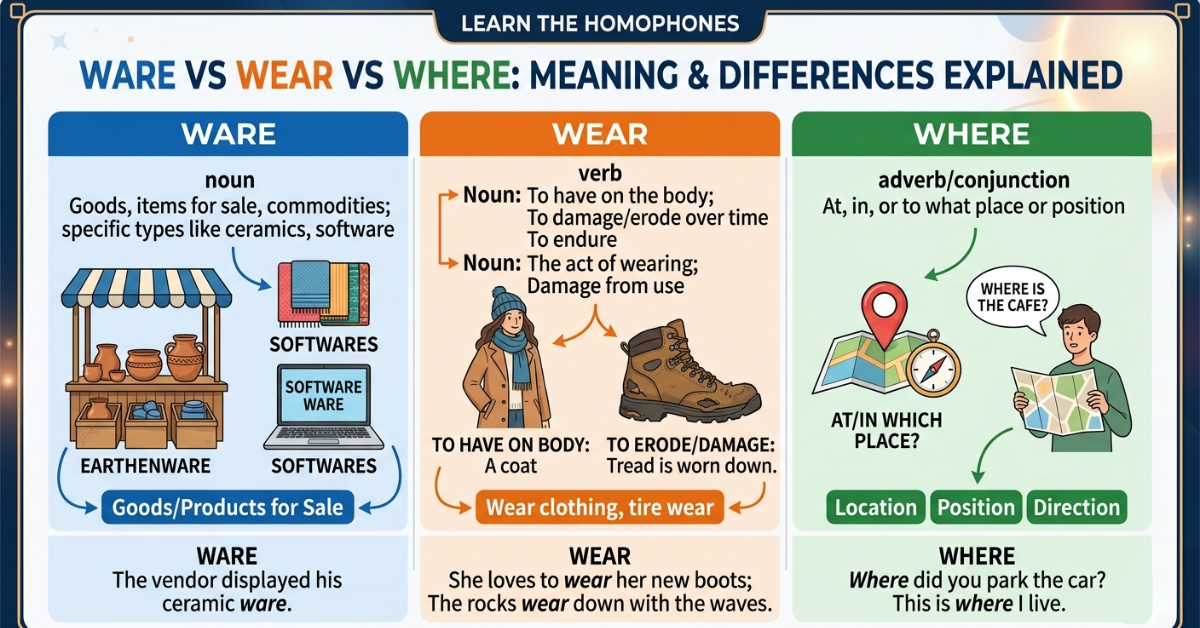
The confusion between Ware vs Wear vs Where is one of the most common spelling challenges in English, especially for learners and even native speakers. These three words sound similar but have completely different meanings and uses.
In this guide, we’ll break down Ware vs Wear vs Where in a simple, practical way so you can finally stop mixing them up. Whether you’re writing emails, essays, or social media captions, understanding these words will improve your clarity and confidence in English.
Ware vs Wear vs Where: What Do They Mean?
To truly understand Ware vs Wear vs Where, you need to look at each word individually. Even though they sound alike, their meanings belong to completely different contexts.
1. Ware
“Ware” usually refers to goods, products, or merchandise.
- Examples:
- Kitchenware (items used in the kitchen)
- Software (computer programs)
- Hardware (physical computer parts)
Think of “ware” as things or products.
2. Wear
“Wear” is mainly used as a verb meaning to put on clothes or carry something on your body.
- Examples:
- I wear glasses every day.
- She wears a blue jacket.
It can also mean damage from use:
- The shoes show signs of wear.
Think of “wear” as using or putting on something.
3. Where
“Where” is a question word used to ask about location or place.
- Examples:
- Where are you going?
- Where is my phone?
Think of “where” as asking about place.
Simple Breakdown of Ware vs Wear vs Where
To make Ware vs Wear vs Where even easier, here’s a quick comparison:
- Ware → things or products (software, kitchenware)
- Wear → clothing or usage (wear a shirt, wear out)
- Where → location (where are you?)
A simple trick:
If you’re confused, think:
- Ware = items
- Wear = clothing/use
- Where = place
Common Mistakes with Ware vs Wear vs Where
Many learners mix these words because they sound identical. Here are some common errors:
1. Spelling Confusion
- Incorrect: Where are you going to the party (when talking about clothes)
- Correct: I will wear a dress to the party
2. Wrong Context Usage
- Incorrect: This shop sells kitchen where
- Correct: This shop sells kitchenware
3. Mixing Question Word
- Incorrect: Wear is your book?
- Correct: Where is your book?
These mistakes happen often, but with practice, they become easy to fix.
Easy Memory Tricks
Here are a few simple tricks to remember:
- Ware = Warehouse = products stored
- Wear = clothes you wear
- Where = question asking place
Another trick:
- “EA” in wear = clothes on your body
- “HE” in where = asking HEre or there?
- “A” in ware = things/items
Why Ware vs Wear vs Where Confuses So Many People
The main reason Ware vs Wear vs Where is confusing is because they are homophones—words that sound the same but have different meanings and spellings.
English has many such words, which makes spelling tricky. That’s why understanding context is more important than just memorizing spellings.
Quick Practice Examples
Try filling in the blanks:
- I will ___ a red shirt today.
- ___ is the nearest café?
- This store sells electronic ___.
Answers:
- wear
- where
- ware
Conclusion
Mastering Ware vs Wear vs Where is all about understanding context rather than memorizing spellings. Once you know that “ware” relates to products, “wear” relates to clothing or usage, and “where” refers to location, the confusion disappears quickly.
Keep practicing with real sentences, and soon you’ll naturally choose the correct word without thinking twice. If you found this guide helpful, try learning other commonly confused English words to further improve your grammar skills.
FAQs
1. Why do ware, wear, and where sound the same?
They are homophones in English, meaning they share pronunciation but differ in meaning and spelling.
2. What is the easiest way to remember them?
Link each word with meaning: ware = products, wear = clothing, where = location.
3. Can ware and wear ever be interchangeable?
No, they have completely different meanings and cannot replace each other.
4. Is where only used in questions?
Mostly yes, but it can also be used in statements like “I know where you live.”
5. How can I improve my spelling of these words?
Practice writing sentences regularly and focus on context instead of memorizing alone.