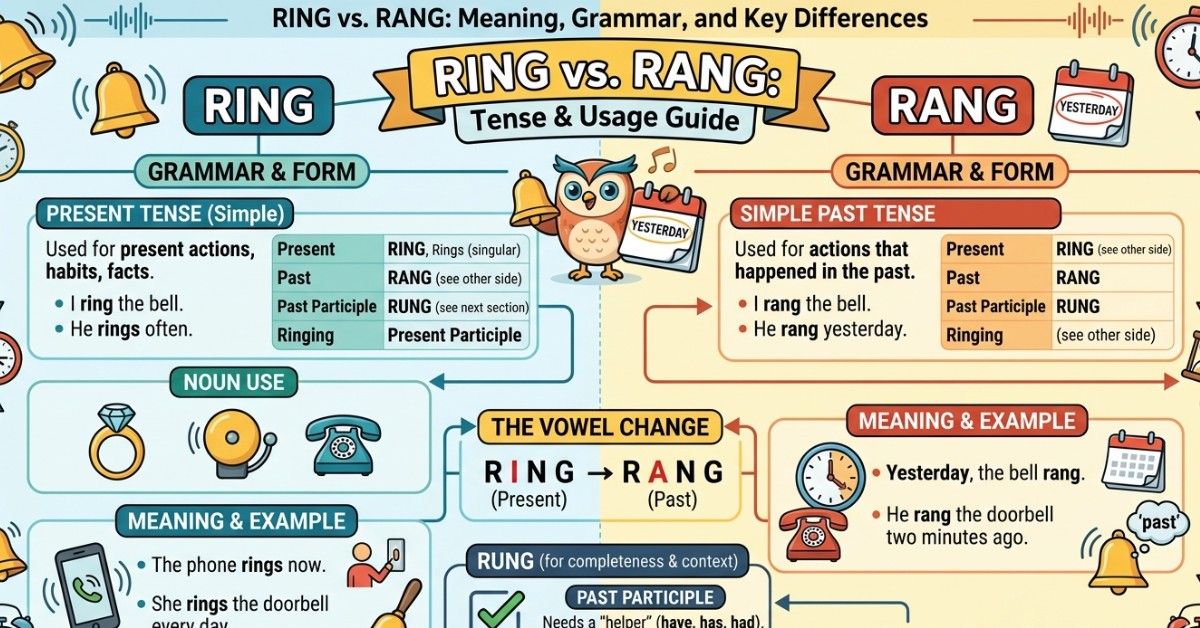
English can be confusing, especially when two words look closely connected but are used differently. One common grammar question people ask is about Ring vs Rang. Are they interchangeable? Which one is correct in a sentence? And why do both words exist in English grammar?
The confusion usually happens because both words come from the same verb but represent different tenses. Understanding when to use each one can instantly improve your writing and speaking skills. In this article, we’ll break down the meanings, grammar rules, sentence examples, and common mistakes related to these words in a simple and easy-to-understand way.
Whether you are a student, writer, or English learner, this guide will help you use these words confidently and correctly.
What Does “Ring” Mean?
“Ring” is the base form (present tense) of the verb. It commonly refers to producing a sound, especially from a bell, phone, or alarm.
Examples of “Ring”
- Please ring the doorbell before entering.
- I usually ring my friend after work.
- The church bells ring every Sunday morning.
The word can also be used as a noun.
“Ring” as a Noun
- She wore a diamond ring.
- The boxer stepped into the ring.
- We sat in a ring around the fire.
In grammar discussions, however, the focus is usually on the verb form.
What Does “Rang” Mean?
“Rang” is the simple past tense of the verb “ring.” It describes an action that already happened in the past.
Examples of “Rang”
- The phone rang during dinner.
- Someone rang the bell late at night.
- My alarm rang at 6 a.m. yesterday.
A simple trick is this:
- Ring = happening now or regularly
- Rang = already happened
Main Difference Between the Two Words
Grammar Comparison
| Word | Part of Speech | Tense | Example |
| Ring | Verb | Present tense | I ring the bell every morning. |
| Rang | Verb | Past tense | The bell rang loudly yesterday. |
This difference is entirely based on time.
If the action is happening now, use “ring.”
If the action already happened, use “rang.”
Why People Confuse These Words
English irregular verbs are often difficult because they do not follow standard “-ed” patterns.
For example:
- Sing → Sang
- Drink → Drank
- Ring → Rang
Instead of becoming “ringed,” the verb changes internally. This pattern can confuse learners who are still becoming familiar with English verb forms.
Verb Forms of “Ring”
Understanding all forms of the verb makes things much easier.
Complete Verb Chart
| Verb Form | Word |
| Base Form | Ring |
| Past Tense | Rang |
| Past Participle | Rung |
| Present Participle | Ringing |
Example Sentences
- I ring the bell every day.
- Yesterday, I rang the bell.
- I have rung the bell already.
- The phone is ringing now.
This table helps explain why people sometimes mistakenly use “rang” instead of “rung.”
Common Mistakes to Avoid
1. Using “Rang” With “Has” or “Have”
Incorrect:
- She has rang the bell.
Correct:
- She has rung the bell.
After “has,” “have,” or “had,” always use the past participle form “rung.”
2. Using “Ring” for Past Events
Incorrect:
- The phone ring last night.
Correct:
- The phone rang last night.
Whenever the event already happened, use the past tense.
Easy Memory Trick
A simple way to remember the difference:
- Ring = Present
- Rang = Past
Think of this sentence pair:
- Today the bell rings.
- Yesterday the bell rang.
This quick comparison makes the tense difference easier to remember.
Examples in Everyday Conversation
Here are practical examples showing how native speakers naturally use these words.
Using “Ring”
- I’ll ring you after class.
- They ring the temple bells every morning.
- Don’t ring the alarm unless it’s necessary.
Using “Rang”
- The school bell rang early today.
- My phone rang while I was sleeping.
- Someone rang the front gate twice.
Reading examples in context helps reinforce correct usage naturally.
Difference in Pronunciation
Although the words are similar, they are pronounced differently.
| Word | Pronunciation |
| Ring | /rɪŋ/ |
| Rang | /ræŋ/ |
“Ring” sounds shorter, while “rang” has a broader vowel sound.
Practicing pronunciation aloud can help distinguish them more clearly.
Are These Words Used in Idioms?
Yes, both words appear in common English expressions.
Popular Expressions With “Ring”
- Ring a bell
- Ring true
- Give someone a ring
Examples
- That name rings a bell.
- His explanation doesn’t ring true.
- I’ll give you a ring later.
The past versions may also appear depending on sentence tense.
Tips to Use These Words Correctly
Here are a few quick grammar tips:
- Use “ring” for present or future actions.
- Use “rang” for completed past actions.
- Use “rung” after helping verbs like has, have, or had.
- Practice with daily examples for better memory.
- Pay attention to time indicators such as yesterday, today, or already.
Ring vs Rang in Writing and Speaking
Correct verb tense improves both formal and casual communication. Whether you are writing essays, emails, stories, or speaking in conversations, choosing the right tense makes your English sound more natural and professional.
Many grammar mistakes happen because people memorize vocabulary without understanding tense changes. Learning irregular verbs through usage examples is often the fastest way to improve.
FAQs
Is “rang” a real word?
Yes, “rang” is the correct past tense of the verb “ring.”
What is the difference between “rang” and “rung”?
“Rang” is simple past tense, while “rung” is the past participle.
Example:
- The bell rang.
- The bell has rung.
Can I say “has rang”?
No, that is grammatically incorrect. The correct phrase is “has rung.”
Is “ringed” correct?
“Ringed” exists but has a different meaning. It usually means surrounded by something.
Example:
- The city was ringed by mountains.
Which word should I use for present tense?
Use “ring” for actions happening now or regularly.
Example:
- I ring the bell every morning.
Conclusion
Understanding the difference between Ring vs Rang is mainly about learning verb tense. “Ring” refers to present actions, while “rang” describes actions that already happened in the past. Since English contains many irregular verbs, these changes can feel confusing at first, but practice makes them easier to remember.
The best way to master these words Ring vs Rang is by reading examples, using them in daily conversation, and remembering the simple tense rule:
- Ring = Present
- Rang = Past
Once you understand this pattern, your grammar becomes clearer, more natural, and more confident. Keep practicing similar irregular verbs to strengthen your overall English skills even further.