Rode vs Road: Meaning, Difference & Easy Usage Guide

If you’ve ever paused mid-sentence wondering whether to write rode vs road, you’re not alone. These two words look similar, sound somewhat related, and often confuse English learners because they come from the same root idea of movement. But in reality, they belong to completely different grammatical categories.
In this guide, we’ll break down the difference between rode vs road in a simple, practical way so you never mix them up again. You’ll see meanings, examples, usage tips, and common mistakes—all explained in a clear and human-friendly way.
What Does “Road” Mean?
Let’s start with the easier one.
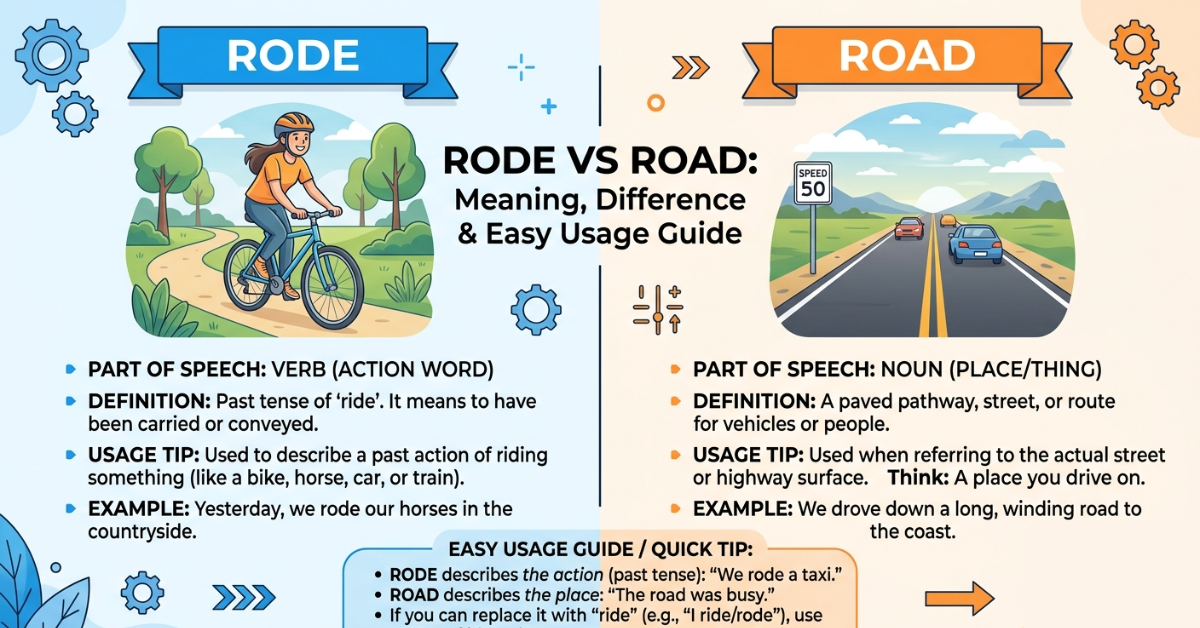
A road is a noun. It refers to a path, street, or highway used for traveling from one place to another.
Simple definition:
A road is a physical route for vehicles, bicycles, or pedestrians.
Examples of “road”:
- The road to the city is very busy in the morning.
- We drove along a narrow mountain road.
- Please cross the road carefully.
Related words (LSI keywords):
street, highway, route, path, lane, motorway
Tip: If you can touch it, drive on it, or see it on a map, it’s probably a road.
What Does “Rode” Mean?
Now let’s look at the trickier one.
Rode is the past tense of the verb “ride.”
It describes an action that already happened—usually involving transportation like horses, bikes, cars, or animals.
Simple definition:
Rode means you were traveling on something in the past.
Examples of “rode”:
- She rode her bicycle to school yesterday.
- He rode a horse during the festival.
- We rode the bus for two hours.
Related words:
ride, riding, traveled, moved, biked, mounted
Tip: If it shows action in the past, it’s “rode.”
Rode vs Road: Key Differences Explained
The confusion between rode vs road usually comes from spelling similarity, but their roles in grammar are completely different.
1. Part of Speech
- Road → noun (thing/place)
- Rode → verb (action in past tense)
2. Meaning
- Road = physical path or street
- Rode = past action of riding something
3. Time Reference
- Road = present or general object
- Rode = past action only
Easy Tricks to Remember Rode vs Road
Here are some simple memory hacks:
1. Think of “A” in Road = “Avenue”
Both are places you travel on.
2. Think of “E” in Rode = “Ended action”
The “e” reminds you it already happened.
3. Sentence Test Method
Try replacing the word:
- If you can replace it with “street,” use road
- If you can replace it with “traveled,” use rode
Common Mistakes People Make
Even fluent English speakers sometimes confuse these words.
Mistake 1:
Incorrect: I rode the long road to school.
Correct: I rode along the long road to school.
Mistake 2:
Incorrect: The rode was empty at night.
Correct: The road was empty at night.
Mistake 3:
Mixing tense and noun:
- Using “rode” when describing a place
- Using “road” when describing past action
Why Rode vs Road Confuses Learners
There are a few reasons this mix-up happens:
- Similar spelling patterns
- Same pronunciation ending sound
- Both connected to travel or movement
- Fast typing errors or autocorrect mistakes
But once you understand their grammar roles, the confusion disappears quickly.
Quick Comparison Table
| Word | Type | Meaning | Example |
| Road | Noun | Street/path | The road is long |
| Rode | Verb (past) | Past of ride | I rode my bike |
FAQs About Rode vs Road
1. What is the main difference between rode vs road?
Road is a noun meaning a street or path, while rode is the past tense of “ride.”
2. Is “rode” present or past tense?
“Rode” is past tense.
3. Can “road” be used as a verb?
No, “road” is not used as a verb in modern English.
4. Why do people confuse rode vs road?
Because they sound similar and are often used in travel-related sentences.
5. What is the easiest way to remember them?
Remember: road = place, rode = action in the past.
Conclusion
Understanding rode vs road is simple once you know the rule: one is a noun (a place you travel on), and the other is a verb in past tense (an action you already did). The key is to focus on meaning and context rather than spelling alone.
Next time you write a sentence, pause for a second and ask: Am I talking about a place or a past action? That small habit will help you avoid mistakes and improve your English accuracy.
If you want to master more confusing word pairs like this, keep practicing—you’ll get better faster than you think.