Draft vs Drift: Key Differences Explained Simply

The confusion between Draft vs Drift is more common than you might think, especially for English learners and writers. These two words look and sound somewhat similar, but their meanings are completely different depending on context.
Understanding Draft vs Drift helps improve your grammar, writing clarity, and even comprehension in science, engineering, and everyday communication. In this guide, we’ll break down both words in a simple, practical way so you never mix them up again.
What Does Draft vs Drift Mean in English?
To understand Draft vs Drift, we first need to look at each word individually.
Meaning of “Draft”
“Draft” has several meanings depending on usage:
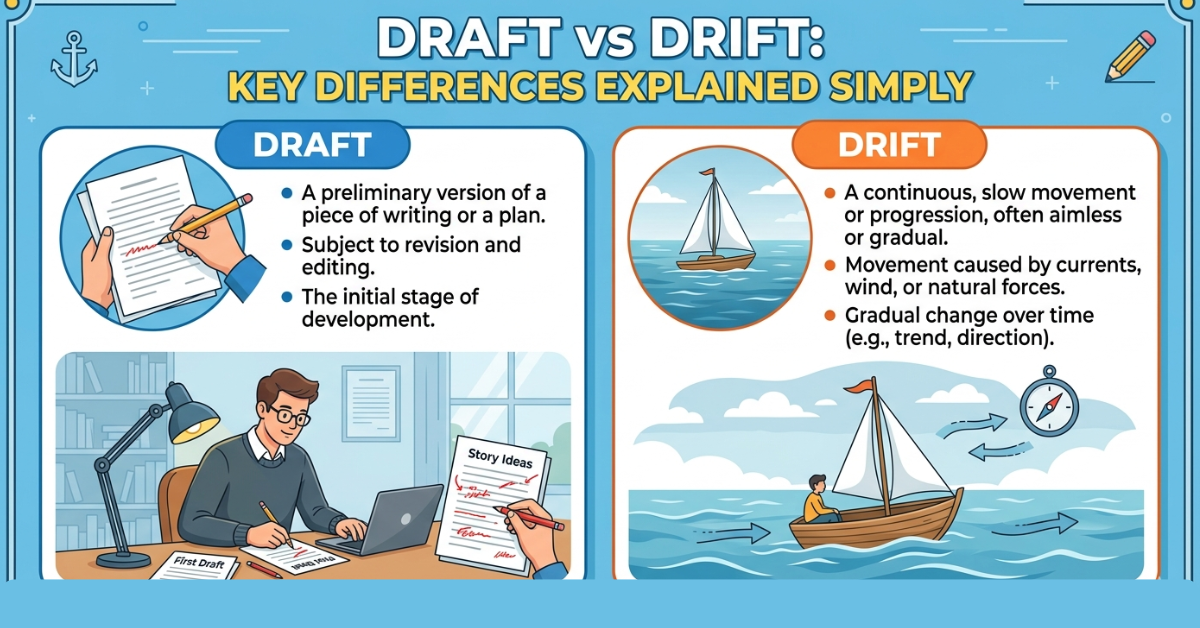
- A preliminary version of writing (e.g., essay draft, email draft)
- A flow of air or water
- A military conscription system (less common in modern usage)
In writing, a draft is basically the first version of something before it is finalized.
Example:
- I wrote the first draft of my assignment last night.
Meaning of “Drift”
“Drift” usually refers to movement without control or direction:
- Slowly moving through air or water
- Gradual change in position, opinion, or behavior
- Snow or sand accumulation caused by wind
Example:
- The boat began to drift away from the shore.
Draft vs Drift in Writing and Communication
When comparing, the most important difference is intention and control.
Draft in Writing
A draft is always intentional. It is part of a structured process:
- First draft → rough ideas
- Second draft → improved structure
- Final draft → polished version
Writers use drafts to refine their thoughts before publishing.
Drift in Meaning and Usage
Drift, on the other hand, suggests lack of control or gradual change:
- Thoughts drifting during a lecture
- Conversation drifting off-topic
- Trends drifting over time
Unlike a draft, drift is not planned.
Key Differences Between Draft and Drift
Here’s a simple breakdown:
- Control
- Draft: Controlled and intentional
- Drift: Uncontrolled or gradual
- Usage
- Draft: Writing, editing, planning
- Drift: Movement, change, behavior
- Nature
- Draft: Structured process
- Drift: Natural or accidental movement
- Context
- Draft: Academic, professional, creative writing
- Drift: Everyday life, science, emotions
Common Mistakes People Make
Many learners confuse because of pronunciation similarity. Here are common errors:
- Saying “drift version” instead of “draft version”
- Using “draft away” instead of “drift away”
- Mixing meanings in writing assignments
A simple trick:
If it’s planned or written, it’s “draft.”
If it’s moving or changing naturally, it’s “drift.”
Real-Life Examples
Draft Examples
- She submitted the first draft of her report.
- The architect prepared a draft design of the building.
Drift Examples
- The conversation drifted into personal topics.
- Leaves drift across the road in autumn.
Why Understanding Draft vs Drift Matters
Knowing the difference is useful because:
- It improves writing accuracy
- It helps in exams and competitive tests
- It enhances communication clarity
- It reduces grammatical confusion in English learning
FAQs
1. What is the main difference in Draft vs Drift?
The main difference is that a draft is a planned version or structure, while drift refers to gradual or uncontrolled movement.
2. Is “draft” only used in writing?
No, draft can also refer to airflow, cold wind, or even military conscription, but it is most commonly used in writing.
3. Can “drift” be used in emotional context?
Yes, drift can describe emotions or thoughts changing slowly over time.
4. Why do people confuse Draft vs Drift?
They sound similar and have overlapping letters, but their meanings are completely unrelated.
5. How can I easily remember Draft vs Drift?
Remember: Draft = Designed. Drift = Directionless movement.
Conclusion
Understanding Draft vs Drift is essential for clear communication and better English usage. While a draft represents structure, planning, and revision, drift represents natural, uncontrolled movement or change.
By mastering the difference, you can improve your writing skills, avoid common mistakes, and express ideas more confidently. Keep practicing with real examples, and soon the confusion will disappear completely.