Stared or Starred: Meaning, Difference & Usage Guide

Have you ever typed a sentence and suddenly paused, wondering whether it should be stared or starred? You’re not alone. These two words look almost identical, but their meanings are completely different—and mixing them up can change your entire sentence.
In this guide, we’ll break down the difference between stared or starred, explain their meanings in simple terms, and show you real examples so you never confuse them again. By the end, you’ll confidently know which word to use and when.
Understanding the Core Difference Between Stared and Starred
At first glance, stared and starred seem like spelling variations of the same word. But they come from two completely different root words.
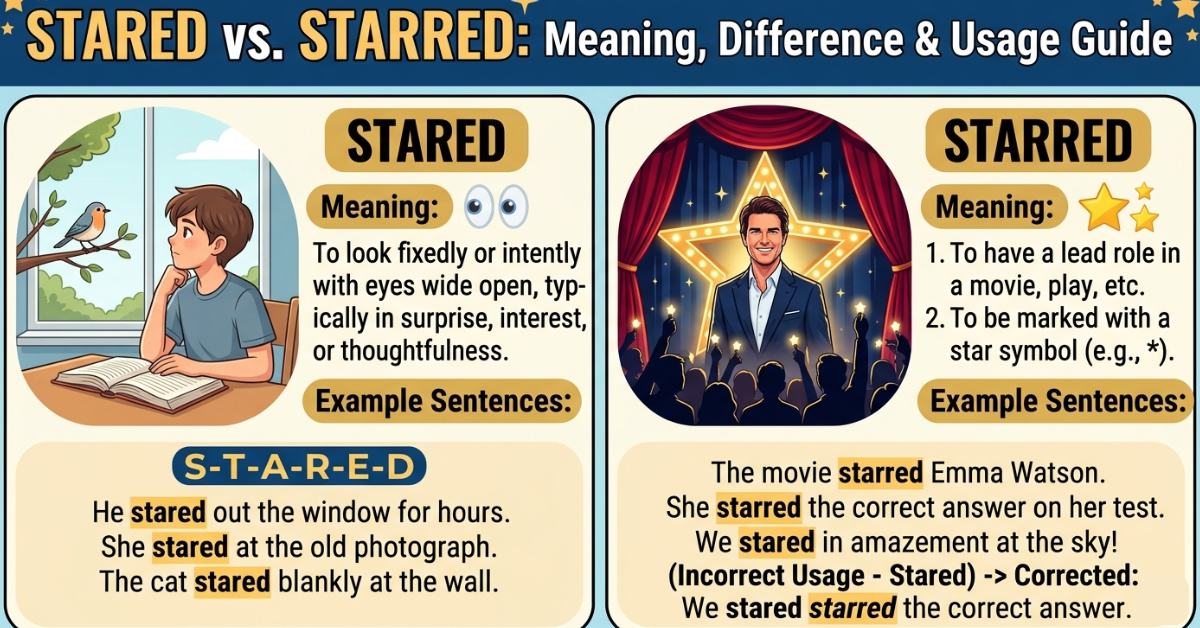
What does “stared” mean?
Stared comes from the verb stare, which means:
- To look at someone or something for a long time
- To gaze fixedly, often in surprise, curiosity, or shock
Example:
- She stared at the painting in silence.
- He stared at me like he didn’t recognize me.
What does “starred” mean?
Starred comes from the word star, and it has two main meanings:
- To feature someone in a movie, show, or performance
- To mark something with a star symbol for importance
Example:
- The movie starred a famous Hollywood actor.
- I starred the important emails in my inbox.
So when comparing stared or starred, the difference is:
- Stared = looking
- Starred = featuring or marking with a star
Why People Confuse Stared or Starred
The confusion between stared or starred is very common, especially in writing and texting. There are a few reasons for this:
1. Similar spelling
Both words differ by just one extra “r”, making them easy to mix up.
2. Pronunciation overlap
In fast speech, stared and starred can sound almost identical.
3. Autocorrect errors
Typing quickly often leads to incorrect substitutions between the two.
4. Lack of context awareness
Without context, it’s hard for writers to instantly choose the correct word.
Understanding these reasons helps reduce mistakes in everyday writing.
Real-Life Usage Examples of Stared vs Starred
Let’s make the difference clearer with side-by-side comparisons.
Stared (Looking at something)
- I stared out of the window during the storm.
- She stared at the phone, waiting for a reply.
- They stared in disbelief after hearing the news.
Starred (Featured or marked)
- The drama starred a well-known actress.
- I starred that message for later reference.
- The list included tasks that were starred as urgent.
When you compare in real sentences, the meaning becomes much clearer.
Simple Trick to Remember the Difference
If you still get confused, here’s an easy memory hack:
“A star is in starred”
- If you see or think about a star → it’s starred
- If it involves looking → it’s stared
Another trick:
- Stared = eyes (looking)
- Starred = awards or marks
This small association helps prevent mistakes in writing.
Common Mistakes People Make
Even experienced writers sometimes misuse. Here are the most common errors:
1. Using “starred” instead of “stared”
Wrong: She starred at the stranger.
Correct: She stared at the stranger.
2. Using “stared” in movie context
Wrong: The film stared Tom Cruise.
Correct: The film starred Tom Cruise.
3. Ignoring context completely
Mixing up both words without checking meaning leads to confusion in professional writing.
Stared or Starred in Writing & Communication
In digital communication, especially social media and emails, the difference between matters more than you think.
- In professional emails, starred often refers to marking priority messages.
- In storytelling or descriptions, stared helps build emotional imagery.
For example:
- Business: “I have starred the important tasks for today.”
- Creative writing: “He stared into the distance, lost in thought.”
Using the correct form improves clarity and professionalism.
Quick Summary (Key Takeaways)
- Stared = to look at something fixedly
- Starred = to feature or mark with a star
- The only difference is meaning, not just spelling
- Context is the key to choosing the right word
- A simple memory trick can prevent confusion
FAQs About Stared or Starred
1. What is the main difference between stared or starred?
“Stared” means to look at something continuously, while “starred” refers to featuring in a role or marking with a star symbol.
2. Why do people confuse stared or starred?
They are spelled similarly and sound almost the same when spoken quickly, which leads to frequent confusion.
3. Can stared or starred be used interchangeably?
No, they have completely different meanings and cannot be used in place of each other.
4. Is “starred” only used for movies?
No, “starred” is also used for marking important items with a star symbol, especially in emails or notes.
5. How do I remember stared or starred easily?
Think: stared = eyes looking, starred = star symbol or fame. This simple trick helps avoid mistakes.
6. What happens if I misuse stared or starred?
It can change the meaning of your sentence completely and make your writing confusing or incorrect.
Conclusion
The confusion between is common, but once you understand their meanings, it becomes easy to avoid mistakes. One describes a human action of looking, while the other refers to marking importance or featuring someone.
By remembering the context and using simple memory tricks, you can confidently choose the correct word every time. Apply these tips in your writing, and your communication will instantly become clearer and more professional.