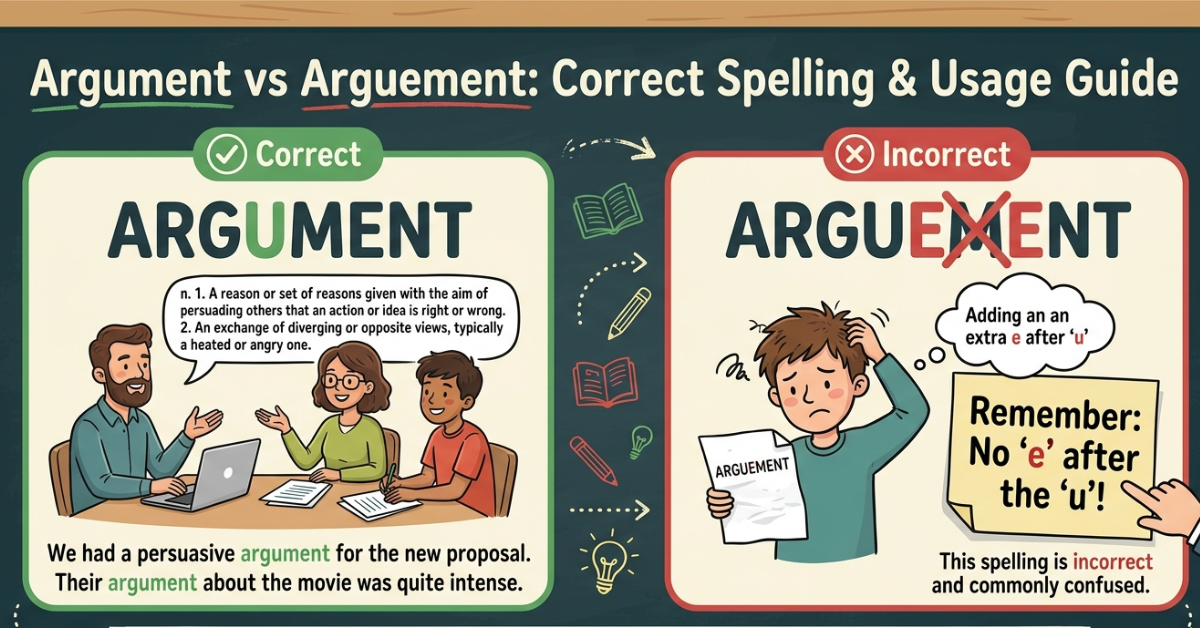
Have you ever paused while writing and wondered whether it’s arguement or argument? You’re not alone. This is one of the most common spelling confusions in English, even among fluent writers. The correct spelling is argument, but the incorrect version arguement appears frequently in informal writing.
Understanding this difference is important not just for spelling accuracy but also for clear communication. In this article, we’ll break down why this mistake happens, how to avoid it, and how to use the word correctly in real-life contexts.
What Is the Correct Spelling: Arguement or Argument?
The correct spelling is argument. The word arguement is simply a common misspelling.
Why “Arguement” Is Wrong
Many people mistakenly add an extra “e” because they assume it follows a pattern similar to words like management or government. However, English spelling rules don’t support this formation.
Correct Usage Examples
- She made a strong argument in the debate.
- There is no need for an argument over such a small issue.
- His argument was based on solid evidence.
Meaning of Argument in English
The word argument has multiple meanings depending on context:
1. Disagreement or Debate
This is the most common usage.
- Example: A heated argument between two friends.
2. Logical Reasoning
Used in academic or formal writing.
- Example: A well-structured argument in an essay.
3. Mathematical or Technical Use
In mathematics, it refers to a value passed into a function.
Understanding these meanings helps you use the word more accurately in writing and speech.
Why People Confuse Arguement or Argument
Spelling mistakes happen for several reasons:
Common Causes:
- Pronunciation influence (people write what they hear)
- Overgeneralizing spelling rules
- Lack of reading practice
- Typing quickly without proofreading
This confusion makes arguement or argument one of the most searched spelling doubts online.
Easy Tips to Remember the Correct Spelling
If you often get confused, these tricks will help:
1. Break the Word Down
Think of it as argue + ment → argument
2. Remove the Extra “E”
Remember: there is no “e” after “g” in the correct spelling.
3. Practice Writing It
Repetition builds memory. Write it a few times in sentences.
4. Use Spell Check Tools
Modern writing tools instantly correct mistakes like arguement.
Common Sentences Using Argument
Here are practical examples to improve understanding:
- They had an argument about money.
- The lawyer presented a strong argument in court.
- Don’t turn this into a silly argument.
- His argument convinced the entire audience.
Grammar Insight: How to Use “Argument” Properly
The word argument can function in different sentence structures:
As a Noun:
- The argument was resolved peacefully.
With Prepositions:
- Argument about something
- Argument over an issue
- Argument with someone
Using these correctly improves both writing clarity and fluency.
FAQs About Arguement or Argument
1. What is the correct spelling: arguement or argument?
The correct spelling is argument. “Arguement” is incorrect.
2. Why do people write arguement instead of argument?
It happens due to pronunciation habits and spelling confusion.
3. Is arguement a word in English?
No, arguement is not recognized as a correct English word.
4. What does argument mean in simple words?
It means a disagreement or a reason given to support an idea.
5. How can I stop spelling argument wrong?
Practice the correct form, break it into syllables (argue + ment), and use spell-check tools.
Conclusion
The confusion between arguement or argument is very common, but now you know the correct spelling is argument. Whether you’re writing essays, emails, or professional documents, using the right spelling improves your credibility and communication.
The key takeaway is simple: remember “argue + ment = argument.” With a little practice, this mistake will disappear from your writing completely.
If you’re improving your English skills, keep exploring similar spelling confusions—they’re small details that make a big difference.