Confused about redact vs retract? You’re not alone. These two words look similar, sound a bit alike, and often get mixed up in writing, editing, and even everyday conversations.
But here’s the truth—they mean completely different things. In fact, using one instead of the other can change the entire meaning of a sentence. In this article, we’ll break down redact vs retract in a simple, human-friendly way so you never confuse them again.
Redact vs Retract: What Do They Actually Mean?
Let’s start with the basics.
What does “redact” mean?
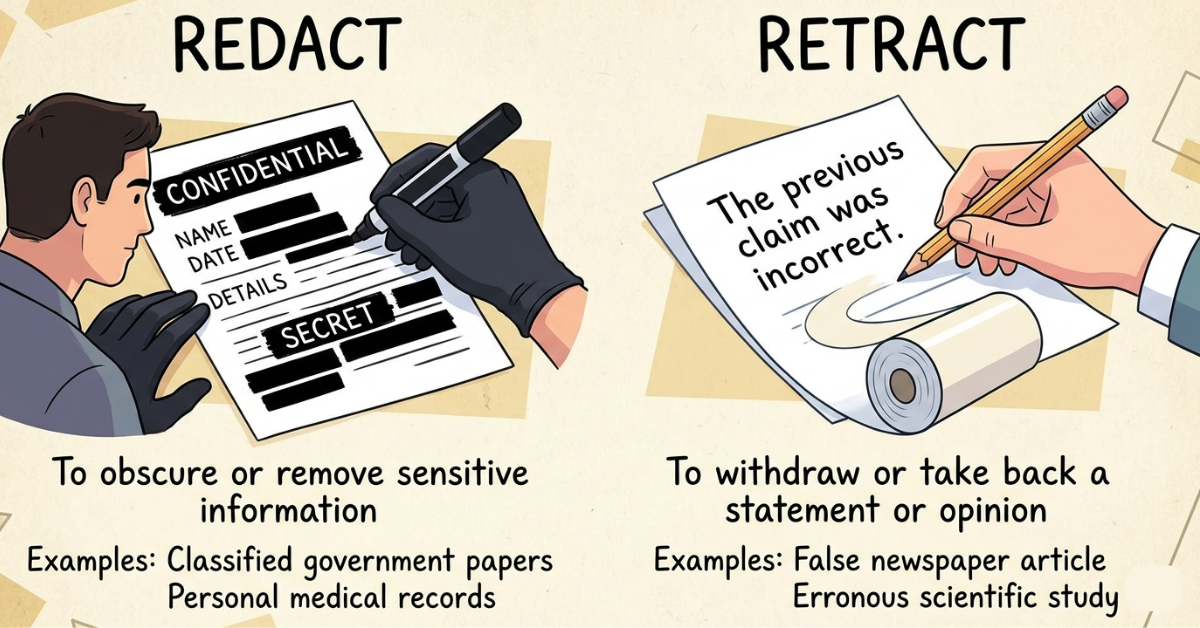
To redact means to edit or censor sensitive information from a document before sharing it publicly. You’ll often see this in legal, government, or official documents where private details are hidden.
Common uses of redact:
- Removing personal information (names, IDs, addresses)
- Hiding confidential data in reports
- Blacking out sensitive parts of documents
Example:
The government released the report, but they redacted private names for security reasons.
What does “retract” mean?
To retract means to take back something you said, wrote, or claimed. It’s about withdrawing a statement, opinion, or promise.
Common uses of retract:
- Taking back a statement or apology
- Correcting false or incorrect information
- Withdrawing an offer or claim
Example:
The journalist had to retract the false news article after confirming the facts.
Redact vs Retract: Key Differences Explained
Now let’s clearly compare them so you can remember easily.
Main differences
- Redact = remove or hide information from a document
- Retract = take back a statement or claim
Quick memory trick
- Redact = redact details (hide them)
- Retract = retreat your words (take them back)
Redact vs Retract in Real-Life Situations
Understanding redact vs retract becomes easier with real-world usage.
1. Legal and official documents
Law agencies often redact sensitive information before releasing reports.
2. Media and journalism
News outlets may need to retract incorrect stories to maintain credibility.
3. Social media and communication
People sometimes retract comments when they realize they made a mistake.
4. Corporate communication
Companies may redact internal data before sharing reports publicly.
Common Mistakes People Make
Many people confuse these words because they both deal with “removal,” but in different ways.
Here’s what usually goes wrong:
- Using retract when they mean hiding information
- Using redact when they mean taking back a statement
- Mixing both in formal writing, leading to unclear communication
Redact vs Retract: Simple Comparison Table
| Feature | Redact | Retract |
| Meaning | Hide or censor information | Take back a statement |
| Context | Documents, reports, files | Speech, writing, claims |
| Purpose | Protect sensitive data | Correct or withdraw info |
FAQs on Redact vs Retract
1. What is the main difference between redact vs retract?
The main difference is that these refers to two separate actions—redact means to hide information, while retract means to take back a statement.
2. Is redact only used in legal documents?
No, redact is commonly used in journalism, corporate reports, and any situation where sensitive information needs to be hidden.
3. Can a person retract a statement publicly?
Yes, individuals often retract statements when they realize they are incorrect or misleading.
4. Are redact and retract interchangeable?
No, they are not interchangeable. Using them incorrectly can completely change the meaning of your sentence.
Conclusion
Understanding redact vs retract is important for clear communication, especially in writing, journalism, and professional contexts. While redact focuses on hiding sensitive information, retract focuses on taking back statements or claims.
If you remember this simple difference, you’ll avoid one of the most common English language mix-ups. Keep practicing with real examples, and soon it’ll become second nature.