If you’ve ever come across the terms laser vs lazer, you’re not alone in wondering which one is correct. At first glance, they look like two different spellings of the same word—but only one is actually accepted in formal English.
In this article, we’ll break down the confusion, explain where the misspelling comes from, and show you how to use the correct term confidently in writing and conversation.
Laser vs Lazer: Which Spelling Is Correct?
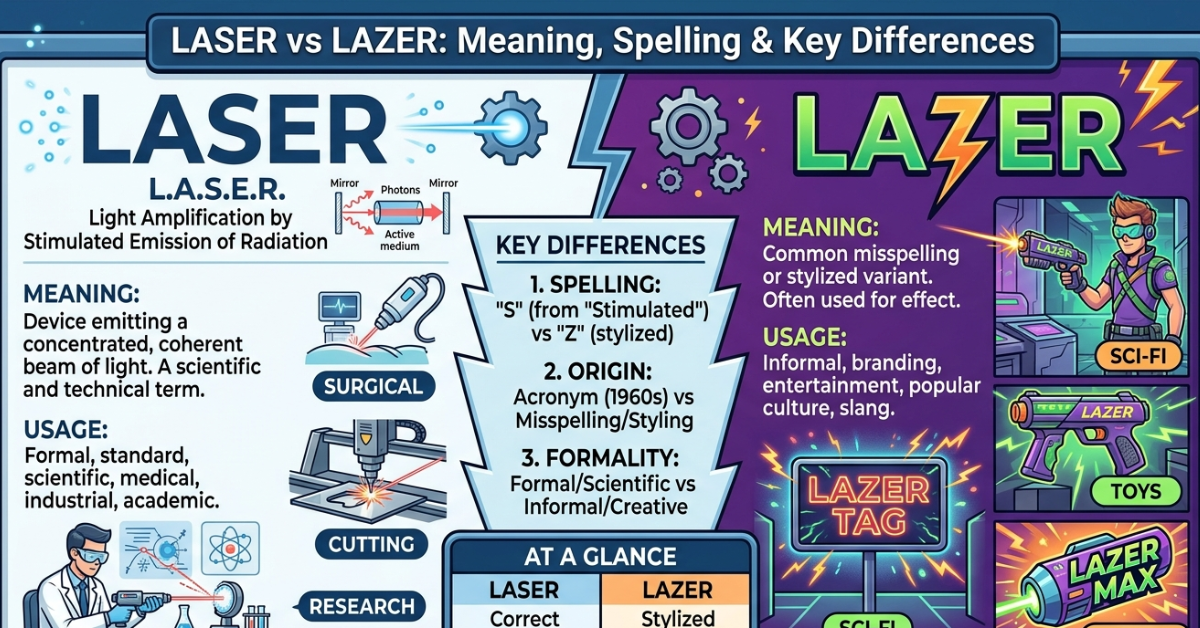
Let’s clear it up right away: “laser” is the correct spelling, while “lazer” is a common misspelling or stylistic variation.
The word laser is an acronym that stands for:
Light Amplification by Stimulated Emission of Radiation
Because it originated as a scientific term, its spelling has remained fixed in English usage. The alternative spelling “lazer” is often seen in branding, music, or pop culture—but it is not technically correct in standard English.
Why Do People Write “Lazer” Instead of “Laser”?
The confusion around laser vs lazer comes from pronunciation and creative branding choices.
Here are a few reasons why “lazer” appears:
- Phonetic spelling: People spell it how it sounds.
- Brand identity: Companies sometimes use “lazer” to sound modern or edgy.
- Pop culture influence: Songs, games, and entertainment often use stylized spelling.
- Informal writing: Social media and casual text encourage flexible spelling.
Even though “lazer” is widely seen, it is still considered non-standard in academic and professional writing.
Meaning of Laser in Science and Technology
A laser is a device that produces a focused beam of light using a process called stimulated emission. This beam is:
- Highly concentrated
- Directional
- Powerful and precise
Lasers are used in many fields, including:
- Medicine (eye surgery, skin treatments)
- Communication (fiber optics)
- Industry (cutting and welding materials)
- Everyday technology (barcode scanners, printers)
So when discussing science or engineering, always use the correct term “laser.”
Laser vs Lazer in Everyday Language
In everyday usage, the confusion between laser vs lazer mostly appears in informal contexts.
Here’s a simple breakdown:
- Laser: Standard English, scientific, professional use
- Lazer: Informal, stylistic, or branding choice
If you’re writing essays, reports, or professional content, stick with “laser.” If you’re designing a logo or creative project, “lazer” might appear for artistic effect—but it still isn’t grammatically standard.
Common Misconceptions
Many people assume both spellings are interchangeable, but that’s not the case. Let’s clear up a few myths:
- “Lazer is a modern spelling of laser” → False
- “Both are equally correct” → False
- “Lazer is used in science” → False
Only laser is recognized in scientific literature and formal dictionaries.
Quick Tips to Remember the Correct Spelling
If you ever get confused about laser vs lazer, these tricks can help:
- Think of science and precision → laser
- Remember the acronym explanation
- Associate “laser” with textbooks, not slang
- Avoid using “z” in formal writing
FAQs
1. Is “lazer” a correct spelling?
No, “lazer” is not correct in formal English. The correct spelling is “laser.”
2. Why do brands use “lazer”?
Brands often use “lazer” for stylistic or marketing purposes to stand out.
3. Does “laser” stand for something?
Yes, it stands for Light Amplification by Stimulated Emission of Radiation.
4. Can I use “lazer” in writing?
Only in informal or creative contexts. For academic or professional writing, avoid it.
5. What is the difference in laser vs lazer usage?
There is no scientific difference—only spelling variation. “Laser” is correct; “lazer” is informal.
Conclusion
Understanding laser vs lazer is simple once you know the rule: laser is the correct and official spelling, while “lazer” is just a stylized or informal variation. Whether you’re writing academically, professionally, or casually, choosing the right spelling helps maintain clarity and credibility.
So next time you see laser vs lazer, you’ll know exactly which one belongs in proper English—and which one is just for style.