Programme vs Program: Key Differences Explained Simply

If you’ve ever been confused about programme vs program, you’re not alone. These two words look almost identical, yet they often create doubt for writers, students, and professionals.
At first glance, it may seem like a spelling mistake—but it’s not. The difference mainly comes down to British English vs American English usage, and the context in which the word is used. Let’s break it down in a simple, clear way so you never get stuck again.
Understanding Programme vs Program
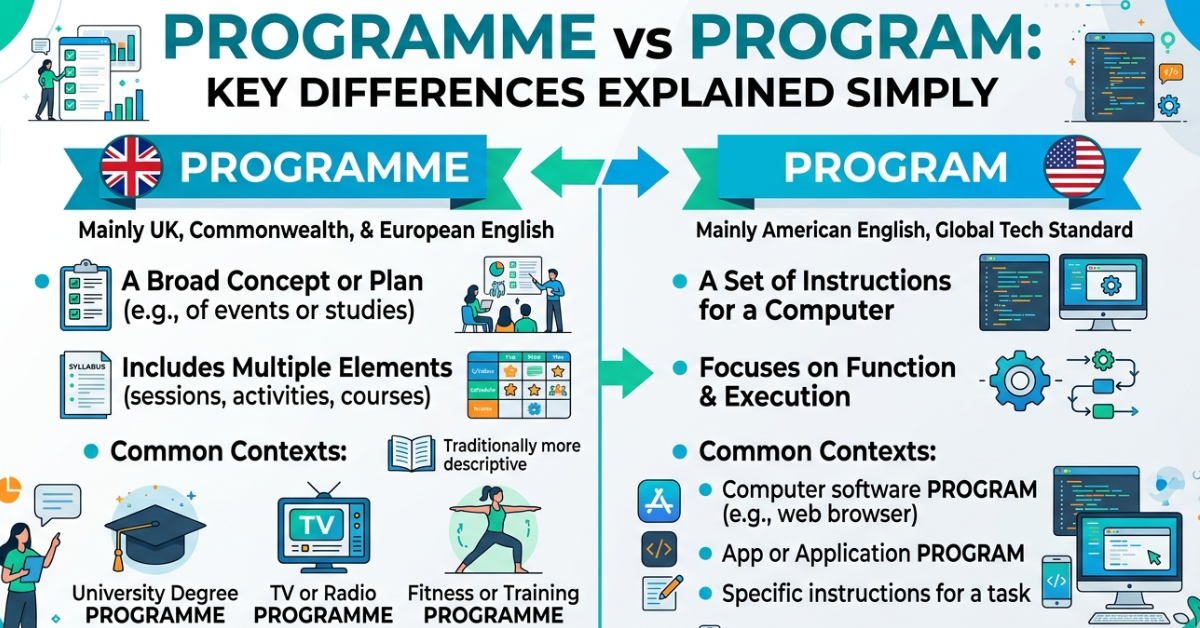
The simplest way to understand programme vs program is to know that both words mean similar things but are used differently depending on location and context.
- Program → Common in American English
- Programme → Common in British English
Both refer to a planned series of activities, instructions, or content.
For example:
- A TV program/programme
- A computer program/programme
- A training program/programme
So, the meaning stays the same—but spelling and usage vary.
British English: When to Use “Programme”
In British English, the word programme is traditionally used in most contexts except computing.
Common uses of “programme”:
- TV or radio shows (TV programme)
- Educational courses (training programme)
- Event schedules (event programme)
However, there is one major exception:
- In computing and technology, even British English uses program
Example:
- “She is learning a computer program.”
So, in short:
- Everyday context → programme
- Computing context → program
American English: When to Use “Program”
In American English, the spelling is simpler—program is used in almost all situations.
Common uses of “program”:
- Television content (TV program)
- Software (computer program)
- Educational plans (study program)
- Official initiatives (government program)
Unlike British English, Americans do not use “programme” in general writing.
This makes American English more consistent, but less traditional in spelling.
Programme vs Program in Computing
One of the easiest ways to avoid confusion is this rule:
In computing, always use program
This applies globally.
Examples:
- Computer program
- Software program
- Programming language
Even in the UK, “programme” is not used for software or coding-related terms.
Key Differences at a Glance
Here’s a simple breakdown:
- British English → “programme” (general use)
- American English → “program” (all uses)
- Computing → always “program”
- Meaning → same in both cases
So, you are not learning two different words—you are learning two spelling systems.
Why the Confusion Exists
The confusion around programme vs program comes from historical language development.
English evolved differently in the UK and the US:
- British English kept traditional French-influenced spelling like “programme”
- American English simplified spelling for ease and efficiency
That’s why both versions still exist today.
How to Remember It Easily
Here’s a quick trick:
- UK = Extra “me” → programme
- US = Short & simple → program
- Tech = Always program
This mental shortcut can save you from common writing mistakes.
Common Examples in Real Life
To make it even clearer, here are practical uses:
- “The TV programme was very informative.” (UK)
- “The TV program starts at 8 PM.” (US)
- “She enrolled in a diploma programme.” (UK)
- “He wrote a software program.” (Both)
FAQs About Programme vs Program
1. Is “programme” wrong in American English?
No, it’s not wrong, but it is rarely used. Americans prefer “program” in all cases.
2. Which one should I use in academic writing?
It depends on your style guide. UK institutions prefer “programme,” while US institutions prefer “program.”
3. Is there any difference in meaning?
No, both words have the same meaning. Only spelling and usage differ.
4. What about computer programming terms?
Always use “program” regardless of country.
5. Can I mix both spellings in one document?
It’s not recommended. Stick to one style for consistency.
Conclusion
The difference between programme vs program is not about meaning—it’s about English variation and context. British English prefers “programme,” while American English uses “program” in most situations.
If you remember one rule, make it this:
Use “programme” for UK English general use, and “program” for US English and all computing terms.
Once you get used to this pattern, you’ll never confuse them again—and your writing will instantly look more polished and professional.