English can be tricky, especially when two words sound exactly the same but mean completely different things. One of the most confusing pairs is pole vs poll.
The confusion between pole vs poll often leads to spelling mistakes in writing, exams, and even professional communication. In this guide, we’ll break down the meanings, differences, and correct usage of these two words in a simple, practical way so you never mix them up again.
What Does Pole Mean?
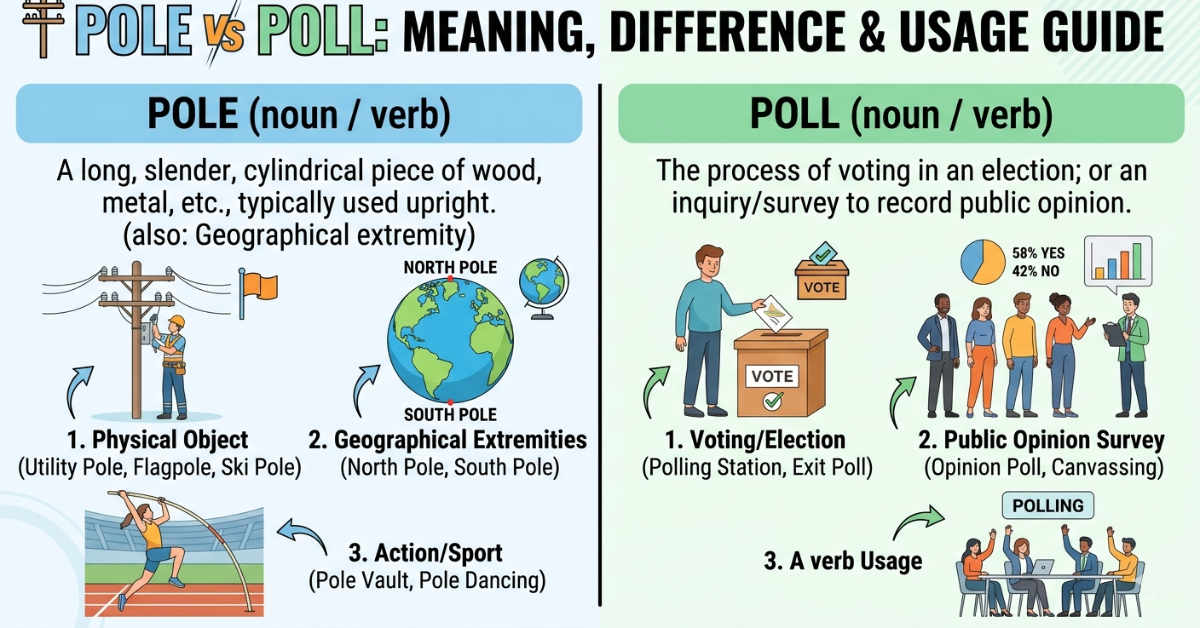
The word pole refers to a long, thin, cylindrical object or a fixed point used for support, direction, or measurement.
Common meanings of “pole”:
- A long wooden or metal stick (like a flagpole)
- Earth’s North Pole and South Pole
- Electrical poles that carry wires
- A fishing rod or support stick
Example sentences:
- The flag was raised on a tall pole.
- Birds migrate near the North Pole.
- The electrician fixed the broken power pole.
So, when you see something physical, structural, or geographic, “pole” is the correct choice.
What Does Poll Mean?
The word poll refers to voting, surveys, or collecting opinions from people.
Common meanings of “poll”:
- A voting process in elections
- A survey asking people their opinions
- Counting votes or responses
Example sentences:
- The election poll results will be announced tonight.
- Students participated in a class poll.
- The survey showed high approval ratings in the poll.
So, when the context is about opinions, voting, or surveys, “poll” is the correct spelling.
Pole vs Poll: Key Differences Explained
Understanding pole vs poll becomes easier when you compare them side by side.
1. Meaning
- Pole: Physical object or geographic point
- Poll: Voting or opinion survey
2. Usage Context
- Pole: Science, geography, construction
- Poll: Politics, research, surveys
3. Pronunciation
- Both are pronounced the same way: /pohl/
- This is why confusion happens often
4. Examples in real life
- A flag on a pole
- A public opinion poll
Easy Tips to Remember Pole vs Poll
If you often confuse, here are simple memory tricks:
- Think “pole = pole (stick)” → both have “e” for extension like a long object
- Think “poll = people” → both involve people’s opinions
- Associate poll with elections and surveys
- Associate pole with physical structures and geography
These small tricks can save you from spelling mistakes in exams and writing.
Common Mistakes People Make
Many learners mix up because of pronunciation. Here are frequent errors:
- Writing “pole” instead of “poll” in survey questions
- Using “poll” when referring to flag posts or electricity poles
- Assuming both words are interchangeable (they are not)
Avoiding these mistakes improves clarity and professionalism in writing.
Why Understanding Pole vs Poll Matters
Correct usage of word is important because:
- It improves writing accuracy
- It prevents confusion in exams
- It enhances professional communication
- It helps in competitive tests and essays
Small spelling differences can completely change meaning, so attention to detail matters.
FAQs About Pole vs Poll
1. What is the main difference between pole vs poll?
The main difference is meaning: pole is a physical object or location, while poll refers to voting or surveys.
2. Why do people confuse pole vs poll?
They sound identical when spoken, which leads to spelling confusion in writing.
3. Can pole and poll be used interchangeably?
No, they have completely different meanings and cannot replace each other.
4. What are examples of pole?
Flagpole, electric pole, North Pole, fishing pole.
5. What are examples of poll?
Election poll, opinion poll, survey poll, voting poll.
Conclusion
To sum it up, mastering pole vs poll is all about understanding context. If you’re talking about something physical or geographic, use pole. If you’re referring to voting or opinions, use poll.
Once you remember this simple distinction, you’ll avoid one of the most common English spelling mistakes. Keep practicing with examples, and soon it will become second nature in your writing.