Pore vs Pour vs Poor: Differences & Examples

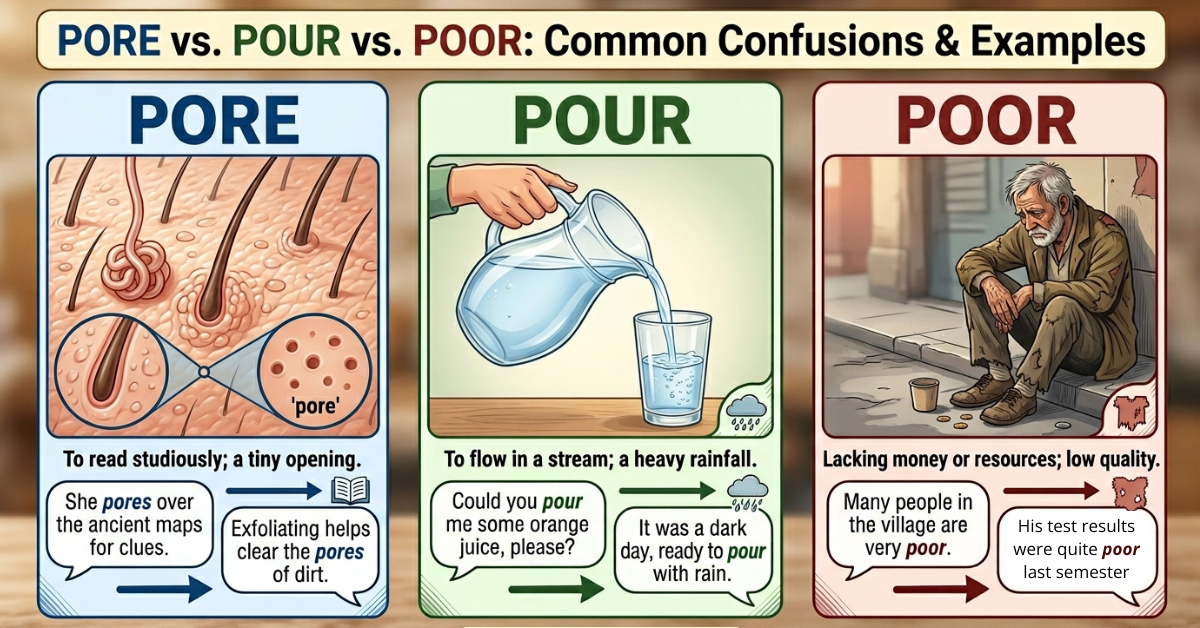
Have you ever written a sentence and stopped because you weren’t sure if it’s pore, pour, or poor? You’re not alone. The confusion around Pore vs Pour vs Poor is one of the most common spelling mix-ups in English.
These three words sound almost identical when spoken, but their meanings are completely different. In this guide, you’ll learn how to use each one correctly with simple explanations, real examples, and memory tricks that actually work.
Why Pore vs Pour vs Poor Confuses So Many Learners
The main reason people struggle is pronunciation. They are homophones in many accents, meaning they sound the same but are spelled differently.
Another issue is context. Since these words have completely different meanings—skin, liquids, and financial status—mixing them can easily change the meaning of a sentence.
Here’s a quick idea:
- One is about skin or studying closely
- One is about pouring liquids
- One is about lack of money or something insufficient
Meaning of Pore vs Pour vs Poor (Quick Breakdown)
Let’s break them down one by one so you never confuse them again.
1. Pore – Tiny openings or to study deeply
“Pore” has two main meanings:
- Small openings in your skin
- To study something carefully and deeply
Examples:
- Sweat comes out through your skin pores.
- She pored over her notes before the exam.
Think of “pore” as peering closely or tiny holes.
2. Pour – To flow or transfer liquid
“Pour” is all about movement, especially liquids or substances flowing from one container to another.
Examples:
- Please pour me a glass of water.
- It started to pour heavily during the storm.
Think of “pour” as flowing freely.
3. Poor – Lack of money or quality
“Poor” describes something or someone with little money, low quality, or unfortunate conditions.
Examples:
- Many poor families struggle with rising prices.
- The report was poorly written.
Think of “poor” as not enough of something.
Easy Tricks to Remember Pore vs Pour vs Poor
If you still get confused, these tricks will help:
- Pore → think “skin pores” or “study hard (pore over books)”
- Pour → think “water pouring”
- Poor → think “no money = poor”
You can also use sound association:
- Pore = small openings
- Pour = liquid flow
- Poor = lack or shortage
Common Mistakes People Make
Here are a few mistakes to avoid:
- “She is pour at English.” (Wrong)
“She is poor at English.” (Correct) - “He poured over the book.” (Wrong in meaning context)
“He pored over the book.” (Correct) - “Open your skin pours.” (Wrong spelling)
“Open your skin pores.” (Correct)
Quick Comparison Table
| Word | Meaning | Example |
| Pore | Skin openings / study deeply | She pored over notes |
| Pour | To flow liquid | Pour the juice |
| Poor | Lack of money/quality | Poor family |
FAQs About Pore vs Pour vs Poor
1. What is the main difference in Pore vs Pour vs Poor?
The difference is meaning: pore relates to skin or studying, pour is about liquids, and poor relates to lack or poverty.
2. Why do people confuse Pore vs Pour vs Poor?
Because they sound almost identical when spoken, especially in fast conversation.
3. Can “pore” and “pour” ever mean the same thing?
No, they are completely different words with unrelated meanings.
4. What is an easy way to remember them?
Link each word to an image: pores on skin, pouring water, and poor people.
Conclusion
Understanding Pore vs Pour vs Poor becomes easy once you connect each word with its real-life meaning. Pore is about skin or deep focus, pour is about liquid flow, and poor refers to lack of money or quality.
With a little practice and memory tricks, you’ll never mix them up again. Try using each word in your own sentences today—you’ll remember them much faster.
If you want to improve further, explore more commonly confused English words and strengthen your vocabulary step by step.